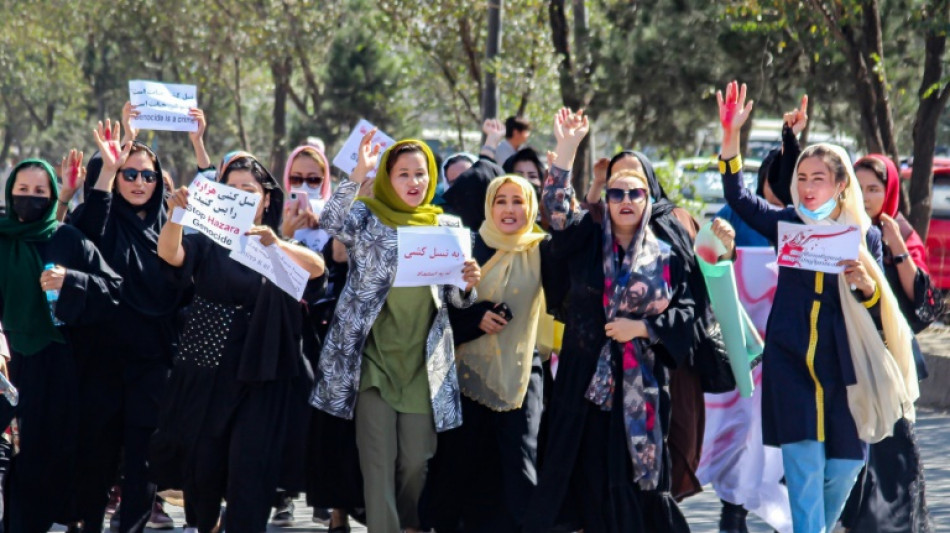
Afghan Hazaras vow return to class despite academy bombing / Photo: © AFP

 Hong Kong court set to sentence activist Joshua Wong in security case

 Australia raises benchmark rate to highest level in 18 years

 'The Remarried Empress' Cast Discusses Bringing Fantasy Royal Drama to Life

 Asian stocks retreat as AI worries outweigh steep oil-price drop

 Hamad International Airport stages emergency drills during WATAN 2026

 Global failure to punish attacks leaves journalists at continuing risk

 Researchers Warn 'Bookkeeping Trick' Masks Beef Industry's Methane Emissions

 Climate Change Intensified Atlantic Hurricanes, Study Finds

 Qatar solar expansion opens scope for technical performance gains

Bodies strewn everywhere, a ceiling caved by blastwaves, classmates dragging each other to safety -- survivors of a suicide bombing in a Kabul study hall described scenes of horror after what should have been a typical exam.
Nonetheless, faced with a death toll of mostly women, students of the minority Hazara community were unbowed by the obstacles to education in Afghanistan -- pledging Saturday they will return to class.
"Education is our weapon and they want to take this weapon away from us," said 19-year-old Wajiha, a day after escaping the assault that killed 35, according to a UN death toll.
"I want to study," she told AFP. "It's my dream and I will always fight for it."
On Friday a bomber blew himself up in the women's section of a gender-segregated study hall in the western district of Dasht-e-Barchi.
Hundreds of students from the historically oppressed Shiite Hazara community were settling down for a test at the Kaaj Higher Educational Centre when the assault began.
"We were sitting in the classroom and had just started our exam when suddenly there was the sound of gunfire," said Wajiha, after revisiting the scene of the devastated schoolroom.
The attacker -- a tall man dressed in military fatigues and holding a gun -- fired continuously, she said, forcing the girls to hide under the benches.
"After the gunfire, there was an explosion and the whole ceiling of the classroom fell, then there was complete silence," Wajiha said, her voice choking with emotion.
Recounting her story in a hijab and grey headscarf, Wajiha said she lost two of her friends and a teacher in the attack.
In the frantic aftermath, she saw her friends and male students scrabbling to escape.
"I saw boys climbing the compound wall and pulling girls along. I saw one boy who was himself injured but he kept pulling girls out," Wajiha said.
"I don't know how I escaped from the classroom. I don't know how I jumped across the wall."
- 'Never stop studying' -
Arsalan, 18, who was writing his test in the courtyard of the centre, saw bodies of women strewn on the floor of the hall.
"It was horrific. There was chaos everywhere," said Arsalan, who credits his survival on his decision to sit outside the classroom.
"I pulled two girls out but I was unable to continue."
Those behind the attack, which no group has yet claimed, aim to stop Hazaras from progressing, he said.
"They want to eliminate us completely. Why are they not attacking any other community?" he asked.
The historically marginalised Hazaras comprise between 10 to 20 percent of Afghanistan's 38 million citizens.
The group massively benefitted when US-led forces overthrew the previous Taliban government in 2001.
They were able to put their children in schools -- including their daughters -- and entered the political scene and workforce in unprecedented numbers.
However recently they have been targeted in some of the most brutal attacks in Afghanistan, some claimed by the Islamic State group which regards them as heretics.
But Arezo Jaghori, a resident from Dasht-e-Barchi, said nothing will stop them from seeking an education.
"We will never stop studying, no matter what happens," the 16-year-old vowed.
"We feel sad for those who lost their lives on this path, but we are proud of ourselves," she said. "No one can stop us."
Y.Bouchard--BTB