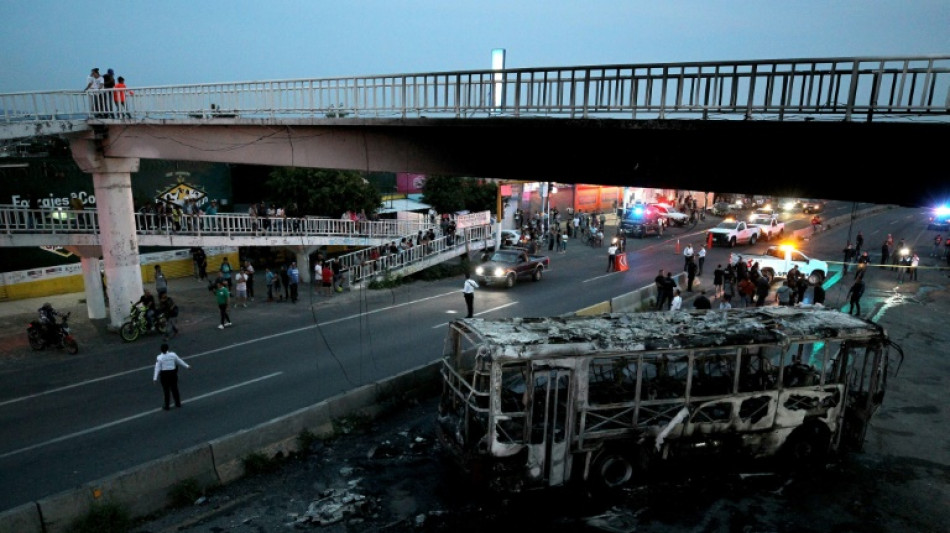
Drug violence tests Mexico president's 'hugs not bullets' strategy / Photo: © AFP/File

 Nocturnal 'coffee frog' discovered in Costa Rica
 India's 'cockroach' protest movement keeps heat on Modi

 Russia's only anti-war party eyes support boost at elections
 Canada tries to adapt to a future of wildfires
 Death of NBA forward Clarke ruled accident due to heroin, cocaine
 Abelardo de la Espriella, Colombian president and flamboyant millionaire
 Maradona's 'Hand of God' ball heads to US auction
 Rybakina advances while Andreeva exits at Toronto

 Shelton storms to Montreal win as title defence solidifies

 All Blacks need to improve says coach after opening win against Stormers

 Spain imposes border checks on Italy as migrant showdown grows
 Bezzecchi smashes Silverstone track record in MotoGP qualifying
 Rashid Khan takes six wickets as Afghanistan thrash Ireland
 Flintoff quits England Lions role after Sydney Thunder appointment

 Movement, El Vecino and RISE Partner to Launch First Digital Dollar Wallet for Mexican Remittances

 FIFA chief Infantino travels to Colombia for presidential inauguration
 Niewiadoma seizes Tour de France Femmes lead on Mont Ventoux

 Trump's ex-lawyer all set for confirmation as US attorney general
 WHO urges Ervebo vaccine trial in DR Congo Ebola outbreak

 Hardline Trump ally De la Espriella to take office in Colombia

 Cambridge to review hiring process amid plagiarism row

 STARTRADER in Discussions with Trustpilot to Consolidate Review Profiles

 US unexpectedly loses jobs in blow to Trump's economy claims

 Call for Infantino to resign comes in wake of wave of support

 Gaza beekeeper starts again on rooftop amid ruins of war
Escalating drug cartel-related violence, including indiscriminate attacks on civilians, has deepened concerns about whether Mexican President Andres Manuel Lopez Obrador's "hugs not bullets" security strategy is working.
Mounting scrutiny of Lopez Obrador's approach comes as his critics accuse him of trying to militarize the Latin American nation by putting the National Guard under army control.
A spate of violence in August in several cities, including Ciudad Juarez on the border with the United States, left 12 people dead -- including several civilians.
Such attacks "generate panic in the civilian population and confusion among the political authorities. The security authorities are paralyzed, without the capacity to react," security consultant David Saucedo told AFP.
Saucedo branded the violence "narcoterrorism" -- a term that Lopez Obrador's government has stopped short of using.
In Ciudad Juarez, gang members went on a killing spree in what Lopez Obrador described as retaliation following a prison riot involving two rival gangs.
In the eastern and central states of Jalisco and Guanajuato, gang violence left one suspected criminal dead and businesses and vehicles on fire following a failed attempt to capture two cartel bosses.
The government's response was not to "examine why it happened and to implement the sort of strategies that have been proven to reduce criminal involvement," said Michael Lettieri, co-founder of the Mexico Violence Resource Project at the University of California, San Diego.
Instead, it ordered the deployment of soldiers -- a response similar to those of previous governments that Lopez Obrador accuses of having exacerbated violence by militarizing the war on drugs.
- 'Two wars' -
While the recent attacks shocked the country, every day there are dozens of murders in Mexico and most do not draw much attention.
The country faces "two wars": high-profile attempts to capture gang leaders and violence affecting ordinary Mexicans that the government has failed to tackle, said Laura Atuesta, coordinator of the drug policy program at the Center for Economic Research and Teaching.
Criminals "keep killing people, breaking into houses and making people disappear," she said.
Lopez Obrador says his "hugs not bullets" strategy aims to tackle violent crime at its roots by fighting poverty and inequality with social programs, rather than with the army.
The new approach was "reducing violence," the president said last week in his annual state of the nation address, adding that federal crimes had dropped 29.3 percent since he took office in 2018.
Between January and July, murders fell 8.7 percent compared with the same period in 2021, to 18,093 victims, according to the government.
More than 340,000 people have been killed in a spiral of bloodshed since the government of then-president Felipe Calderon deployed the army to fight drug cartels in 2006.
Human rights group Amnesty International has urged Lopez Obrador to abandon his plan to give the military control of the National Guard.
The president created the new security force in 2019 with a civilian command to replace federal police accused of corruption and rights violations.
"Experience shows that today Mexico is more dangerous than 16 years ago when it was decided that the military should take to the streets," Amnesty said last month.
"There has been an increase in forced disappearances, arbitrary arrests, physical, psychological and even sexual torture," it added.
Lopez Obrador's plan has been approved by the lower house of Congress but seems unlikely to be passed in the upper chamber, so he has vowed to seek other legal options.
Even if the National Guard is put under military control, it will take time for the force to develop operational capabilities, according to experts.
Lopez Obrador is only managing, rather than solving, the security problem, "laying the groundwork for a future war" that will not happen before his term ends in 2024, Saucedo said.
Y.Bouchard--BTB