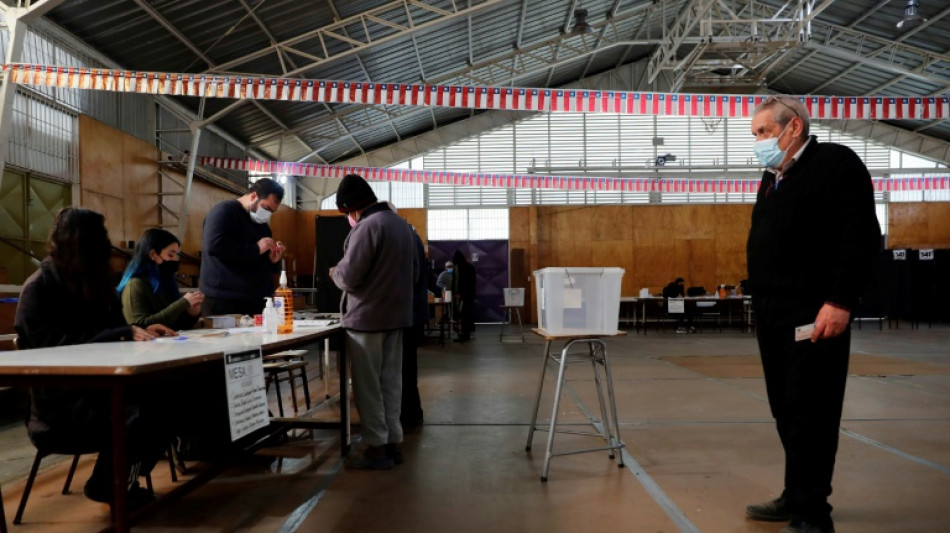
Chile votes on overhaul of dictatorship-era constitution / Photo: © AFP

 Nocturnal 'coffee frog' discovered in Costa Rica

 India's 'cockroach' protest movement keeps heat on Modi
 Russia's only anti-war party eyes support boost at elections
 Canada tries to adapt to a future of wildfires
 Death of NBA forward Clarke ruled accident due to heroin, cocaine

 Abelardo de la Espriella, Colombian president and flamboyant millionaire
 Maradona's 'Hand of God' ball heads to US auction

 Rybakina advances while Andreeva exits at Toronto

 Shelton storms to Montreal win as title defence solidifies

 All Blacks need to improve says coach after opening win against Stormers

 Spain imposes border checks on Italy as migrant showdown grows
 Bezzecchi smashes Silverstone track record in MotoGP qualifying
 Rashid Khan takes six wickets as Afghanistan thrash Ireland
 Flintoff quits England Lions role after Sydney Thunder appointment

 Movement, El Vecino and RISE Partner to Launch First Digital Dollar Wallet for Mexican Remittances
 FIFA chief Infantino travels to Colombia for presidential inauguration
 Niewiadoma seizes Tour de France Femmes lead on Mont Ventoux

 Trump's ex-lawyer all set for confirmation as US attorney general

 WHO urges Ervebo vaccine trial in DR Congo Ebola outbreak

 Hardline Trump ally De la Espriella to take office in Colombia

 Cambridge to review hiring process amid plagiarism row

 STARTRADER in Discussions with Trustpilot to Consolidate Review Profiles

 US unexpectedly loses jobs in blow to Trump's economy claims
 Call for Infantino to resign comes in wake of wave of support

 Gaza beekeeper starts again on rooftop amid ruins of war
Chileans voted Sunday on whether to adopt a new constitution that would break from the era of Augusto Pinochet's dictatorship, foster a more welfare-based society and boost Indigenous rights.
Although Chileans previously voted in droves for a rewrite of the current constitution -- adopted in 1980 during Pinochet's rule -- opinion polls suggest the new text could be rejected.
Polling stations opened at 8:00 am (1200 GMT), with long lines of voters gathered in some parts of the country.
Social upheaval that began in 2019 provided the impulse to overhaul the constitution, but the 388-article draft -- including proposals to legalize abortion -- has proved controversial and often confusing.
"I will reject it because it was a constitution that started badly," Maria Angelica Ebnes, a 66-year-old homemaker, told AFP in Santiago. "It was forced, through violence."
In October 2019, protests sprung up mostly in the capital led by students initially angered by a proposed metro fare hike.
Those demonstrations spiraled into wider discontent with the country's neoliberal economic system as well as growing inequality.
Those in favor of the new text are still holding out hope of victory.
"People will go out to vote en masse and the polls will be wrong once again," said Juan Carlos Latorre, a legislator in the ruling coalition of leftist President Gabriel Boric, who supports the new text.
Boric called for national unity whatever the outcome as he voted in Punta Arenas.
More than 15 million Chileans are eligible to vote in the compulsory referendum.
- Protect natural resources -
Among the chief concerns of opponents is the prominence given to the country's Indigenous peoples, who make up close to 13 percent of the 19 million population.
Proposals to enshrine reproductive rights and protect the environment as well as natural resources such as water, which some say is exploited by private mining companies, have also garnered much attention.
The new constitution would also overhaul Chile's government, replacing the Senate with a less powerful "chamber of regions," and requiring women to hold at least half of positions in public institutions.
While recent polls have had the "reject" vote leading by as much as 10 percentage points, sociologist Marta Lagos said the result was not certain.
In the vast Santiago metropolitan area, the majority of people appear likely to vote in favor of the new constitution, Lagos said.
"There's always the possibility that all the polls are wrong," Lagos told AFP. "(But) I don't think this possibility is more than five percent, and 'reject' is 95 percent likely to win."
Only a simple majority is required for the new constitution to be adopted.
Around 40 world-renowned economists and political scientists have expressed their support for the new constitution.
Yet some fear the new text would generate instability and uncertainty, which could then harm the economy.
"What you can see is a certain conservatism in the Chilean electorate that we haven't seen for years," said Lagos.
It was certainly muted last December when millennial Boric was elected president.
- Social tensions -
Those in favor of the new constitution say it will prompt changes in a conservative country marked by social and ethnic tensions and lay the foundation for a more egalitarian society.
They say the current constitution gave private enterprise free rein over crucial industries and created a fertile breeding ground for the rich to prosper and the poor to struggle.
Although the 1980 constitution has undergone several reforms since it was adopted, it retains the stigma of having been introduced during a dictatorship.
Chileans have already voted once to rewrite the constitution and then again to elect the representatives to do so, making Sunday's vote the third time in just two years that they have gone to the polls over the issue.
The new text was drawn up by a constitutional convention made up of 154 members -- mostly with no political affiliation -- split equally between men and women and with 17 places reserved for Indigenous people.
The resulting proposal recognizes 11 Indigenous peoples and offers them greater autonomy, particularly on judicial issues.
Some critics accuse the authors of trying to turn the traditionally marginalized Indigenous people into a higher class of citizens.
If accepted, Chile's congress will then start deciding how to apply the new laws.
If the new text is rejected, the current constitution will remain in place.
S.Keller--BTB