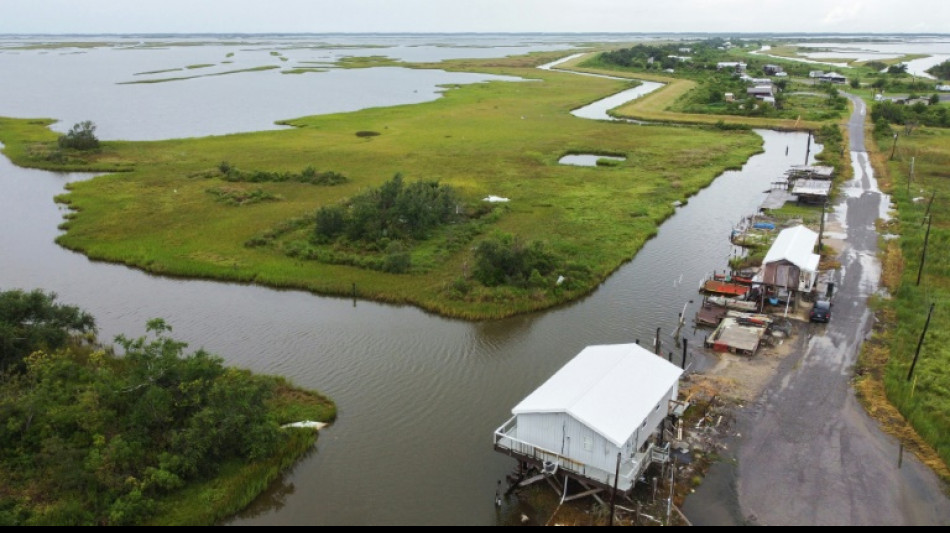
In Louisiana, the first US climate refugees find new safe haven / Photo: © AFP

 Nocturnal 'coffee frog' discovered in Costa Rica

 India's 'cockroach' protest movement keeps heat on Modi

 Russia's only anti-war party eyes support boost at elections

 Canada tries to adapt to a future of wildfires

 Death of NBA forward Clarke ruled accident due to heroin, cocaine

 Abelardo de la Espriella, Colombian president and flamboyant millionaire

 Maradona's 'Hand of God' ball heads to US auction

 Rybakina advances while Andreeva exits at Toronto

 Shelton storms to Montreal win as title defence solidifies

 All Blacks need to improve says coach after opening win against Stormers

 Spain imposes border checks on Italy as migrant showdown grows

 Bezzecchi smashes Silverstone track record in MotoGP qualifying

 Rashid Khan takes six wickets as Afghanistan thrash Ireland

 Flintoff quits England Lions role after Sydney Thunder appointment

 Movement, El Vecino and RISE Partner to Launch First Digital Dollar Wallet for Mexican Remittances

 FIFA chief Infantino travels to Colombia for presidential inauguration

 Niewiadoma seizes Tour de France Femmes lead on Mont Ventoux

 Trump's ex-lawyer all set for confirmation as US attorney general

 WHO urges Ervebo vaccine trial in DR Congo Ebola outbreak

 Hardline Trump ally De la Espriella to take office in Colombia

 Cambridge to review hiring process amid plagiarism row

 STARTRADER in Discussions with Trustpilot to Consolidate Review Profiles

 US unexpectedly loses jobs in blow to Trump's economy claims

 Call for Infantino to resign comes in wake of wave of support

 Gaza beekeeper starts again on rooftop amid ruins of war

Joann Bourg stands in front of her new home, about an hour's drive from the low-lying Louisiana island where she grew up -- an area gradually sinking into the Gulf of Mexico.
"I'm very excited. I can't wait to just move on in," Bourg told AFP. "I've been waiting for this day forever."
Bourg is one of about a dozen Native Americans from the Isle de Jean Charles who have been relocated to Schriever, less than 40 miles (60 kilometers) to the northwest -- the maiden beneficiaries of a federal resettlement grant awarded in 2016.
They are the first so-called "climate refugees" in the United States, forced from their homes due to the consequences of climate change.
"The house we had back there on the island -- well, that has been home forever. Me and my siblings all grew up there, went to school down there," Bourg recalls. "It was peaceful."
But the family home -- as with many others on the island -- was destroyed.
There is only one road connecting Isle de Jean Charles to the mainland, and it is sometimes impassable due to high winds or tides.
Residents are mainly of Native American descent -- several tribes sought shelter on the island from rampant government persecution in the 1800s.
But climate change has transformed the island into a symbol of the scourge that plagues much of hurricane-prone Louisiana -- coastal erosion.
- 90 percent under water -
Eventually, 37 new homes will be built in Schriever to accommodate about 100 current or former residents of Isle de Jean Charles, thanks to a $48 million federal grant initially allocated in 2016.
"This is the first project of its kind in our nation's history," state Governor John Bel Edwards, who was on site to see the residents close on their new properties, told AFP.
"We've had people over the years that we would buy their homes out and move them. But we've not done whole communities like this and moved them to one place before because of climate change."
Since the 1930s, Isle de Jean Charles has lost "about 90 percent" of its surface area to the encroaching bayou waters, explains Alex Kolker, an associate professor at the Louisiana Universities Marine Consortium.
The island was already fragile, but climate change heightens the risks, he says -- sea levels are rising, the ground is sinking and erosion is rampant. More frequent and fiercer storms intensify the problem.
"This community is one of the most vulnerable communities in Louisiana, and Louisiana is one of the most vulnerable places in the US," Kolker says.
- Dead trees -
The road to Isle de Jean Charles is lined with dozens of homes, many of which are stripped down to the pilings.
A year ago, Hurricane Ida slammed into Louisiana as a dangerous category 4 storm; it was the second most damaging hurricane on record in the state, after the devastation of Katrina in 2005.
The storm ripped part of Chris Brunet's roof off his home.
The 57-year-old placed a sign in front of his home: "Climate change sucks."
Seemingly indifferent to the voracious and omnipresent mosquitos, and occasionally speaking the old Acadian French associated with the area, Brunet says hurricanes are nothing compared to so-called "saltwater intrusion" destroying canals and other waterways.
A few years ago, he finally agreed to relocation, adopting the view of the leader of his Choctaw tribe that it was the only way to preserve the island's dwindling community.
But those whose homes remain upright do not want to completely abandon their ancestral land.
Bert Naquin, who is moving into one of the new federally funded houses in Schriever, hopes to repaint her family dwelling in Isle de Jean Charles, despite her joy at being a first-time full homeowner.
"I plan on being down there a lot, because it's still my home," the 64-year-old Naquin said.
"This house up here is my house. But the island is always going to be my home in my heart."
K.Thomson--BTB