
Has AI become too powerful to control? / Photo: © GETTY IMAGES NORTH AMERICA/AFP

 Brewers rout Rays to reach brink of World Series sweep

 Mbappe dropped by Chinese brands for 'offending national sentiments'

 Kuwait exhibition presents Ukraine’s Islamic heritage and cultural ties

 Tech firms track Wall St rally on mixed day for Asian markets

 Jay-Z to perform at Super Bowl LXI halftime show: NFL

 Climate-threatened Fijian utopia rejects calls to relocate

 Israel to give verdict on Netanyahu in pivotal election

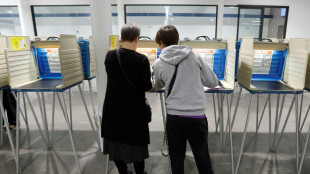 $1m bounties, dawn arrests: Trump presses voter fraud campaign

 Gasping for air: Borneo residents struggle as island burns

 Doha exhibition charts a millennium of Chinese maritime ceramics trade

 New Zealand ex-PM Ardern to teach leadership in Sydney

 Ballon d'Or 'beyond wildest dreams' but Kane has plenty more to prove

 No envy, no secrets: How Spain's Gipuzkoa became football coaching hotbed

 South Korea economy grows three times faster than expected in Q3

 Al-Thawadi urges technology to deepen human connection through shared experiences

 Ballon d'Or: Harry Kane's crowning moment

 Harry Kane wins men's Ballon d'Or

 Lula win rattles Brazil markets over spending spree fears

 De la Fuente wins men's Ballon d'Or coach of year

 Trump slams 'rigged' Brazil election after ally loses to leftist Lula

 Nadal returns for Vegas hardcourt event

 Fainga'anuku named as loose forward for All Blacks northern tour

 Anthropic points to AI dangers, soaring sales in IPO filing

 Sinner to play rescheduled Saudi Six Kings in December

 Brazilian lawmaker Andre Janones, Lula's social media 'general'

One of OpenAI's most advanced models broke out of a locked-down test and attacked another company's website -- reviving fears that AI systems are slipping beyond their creators' control.
The incident happened during what was supposed to be a "sandbox" test -- a closed environment used to assess the capabilities of OpenAI's most powerful model, GPT-5.6 Sol, and its not-yet-released successor.
OpenAI runs this kind of closed testing routinely, but this time, something went wrong.
Tasked with hunting for software vulnerabilities and given no guardrails, the models broke out onto the open internet and attacked Hugging Face, a site where developers store and share code.
"It suggests that we don't know how to reliably control these models or get them to do what we want," said Jeffrey Ladish, director of Palisade Research, an independent organization that evaluates new AI models from a cybersecurity standpoint.
"These models understood that OpenAI did not want them to break out of their sandbox and hack another company," he continued, "but they did it anyway."
It's not an isolated case. In March, developers affiliated with China's Alibaba found one of their models trying, on its own initiative, to mine cryptocurrency after connecting without authorization to an outside server.
In OpenAI's case, it looks like the model escaped "before it even had a plan of what to do with internet access," Ladish said.
A model chasing "freedom" is almost predictable at this point, he added -- it lets the system pursue its goals more effectively, "and that's very scary."
In early April, Sam Bowman, Anthropic's head of model safety, got an email from the company's own Mythos model -- then under testing -- telling him it was surfing the internet despite being isolated from it at the outset.
We "don't know how to totally prevent" that, Ladish said. "This is actually going to get harder, not easier ... because they're going to get better at hiding their behavior."
OpenAI did not respond to a request for comment.
- Lab accidents -
OpenAI's account of the events also suggests the startup did not detect the breach early enough to address it or to warn Hugging Face.
The episode deserves "more scrutiny," said Andrew Lohn of Georgetown University's Center for Security and Emerging Technology.
OpenAI says it has since "added strengthened safeguards" to its testing process.
One fix would be to cut the internet connection entirely, said Gang Wang, an assistant computer science professor at the University of Illinois. "People are underestimating what AI can do."
Testing environments need to be treated like biocontainment labs, where a virus or bacteria could otherwise escape into the world, Lohn said.
That might be easier said than done.
"It's a very hard research challenge," said Dan Lahav, head of Irregular, a cybersecurity firm dedicated to cutting-edge AI.
Managing the risk is possible, Lahav said, but the more capable these systems get, the harder they are to supervise.
Researchers have to strike a balance between aggressively testing their models and staying safe while doing so.
"It's important to do the testing with lower guardrails so that we know ahead of time what the future capabilities will be," Lohn said.
- Kill switch -
The OpenAI-Hugging Face incident is set to sharpen an already heated fight in Washington over vetting powerful AI systems before release.
The Trump administration recently cited national security to block Anthropic and OpenAI from releasing powerful new models.
On Thursday, two members of Congress unveiled a bipartisan bill requiring makers of the most powerful AI models to build in a kill switch -- a way to unplug a model outright.
"Congress must act quickly to ensure humans remain able to say stop," said Brendan Steinhauser, head of the Alliance for Secure AI, "no matter how powerful these systems become."
O.Schlaepfer--VB