Six months on, shelling becomes new normal in Mykolaiv / Photo: © AFP

 Ukraine's Zelensky visits Russian ally Serbia as Moscow pounds Kyiv

 Ukraine's Zelensky visits Russian ally Serbia for talks

 Defending champion Shelton storms to Montreal win

 Exodus: West Bank hardships drive out Palestinian Christians

 Travis Head wins Australian cricketer of the year gong

 Colombia's new president vows to 'defeat narco-terrorists'

 Call for Infantino to resign comes amid wave of support

 Trump ally Abelardo de la Espriella sworn in as Colombia president

 FIFA chief Infantino gets backing of South American football

 Amazon behind massive private gas plant for new data centers

 Apple and OpenAI escalate legal battle over devices

 All Blacks strike late to secure opening win against Stormers
 Saudi Arabia, Turkey, Pakistan sign defence pact amid regional war

 Trump renews effort to remove US Fed Governor Lisa Cook

 Abelardo de la Espriella, the flamboyant millionaire taking power in Colombia

 Germany holds security meeting over explosive drone amid Russia protest

 Austrian writer Stefan Zweig, who fled Nazis, honoured in London
 Mexico and Peru reestablish ties after asylum spat

 Dollar drops, stocks climb as weak US jobs data eases rate fears

 Japan defender Tomiyasu joins Crystal Palace

 Celtic boss O'Neill out of hospital after 'small procedure'

 Man City reject Barcelona bid for Rodri - reports

 US unexpectedly loses jobs in blow to Trump ahead of midterms

 Dollar drops, stocks climb after surprise US jobs miss

 Thai students in disbelief after deadly school shooting

Six months since the start of Russia's invasion, residents of Mykolaiv feel dread and resignation as the daily shelling of their city in southern Ukraine becomes the new routine.
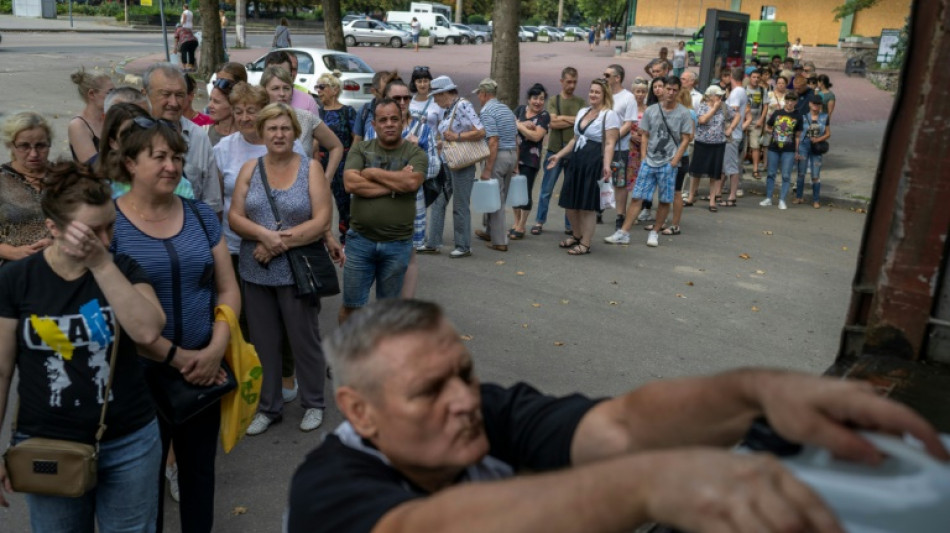
In the city's Sukhii Fontan (Dry Fountain) district, a dozen people holding empty canisters chat as they stand in line for drinking water.
Fighting in April put a water pipeline out of service.
The water has started running again but it is salty and the only way to get drinking water now is to go to distribution points set up in each district.
But water is far from the main concern.
"There was an explosion next to my place recently. It's awful, but the scariest part of it all is that I have adapted," said Eva Gudzon, a 35-year-old singer and photographer.
"I don't sleep at night anymore. I just lie there, waiting for the strikes. It messes with my internal clock, and I still have to take care of my children during the day," she said.
Mykolaiv, which lies on an estuary just off the Black Sea, was almost encircled and seized by Russian troops at the beginning of the war.
It was a critical objective for the Russian army, which was hoping to secure a path to Odessa -- Ukraine's largest port -- and eventually seize control of Ukraine's entire Black Sea coast.
To avoid this fate, Ukraine put up a fierce fight and managed to drive Russian forces back.
Russia's grip around Mykolaiv has loosened since then, but the shelling never stopped.
The deadliest one, a strike on the administration's buildings on March 29, killed 37 people, including many city employees.
- 'Keep living their lives' -
The economy is in a shambles too.
The city used to be home to 500,000 people. Now, the port is under Russian blockade, and shipyards are at a standstill.
Some are managing to catch a breath: teenagers, wilfully ignoring the "swimming is prohibited" sign, have taken over a deserted yacht-club.
The centre of the city and its restaurants are also surprisingly lively. Most clients are off-duty soldiers like 33-year-old Mykola.
"It's a sad thing to say, but people are starting to get used to it, they try to keep living their lives like before," said Mykola, who comes from Russian-occupied Kherson, where his family still lives.
This alarms Valentyn Raylan, a Red Cross volunteer planning to spend the evening repairing his mother's roof after supervising the day's water distribution.
"It's dangerous to get used to these strikes. People need to keep going down to shelters," Raylan said.
The air-raid sirens regularly blasting up in Mykolaiv are mostly ignored by passers-by, despite explosions reminding them that the frontline is only around 20 kilometres (12 miles) away.
The most dangerous time is at night, when strikes on the city intensify.
- 'Ukraine is suffering' -
Two universities were damaged in July. On August 1, a medical centre was hit, along with a warehouse where about 100 tons of food burned, according to Mykolaiv governor Vitaliy Kim.
Among the victims of the overnight strikes were Ukraine grain tycoon Oleksiy Vadatursky and his wife, who were killed in their home on July 31.
For some, the strikes will never become normal.
Among them is Andrii, a 40-year-old docker whose father was killed along with 11 others in a strike on April 4.
"When you actually hear an explosion, when you hear sirens, or a roof falling down... it's really something else, it's terrifying," Andrii said.
"People are suffering, the city is suffering, Ukraine is suffering. No one expected this. But we stand firm."
W.Lapointe--BTB