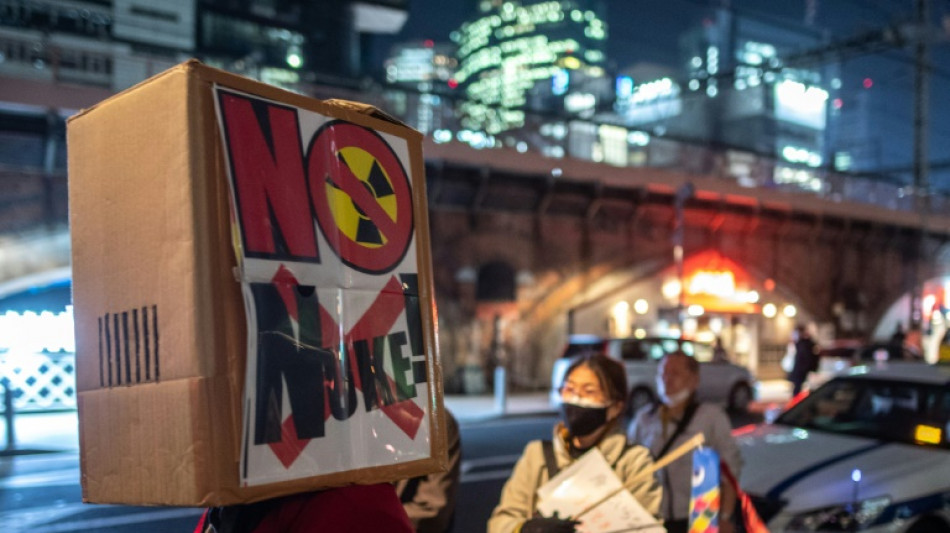
Japan PM eyes nuclear power push to combat energy crunch / Photo: © AFP

 Chinese car brands reshape Australia’s automotive market

 Electric cars enter their most decisive generation yet

 Three Chinese carmakers enter the global automotive top 10
 Ukraine's Zelensky visits Russian ally Serbia as Moscow pounds Kyiv
 Ukraine's Zelensky visits Russian ally Serbia for talks

 Defending champion Shelton storms to Montreal win

 Exodus: West Bank hardships drive out Palestinian Christians

 Travis Head wins Australian cricketer of the year gong
 Colombia's new president vows to 'defeat narco-terrorists'

 Call for Infantino to resign comes amid wave of support

 Trump ally Abelardo de la Espriella sworn in as Colombia president

 FIFA chief Infantino gets backing of South American football

 Amazon behind massive private gas plant for new data centers

 Apple and OpenAI escalate legal battle over devices

 All Blacks strike late to secure opening win against Stormers

 Saudi Arabia, Turkey, Pakistan sign defence pact amid regional war

 Trump renews effort to remove US Fed Governor Lisa Cook

 Abelardo de la Espriella, the flamboyant millionaire taking power in Colombia

 Germany holds security meeting over explosive drone amid Russia protest

 Austrian writer Stefan Zweig, who fled Nazis, honoured in London
 Mexico and Peru reestablish ties after asylum spat

 Dollar drops, stocks climb as weak US jobs data eases rate fears
 Japan defender Tomiyasu joins Crystal Palace

 Celtic boss O'Neill out of hospital after 'small procedure'
 Man City reject Barcelona bid for Rodri - reports
Japan's prime minister on Wednesday called for a push to revive the country's nuclear power industry in a bid to tackle soaring imported energy costs linked to the Ukraine war.
Such a move could prove controversial after the 2011 Fukushima disaster led to the suspension of many nuclear reactors over safety fears.
But like many countries, Japan -- which is aiming to become carbon neutral by 2050 -- has faced a squeeze on its energy supplies since Russian forces entered Ukraine six months ago.
"Russia's invasion of Ukraine has vastly transformed the world's energy landscape" and so "Japan needs to bear in mind potential crisis scenarios", Prime Minister Fumio Kishida said at an energy policy meeting.
Japan should consider building next-generation nuclear reactors, he said, while the government will also discuss bringing more nuclear plants online and extending the service life of reactors if safety can be guaranteed.
Kishida called for "concrete conclusions by the end of the year" on the topic, which remains a sensitive one after a deadly tsunami in March 2011 caused a meltdown at the Fukushima plant, the world's worst nuclear disaster since Chernobyl.
Eleven years on, 10 of Japan's 33 nuclear reactors are back in action, although not all are operational year-round, and the country is heavily dependent on imported fossil fuels.
The national nuclear safety watchdog has approved in principle the restart of seven more reactors, but those moves often face opposition from local communities.
- 'Politically challenging' -
"In addition to securing the operations of the 10 reactors that are already back online, the government will spearhead an effort to do all it takes to realise the restart" of the others whose safety has been approved, Kishida said.
The prime minister, who joined the meeting remotely after testing positive for Covid-19, also urged policymakers to consider "constructing next-generation nuclear reactors equipped with new safety mechanisms".
Before the Fukushima disaster, a third of Japan's power generation came from nuclear sources, but in 2020 the figure stood at less than five percent.
Tom O'Sullivan, a Tokyo-based energy consultant at Mathyos Advisory, said building next-generation reactors in Japan would be a "major step", because "all the current reactors are conventional ones".
Bringing more existing nuclear plants online will need to be approved by local governors, which could prove "politically challenging", O'Sullivan told AFP.
"But again, there's a different environment now after the Ukraine war," he said.
For the Japanese public, "I don't think it's just the electricity costs. It's the reliance on Russia, for natural gas, oil and coal... the Japanese public have really woken up to that."
The price of Japanese shares related to nuclear power surged in afternoon trade as local media reported the possible plans, with Tokyo Electric Power ending up 9.96 percent and Mitsubishi Heavy Industries jumping 6.85 percent.
Japan has imposed sanctions on Russia over the war in Ukraine along with other G7 countries.
The government has also pledged to make efforts to reduce its energy dependency on Russia, which supplies around eight percent of Japan's LNG needs.
P.Anderson--BTB