
Chad sees influx of drone victims from Sudan / Photo: © AFP

 Charity crowdfunds millions to buy historic English estate

 'Diabolical' Halloween festivities banned in Honduran towns

 Everton boss Moyes backs 'club decision' to drop Grealish for Newcastle tie

 DoorDash shares rise as Instacart slips following $17 billion takeover plan

 Japanese star Forever Young goes for rare Breeders Cup Classic repeat

 Inter Miami stay third after 2-2 draw with FC Cincinnati

 Inkle buys Finally bookkeeping unit and expands India-based workforce

 PI Industries plans Indian launch of Pioxaniliprole insecticide this rabi season

 Small-market Brewers upend big-spenders as baseball lockout looms

 ISRO schedules NVS-03 navigation satellite launch for Friday

 Antonelli struck with illness ahead of Mexico GP

 Google drags down US stocks as Lagarde signals early ECB exit

 Kuwait minister and Blind Association discuss support for visually impaired people

 'Star Trek', 'X-Men' star Patrick Stewart dead at 86

 Kuwait traffic authority cautions against hazard lights while driving in rain

 Germany's Zverev becomes tennis world No. 1

 Grealish dropped for Everton's League Cup tie after disciplinary breach

 Kuwait National Guard official visits member injured during training

 Machado says Trump opened 'floodgate to freedom' for Venezuela

 CNN Global Perspectives prepares Doha debut with international speaker lineup

 Qatar Olympic Academy completes record sports management course

 Jazeera Paints showcases housing solutions at Build Your House 2026 in Qatar

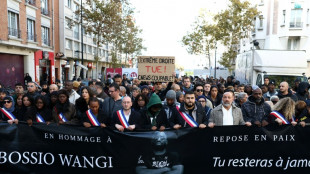 French shooting suspect targeted Muslims, Africans: prosecutor

 Es’hailSat and Arabsat agree broader satellite and broadcasting cooperation
 Qatar and Russia outline plans to expand strategic partnership

Faouzi Abdulbagi Mahammat Anour woke up in Tine, Chad, with a burnt face and his right eye missing after being attacked on the Sudanese side of the border by a drone.
The attack happened on the morning of June 10, when the 18-year-old was grazing his family's livestock northeast of the twin town of Tina in Sudan, in an area still outside the control of the Rapid Support Forces (RSF).
Eight hours later, he found himself in a hospital in Tine, with his hands burnt and bandaged. His 15-year-old cousin, Tadjerdin Mahammat Anour, was at his bedside.
The conflict in Sudan has pitted the country's army against its former allies the RSF since April 2023, killing more than 11,000 civilians and forcing over 15 million to flee their homes, according to the UN.
- 1,000+ killed -
Another cousin, aged just 16, was killed on the spot, said Tadjerdin, dressed in a white tunic and also with burns on a large part of his face.
"I don't understand why we were targeted. We didn't have any weapons," he added.
After four days in hospital, Tadjerdin was discharged, accompanied by his uncle, Souleymane Haggar Anour, 27, who had no doubt about who was behind the attack.
"Since the world is not paying attention to what is happening in Sudan, the RSF are taking advantage to behave like terrorists by targeting civilians," he said, wearing a long white kadamoul head scarf worn in the region.
According to the UN human rights agency, more than 1,000 civilians were killed in drone strikes in Sudan in the first five months of this year.
The Zaghawa people, the ethnic majority in the western Darfur region, are being particularly targeted by the RSF.
"The expanding use of drones has fundamentally transformed the security landscape in Sudan," the Global Centre for the Responsibility to Protect, an NGO, said last week.
"In recent months, such strikes have intensified dramatically and demonstrated increasing precision for targeting civilian spaces, including markets, residential neighbourhoods, hospitals and essential civilian infrastructure," it added.
"Since early May, drone strikes have intensified around Tina, a city on the Sudanese side of the Chad–Sudan border," said medical charity Doctors Without Borders, which is known by its French acronym, MSF.
This has led to repeated influxes of wounded patients arriving at Tine hospital in Chad.
MSF supports the hospital and since it opened at the end of February, of the nearly 300 people admitted to the surgery department, more than 90 percent have been victims of drones, its manager, Malachie Mbairamadji, estimated.
"Drone injuries cause burns, fractures, wounds, loss of limbs," said the 31-year-old nurse, wearing a hair cap during a morning round on his ward.
On the other side of the yellow and green wall of the two cousins' room, three other Sudanese wounded by drones were lying in bed.
Hissen Ibrahim Abdelmadjid, 15, lay on his stomach with half of his back burnt.
Beside him, Rama Adam Ibrahim, 17, has just received a skin graft taken from his thigh to reconstruct the skin of his right foot.
At the other end of the room, Ahmat Adam Ateib, 22, has a metal rod in his right leg, to mend a double fracture of his femur.
- Destroyed health system -
It is impossible for the wounded Sudanese to get medical treatment in their own country.
"The entire health system on the Sudanese side has been destabilised," said Cisse Boucari Hamadoum, MSF project coordinator in Tine.
"Health personnel have fled, health facilities have been destroyed or become inaccessible, so Tine is the first accessible hospital for victims from the other side of the border," he added.
Since the start of the conflict in Sudan, 755 attacks against health centres or hospitals have been recorded, according to a report by the Insecurity Insight group published this month.
The organisation said two-thirds of the attacks were carried out by the RSF.
MSF supports the hospital in Tine by providing personnel, equipment and medication.
"But we are not able to treat the most serious injuries, for example when more than 50 percent of the body is burnt," Boucari Hamadoum said.
He pointed to a lack of resources to care for the wounded.
"Refugees continue to arrive but partners are pulling out," he added.
The most seriously hurt are sent to the hospital in Abeche, more than six hours away by dirt road to the south. With the rainy season starting at the end of the month, that travel time could double.
But other threats seem more pressing than rain.
"The warning lights are flashing red," according to several local sources, who said they feared an imminent attack by the RSF to take Tina, which until now has been defended by the Joint Force allied with the Sudanese army.
J.Sauter--VB