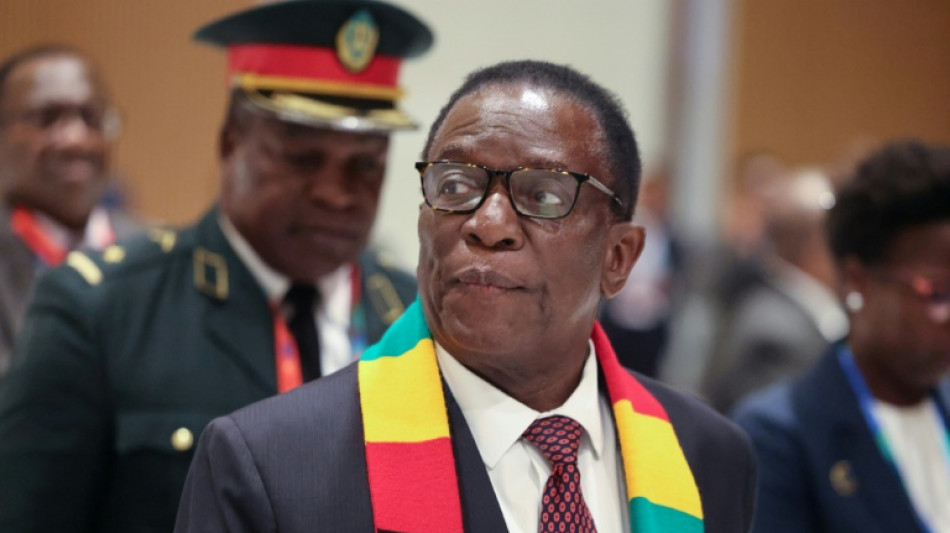
Zimbabwe Senate approves bill to extend presidential term / Photo: © AFP

 Charity crowdfunds millions to buy historic English estate

 'Diabolical' Halloween festivities banned in Honduran towns

 Everton boss Moyes backs 'club decision' to drop Grealish for Newcastle tie

 DoorDash shares rise as Instacart slips following $17 billion takeover plan

 Japanese star Forever Young goes for rare Breeders Cup Classic repeat

 Inter Miami stay third after 2-2 draw with FC Cincinnati

 Inkle buys Finally bookkeeping unit and expands India-based workforce

 PI Industries plans Indian launch of Pioxaniliprole insecticide this rabi season
 Small-market Brewers upend big-spenders as baseball lockout looms
 ISRO schedules NVS-03 navigation satellite launch for Friday

 Antonelli struck with illness ahead of Mexico GP

 Google drags down US stocks as Lagarde signals early ECB exit

 Kuwait minister and Blind Association discuss support for visually impaired people

 'Star Trek', 'X-Men' star Patrick Stewart dead at 86

 Kuwait traffic authority cautions against hazard lights while driving in rain

 Germany's Zverev becomes tennis world No. 1

 Grealish dropped for Everton's League Cup tie after disciplinary breach

 Kuwait National Guard official visits member injured during training

 Machado says Trump opened 'floodgate to freedom' for Venezuela

 CNN Global Perspectives prepares Doha debut with international speaker lineup

 Qatar Olympic Academy completes record sports management course
 Jazeera Paints showcases housing solutions at Build Your House 2026 in Qatar

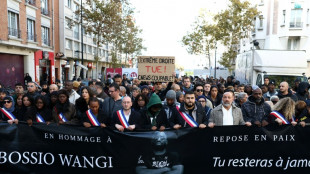 French shooting suspect targeted Muslims, Africans: prosecutor

 Es’hailSat and Arabsat agree broader satellite and broadcasting cooperation

 Qatar and Russia outline plans to expand strategic partnership

Zimbabwe's Senate on Wednesday overwhelmingly approved controversial constitutional amendments that would keep President Emmerson Mnangagwa in office until 2030, giving the changes full parliamentary support after earlier consent from the lower house.
The amendments are among the most contentious political issues in the country where 83-year-old Mnangagwa's Zanu-PF party holds a strong majority in parliament and has ruled since independence in 1980.
Senate president Mabel Chinomona said 75 senators voted in favour and four against.
The bill also sailed through the national assembly on June 18, when 216 voted in favour and 42 against.
The bill will have to return to the National Assembly to sign off on technical adjustments before being signed into law by Mnangagwa, an official said.
The raft of sweeping changes -- labelled a "constitutional coup" by critics -- includes a provision that would extend the presidential and parliamentary terms from five to seven years.
This means that the last of Mnangagwa's constitutionally limited two terms would be extended until 2030.
Another amendment gives parliament the power to appoint the president, doing away with direct presidential elections that were introduced in 1987, seven years after independence.
- Weakened opposition -
Zimbabwe's opposition, weakened by years of repression and tainted elections, charges that the measures will entrench Zanu-PF's grip on power in the resource-rich nation.
Activists who have tried to mobilise resistance have reported intimidation and violence, including arrests or assault by suspected state agents.
Mnangagwa -- nicknamed "The Crocodile" because of his ruthlessness -- came to power in 2017 in a military-backed coup that ousted Robert Mugabe at the age of 93 and after 37 years in power.
Judged by some analysts as more autocratic than his predecessor, he was elected for two five-year terms in 2018 and 2023.
When the cabinet approved in February the plan to extend his term, it said this would "enhance political stability and policy continuity to allow development programmes to be implemented to completion".
- Turn to the courts -
Opposition figures have vowed to continue to challenge the amendments in court.
They were an "effective breach" of constitutional provisions, including on the right to vote for public officials, and so should be put to a national referendum, senior opposition figure and former senator David Coltart told AFP.
"I have no doubt that the faction of Zanu-PF promoting this will ignore their constitutional obligations," Coltart said.
"The only way we will be able to get a referendum is if the Constitutional Court issues an order that this is compulsory, as it is."
The Constitutional Court, however, threw out on June 17 an earlier bid to challenge the amendment bill, saying it had no legal grounding.
Prominent journalist Hopewell Chin'ono said on X that the enactment of the bill "will represent a further consolidation of Zanu-PF's hold on power and diminish the prospects of Zimbabwe having a president from outside the ruling party in the foreseeable future."
Musa Kika, director of the Institute for Human Rights and Development in Africa NGO, said the bill should be referred to the judiciary "if only for the record, and to also expose them for being complicit in constitutional mutilation."
Rejecting the need for a referendum, officials have claimed a public consultation process through hearings and written submissions showed overwhelming support.
Human Rights Watch said in March that authorities were using violence and intimidation against opponents of the amendments.
"Over the last few months, the police and unidentified armed men have threatened, harassed, and beat up several people who are opposed to the proposed constitutional amendment," it said in a statement.
strs-br/ach
F.Stadler--VB