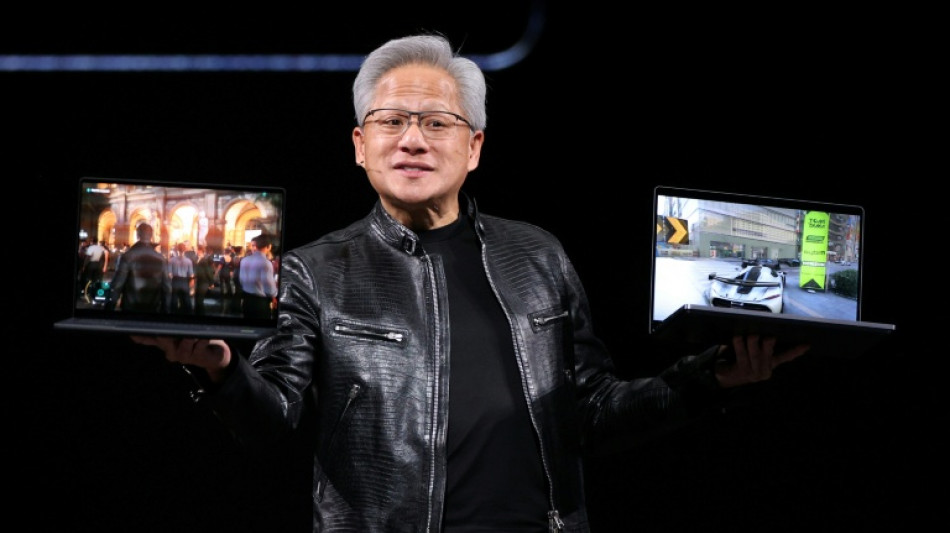
Nvidia launches Windows laptop chip for AI era / Photo: © AFP

 US eyes offshore nuclear reactors

 The Sterling Announces Luxury Cocktail Lounge Concept and Investor Showcase in Orlando

 Inter Miami signs Brazil veteran Casemiro but MLS probes deal

 White House accuses China's Moonshot of stealing Anthropic AI

 Pogacar sweating on Yates's fitness ahead of Tour Queen stage

 Ukrainian soldiers and civilians welcome new army commander
 UK fintech Revolut valuation soars to $115 bn: source

 German FM, on Africa tour, eyes business ties amid US, China pressure

 Rubio says at ASEAN meeting he expects 'positive' US visit by China's Xi

 Philipsen wins Tour de France 17th stage

 DonnaPro Introduces AI-Trained Executive Assistants for European CEOs

 Happy birthday, George! UK prince becomes a teenager

 Oil prices jump on Mideast war, stock markets diverge

 US hits Iranian island, says war cost at $37.5 bn

 Metal mining's carbon footprint far larger than thought: study

 TokenInsight Q2 2026 Report: TradFi Momentum Lifts MEXC to No. 2 in Commodity Perpetuals

 Leonardo chief sees potential for Germany to join GCAP fighter jet project

 Louvre heist gallery reopens to public, but with nothing to steal

 Ukraine's new army chief: who is Mykhailo Drapaty?

 India student protests keep up pressure on Modi government

 Italian FA chief says in touch with Guardiola over coaching vacancy

 Cooler inflation hands new UK PM Burnham an early boost

 Bezos holds talks with group interested in buying Liverpool stake: reports

 The student movement in India challenging Modi's government

 Danish fish fossil cliffs set to gain UNESCO status

Nvidia unveiled a powerful laptop chip for Windows machines on Monday, staking its claim in the market for next-generation consumer PCs integrated with artificial intelligence.
The US hardware titan's move challenges the likes of Apple, Intel and AMD in the PC domain, although the new devices will likely carry a hefty price tag.
It also represents an attempt by Nvidia -- which the AI boom has made the world's most valuable company -- to diversify into the consumer market, even as it reaps record profits from selling data centre processors to global tech giants.
"Microsoft and Nvidia are going to reinvent the PC," Nvidia's chief executive Jensen Huang said in Taipei as he launched the RTX Spark chip ahead of Computex, a major technology show.
"If you want to run digital biology, no problem. If you want to do seismic processing, no problem. You want astrophysics, no problem," Huang added, calling it "an incredible computer".
It is "as big of a deal as the reinvention of the phone into what we now know as the smartphone", he said.
RTX Spark-powered laptops and desktops, made by the likes of Dell and Lenovo, will be available this autumn, Nvidia said.
It is not the first time Nvidia chips have powered Windows devices -- a range of tablets did so in the early 2010s.
But the new PCs are positioned as tools that can easily run AI services such as agents, which can carry out tasks for users.
- 'Existential threat' -
Nvidia is best known for its GPUs, specialised chips originally designed to render gaming graphics at high speed, which have more recently become the engine for chatbots and other AI tools.
As governments and companies pour hundreds of billions of dollars into AI infrastructure, the company's value has topped $5 trillion, more than the gross domestic product of Japan or India.
Monday's announcement instead focuses on a new CPU, or central processing unit, which acts like the brain of a personal computer.
"Nvidia is bypassing the traditional PC supply chain to build an end-to-end hardware monopoly," said Stephen Wu, a former AI software engineer and founder of the Carthage Capital investment fund.
Wu told AFP that the development, long awaited in the industry, represents an "existential threat" to current laptop chip designs, with Intel and AMD "the immediate casualties".
It is also a strategic attempt by Nvidia to get programmers to build new tech products on their hardware, which will boost demand for data centre GPUs, he said.
But with a memory chip shortage pushing up the cost of consumer electronics, "the biggest question... may not be how powerful the next wave of PC hardware is, but whether buyers can still afford it," PC World magazine senior editor Alaina Yee wrote last week.
- Jobs debate -
Huang showcased Nvidia's upcoming Vera Rubin chip platform on stage Monday, saying that a rush to so-called agentic AI is driving up the already overwhelming demand for computing power.
He also called concerns that AI will decimate jobs worldwide "complete nonsense".
"The number of software engineers is actually increasing," he said. "Useful AI has arrived. AI is now a profit generator. AI is now a GDP generator."
Huang did not however address the thorny issue of his months-long campaign to sell chips in China that can train and run AI systems.
Washington in December eased national security export restrictions to China of a cutting-edge Nvidia model, the H200 chip.
But there have been no signs of orders from Chinese tech companies as Beijing ramps up domestic chip development, in a bid to challenge US dominance in the sector.
D.Schlegel--VB