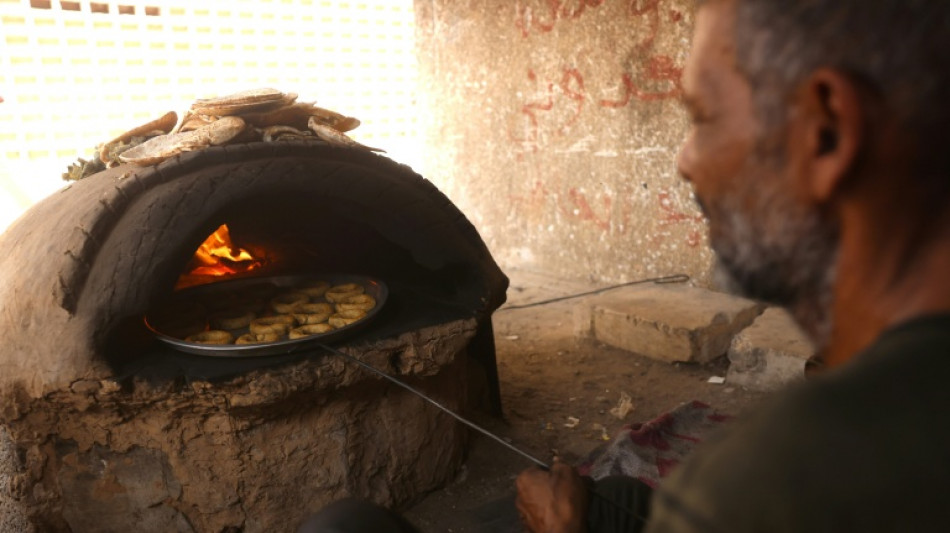
No feasts, no joy: Gazans mark a dark Eid / Photo: © AFP

 Tesla shares fall as Musk touts ambitious -- and costly -- plans
 Houthis claim Red Sea tanker strikes as US hits Iran again

 Wildfires ravage parts of southern France, Italy and Spain

 Alphabet beats expectations in second quarter, cloud revenue nearly doubles

 Trump threatens Iran infrastructure, Tehran vows 'eye for eye'

 US teen withdraws lawsuit against Meta over social media addiction

 Lebanon PM says Beirut working for 'complete Israeli withdrawal'

 EU conditionally clears Paramount bid for Warner Bros.

 Philipsen snaps 'horrible' drought with Tour de France stage 17 victory

 US trial of Venezuela's Maduro set for June 2027

 New UK PM Burnham gets early boost as inflation dips

 Samsung launches new, more expensive foldable smartphones

 Philipsen ends 'horrible' drought with Tour de France 17th stage victory

 Hungary's Orban says graft case is 'pretext' to target his party

 South African tycoon Motsepe rules out presidential bid

 Trump threatens Iran bridges, power as payback for Hormuz attacks

 Germany's Merz replaces leader ousted over surrogacy row

 CAF chief Motsepe backs Infantino despite criticism

 Evacuees from Spain's wildfire struggle with scale of devastation

 Ancient Lebanese city of Tyre added to heritage danger list

 Extreme heatwave grips Tunisia as wide power cuts fuel frustration

 'Beautiful game' provides Venezuelans with welcome distraction in wake of tragedy
 Oil prices surge on Mideast war, stock markets diverge

 Fury says 'best yet to come' ahead of Thailand fight

 Japan suffers heat 'disaster as cities hit by 'cruelly hot' days
New clothes for children, sacrificial sheep and Eid biscuits, the hallmarks of the Muslim holiday, are all either unaffordable or unavailable in Gaza, casting a shadow over what is usually a time of celebration and joy.
"I go to the market only to look around because I cannot afford to buy anything. Whenever I ask about prices, I return heartbroken," Nadia Abu Shamala, a Palestinian resident of Gaza, told AFP.
"This year, Eid comes with none of the joy we once knew in Gaza because of the effects of the war, the soaring prices, and our inability to provide even the simplest needs for our children," said the 40-year-old woman from Gaza's north displaced to the central Gaza city of Deir al-Balah for over two years.
Despite a US-brokered ceasefire that began in October 2025, Israeli air strikes are still common in Gaza, where 80 percent of buildings were damaged in the war and most of the population depends on aid for basic needs, according to the United Nations.
Israel controls all entry points to Gaza, and lets trucks of foreign aid and private sector goods enter in numbers that are too low to bring down war-inflated prices or shortages, NGOs on the ground say.
"The truce is a big lie, but in any case, we are trying to create joy for the children," said Abu Abdullah al-Mosadar, 59, who told AFP he pooled around 13,000 shekels ($4,570) with his brother to buy a sheep for sacrifice.
It is an amount that very few Gazans can afford.
"I know it is very expensive, but I decided to perform the sacrifice this year," said Mosadar, a former property dealer from one of central Gaza's well-established families, adding that he hopes to start his construction and real estate business when circumstances permit.
- Sheep shortage -
Central to Eid al-Adha celebrations, which mark the end of the Hajj pilgrimage to Mecca, is the sacrificing of a sheep.
According to Islamic tradition, God asked the Prophet Ibrahim, or Abraham in Jewish and Christian tradition, to sacrifice his son as a test of faith, only to stop him at the last moment and provide an animal to sacrifice instead.
But in tiny Gaza, livestock cannot enter from the outside, and only one quarter of the pre-war's sheep population remains, or about 15,000 for the coastal territory's 2.1 million inhabitants, according to the UN's Food and Agriculture Organisation (FAO).
"Regarding prices this year, sacrificial animals are witnessing an unprecedented increase due to the limited supply and the rising costs of breeding, feed, and transportation, and the shutdown of many farms," said Raafat Asaliya, spokesperson for Gaza's agriculture ministry.
As a result, "a sheep or goat that was sold before the war for around 1,000 shekels is now priced between 11,000 and 15,000 shekels," Asaliya said.
Gazans say they are shocked by the prices of sheep this year.
"We have never heard of such prices in our lives," Ahmed Abu Salem, a resident of Gaza City, told AFP.
"Families like ours, who used to make sacrifices every year, are now unable even to buy one kilogramme of meat for our children," the 50-year-old said.
- Tent-made sweets -
With gas in short supply, baking and cooking at home becomes an issue as well, Abu Ahmed Wafi, a 42-year-old displaced with his family in south Gaza, told AFP.
"The markets are mostly filled with kaak, maamoul, and sweets. We used to dream of making them at home as we always did before, but prices have risen sharply and there is no cooking gas available to bake them," Wafi said.
In the south Gaza city of Khan Yunis, one family managed to prepare trays of maamoul, the Eid biscuits, under a makeshift shelter covered in a reused tarp bearing the logo of UN children agency UNICEF.
Sitting on the ground, a woman and her daughter assembled the dough in circles Gaza-style, before a man baked them in a makeshift clay oven.
From her tent in Deir el-Balah, an exhausted Shamala hoped for better days.
"We are still living in tents with no atmosphere of joy, only worries, fear, and exhaustion, without any of the happiness we once knew," she said.
M.Vogt--VB