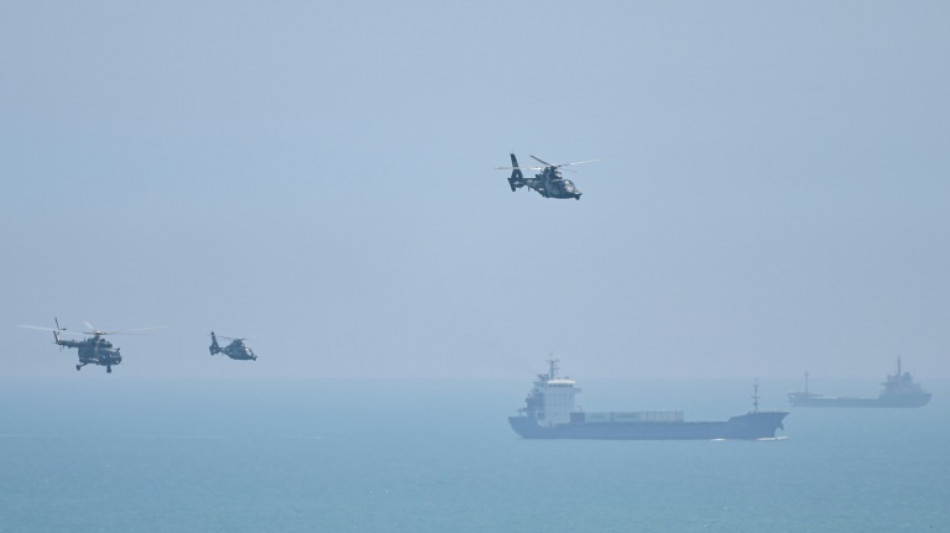
China drills reveal plans for Taiwan blockade: experts / Photo: © AFP

 Israel elections chief says inquiry into irregularities will not undermine result

 Vacherot beats Lehecka to clinch Basel title

 Buzzy Holmes doc wins slow Halloween box office in N. America
 Mbappe strikes after China controversy as Real Madrid beat Santander

 Almgren makes triumphant marathon debut in New York

 Chinese state TV fails to air Real Madrid match after Mbappe row

 France launches 'attempted murder' probe after petrol bomb attacks on security forces

 Bayern's Saibari sidelined after ankle surgery
 France launches 'attempted murder' probe after petrol bomb attack on security forces
 Tens of thousands protest in India's capital against voter roll revision
 Irish European athletics champion Ciara Mageean dies aged 34
 Seifert blasts 93 as New Zealand win fifth India T20

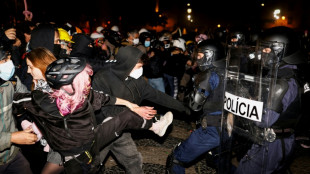 Portuguese police clash with housing protesters, arrest 13

 Marquez wins in Malaysia to stand on brink of MotoGP world title

 Binance says resuming withdrawals after major hack

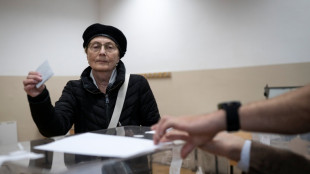 Divided Bulgaria votes in tense presidential runoff
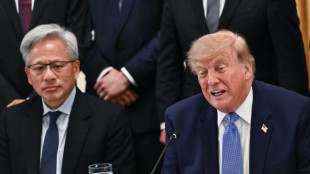 Trump says US looking 'closely' at report Nvidia CEO target of China spy plot

 Maxey scores 38 to lead Sixers 'fighters' to another comeback win
 Valkyries defeat Dream to capture first WNBA crown

 'Seen and heard': Uruguay neighborhood places hopes in pope
 Spewing US election falsehoods, AI chatbots face scrutiny

 EU's new levy on parcels kicks in

 Ocon denies reports of altercation after being dumped by Haas

 Hamilton says love of racing keeps him young

 'Disgraceful' Australia face reckoning after South Africa humbling

Beijing's largest-ever exercises around Taiwan have offered key clues into its plans for a gruelling blockade in the event of a war to take the self-ruled island, and revealed an increasingly emboldened Chinese military, experts told AFP.
The visit to Taiwan by US House Speaker Nancy Pelosi -- second in line to the presidency -- sparked outrage from Beijing, which launched vast military manoeuvres around the island, even at the risk of partially exposing its plans to the United States and its Asian allies.
Mobilising fighter planes, helicopters and even warships, the drills aim to simulate a blockade of Taiwan and include practising an "attack on targets at sea", according to state news agency Xinhua.
It is the first time Chinese exercises have taken place so close to Taiwan, with some of the drills happening less than 20 kilometres from the island's coast.
Also unprecedented are Beijing's drills on Taiwan's eastern flank, a strategically vital area for supplies to the island's military forces -- as well as any potential American reinforcements.
China sees Taiwan as part of its territory and has vowed to one day take it, by force if necessary.
A "blockade scenario" was long speculated to be one of China's preferred strategies were it to try and conquer the island, and this week's drills have revealed how that might go down.
Such a besiegement would aim to prevent any entry or exit of commercial or military ships and aircraft.
But it would also deny American forces stationed in the region access to the island.
The Chinese military "obviously has all the capabilities to impose such a blockade", Song Zhongping, an independent Chinese military commentator, told AFP.
"We already see during the current exercises that Taiwanese fighter jets and ships absolutely cannot take off or leave their ports."
- 'They can't be dismissed' -
The Chinese military fired a dozen ballistic missiles on Thursday that hit various areas around Taiwan -- with some flying over the island, Beijing's state broadcaster CCTV said on Friday.
According to Xinhua, Beijing has mobilised more than 100 planes and more than 10 frigates and destroyers -- including the J-20 stealth fighter and a Type 055 destroyer, the crown jewels of China's air and naval forces.
But beyond the big guns, these exercises make it possible to test and sharpen the level of coordination between the various army corps mobilised: land, sea, air and rocket forces, as well as strategic support, tasked with cyber warfare.
It is also a crucial test for the recently inaugurated Eastern Theatre of Operations of the Chinese army, created in 2016 and which oversees the country's entire eastern maritime space -- and therefore Taiwan.
What China has done so far demonstrates its "robust capabilities", John Blaxland, professor of international security at the Australian National University, told AFP.
"They can't be dismissed as some kind of less inexperienced, incapable force," he said.
"They clearly have the ability to coordinate their land and sea, they have the ability to deploy missile systems and they function effectively."
These exercises also demonstrate to the Taiwanese, the Americans and the Japanese that the Chinese "have what it takes to do what they threaten to do", he added.
"The converse, of course to this is that what they are doing is being closely studied and monitored for lessons to be learned by Taiwan, the United States, Japan and others," Blaxland noted.
- 'Dangerous opponent' -
During the previous Taiwan Strait crisis from 1995 to 1996, under Bill Clinton, the US Navy transited several warships through the waterway and deployed aircraft carriers near the island.
This time, however, "the US Government is taking prudent steps to avoid unwanted escalation", said Lonnie Henley, a former US intelligence officer and professor at the Elliott School of International Studies in Washington.
American caution is also rooted in the fact that China has greatly increased its military capabilities since 1996, when it was unable to deny the US Navy access to the area.
"In some areas the PLA might even surpass US capabilities," noted Grant Newsham, a former US Navy officer and researcher at the Japan Forum for Strategic Studies, referring to China's military by its official name.
"If the battle is confined to the area right around Taiwan, today's Chinese navy is a dangerous opponent -- and if the Americans and Japanese do not intervene for some reason, things would be difficult for Taiwan."
Chinese incursions across the so-called median line between the mainland and Taiwan -- never recognised by Beijing -- also speak to a growing confidence, experts said.
"China has not felt comfortable to push its claims on the median line until recently," said Blaxland.
"We can expect them to continue to operate as if the median line is not valid. That's been the case for a while, but it's now accelerating."
K.Brown--BTB