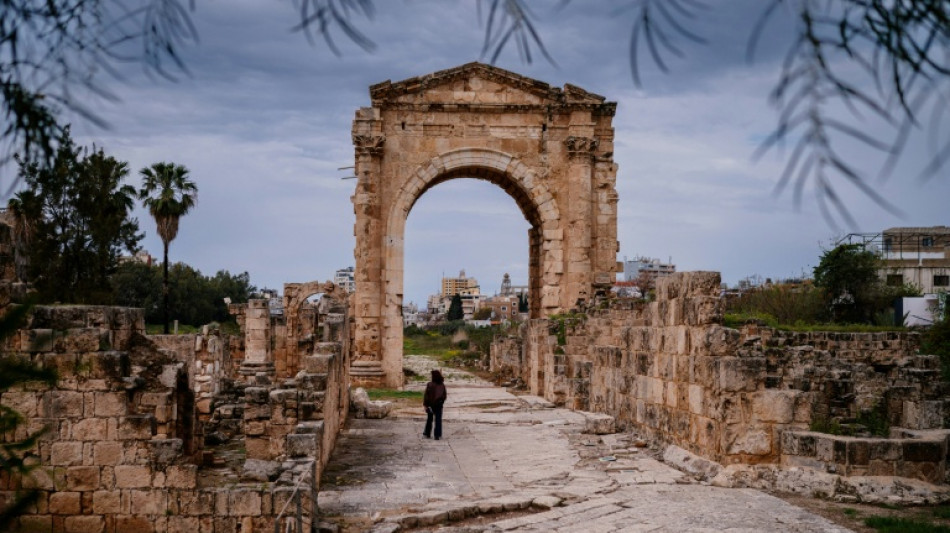
In Lebanon's Tyre, ancient site threatened by Israeli bombs / Photo: © AFP

 Oil sinks on Mideast deal, but Fed outlook knocks equities

 Dupont to start for Toulouse in Top 14 semi, Ramos out

 Zverev wins all-German duel with Hanfmann to reach Halle quarters

 Iran war leaves Islamic republic intact and opponents divided

 Galthie confirms Edwards to exit in France rugby coaching shake-up

 Knicks celebrate NBA win with huge New York parade

 Sana will become first Pakistani woman to play in The Hundred
 Cuba leader admits 'urgent changes' needed to overcome crisis
 Haiti's World Cup return lifts community in New York

 Trump's Iran deal sparks anger among Republican hawks

 Grand Theft Auto VI presales to begin next week

 Hegseth blasts NATO allies, says US will review forces in Europe
 Greenland sees wildfires earlier in the year

 The vaccines and treatments being developed for Ebola outbreak

 Ton-up Phillips stars for New Zealand against England

 Swiss central bank holds interest rates, with eye on currency risks

 Bank of England follows Fed in holding interest rate

 Trump defends Iran deal from critics he calls 'fools'
 German chemical company to cut 3,200 jobs as crisis worsens

 Oil falls further on Mideast deal, but Fed outlook knocks equities

 Range raises $8.3M Series A to unify treasury, risk and compliance across stablecoins and fiat

 Ibrahima Konate signs four-year deal with Real Madrid

 Innovations on show at Paris Vivatech fest

 Bird flu kills 13,000 seal pups on remote Australian island
 South Korean lawmakers launch probe into ballot paper shortages

At an archaeological site in southern Lebanon's Tyre, small signs bearing a blue and white emblem provide a symbolic shield, meant to protect the ancient ruins from bombardment.
One of the oldest cities on the Mediterranean coast, Tyre is located around 20 kilometres (12 miles) from the Israeli border, and has been the target of several strikes since Lebanon was drawn into the Middle East war by Hezbollah's March 2 rocket attack on Israel.
The Al-Bass site is centred on a necropolis that dates back three millennia to Tyre's time as a major Phoenician city and was still in use until the Arab conquests of the 7h Century.
An organisation linked to UNESCO, the United Nations' cultural heritage agency, launched the signs initiative near the site, part of a push that covers more than 30 locations across the country.
It is a reminder that the 1954 Hague Convention obliges warring parties to protect cultural property.
On March 6, an Israeli strike hit just a few metres away, killing eight people according to Lebanon's health ministry.
The target, a family home, is now a pile of rubble.
"They were our neighbours... They thought that being close to an archaeological site protected them, that because this is a World Heritage site it would not be struck," said Nader Saqlawi, director of archaeological excavations in the south for Lebanon's culture ministry.
- Human remains -
The team from the ministry that came to inspect possible damage to the monuments found human remains -- "a hand and pieces of flesh" -- on the roof of the site's museum, which is still under construction, he said.
The museum suffered damage, its windows were blown out, but the explosion did not reach the necropolis nor the Roman-era triumphal arch, aqueducts and hippodrome that are also part of the site.
In antiquity, the city of Tyre was at various times Phoenician, Persian, Hellenistic, Roman and Byzantine.
While many of its inhabitants have fled the latest war, others remain alongside the city's precious relics.
Lebanese Culture Minister Ghassan Salame condemned what he called Israel's aggression.
"The archaeological sites do not contain any military or security presence. Therefore, this argument cannot be used to justify their bombing," he said.
There was no immediate comment in response to AFP's request from the Israeli army, which usually says it is targeting Hezbollah sites or operatives with its attacks.
"Lebanon is full of archaeological riches... and the Beirut depots do not have the capacity to accommodate all these threatened objects," said David Sassine, an expert at the International Alliance for the Protection of Heritage.
- 'No one cares' -
There is also no guarantee that the objects would be safer in the capital, which is itself regularly bombed by Israel, and transporting the items from the south of the country, even under military escort, "remains risky", Sassine said.
During the previous Israel-Hezbollah conflict in 2024, gold coins, millennia-old amphorae and valuable sarcophagi were transferred to Beirut, where they have remained.
Tyre was heavily damaged by Israeli strikes during that war, while much of the population evacuated at the time.
Closer to the border, the citadel in the village of Shamaa was also partly destroyed by the Israeli military.
Saqlawi of the culture ministry said he believed attacks on historic sites were intentional.
"The Israelis know everything. They know your shoe size... and they know very well this is an archaeological site," he said.
Mustapha Najdi, a guard at the archaeological sites, was at the Al-Bass site when the March 6 strike hit.
"I heard a very violent impact. I fled and alerted the authorities," he said.
"No one cares about us", Najdi lamented, calling on "everyone who can to exert pressure to stop this barbarity".
"This civilisation represents history, represents us all, Lebanese and non-Lebanese."
R.Fischer--VB