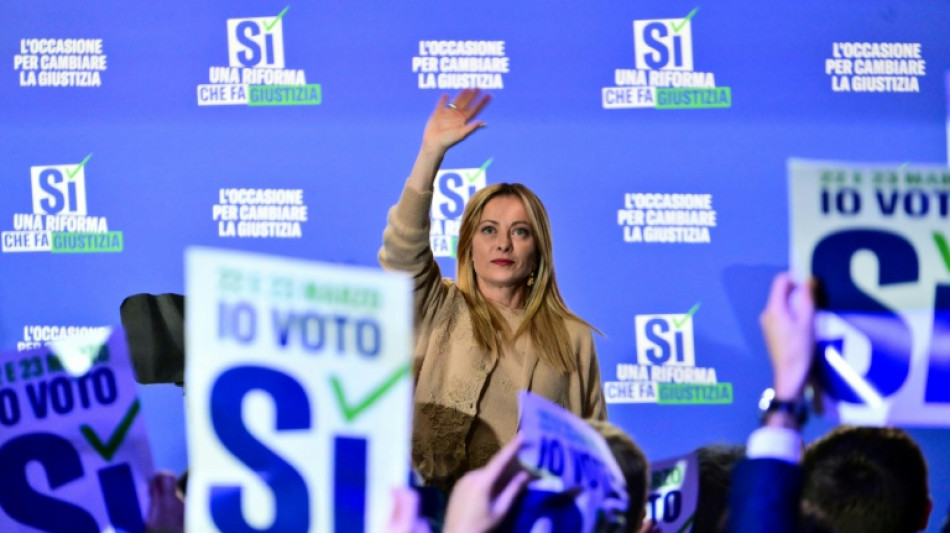
Italian voters reject Meloni's reforms in referendum blow / Photo: © AFP

 New Zealand's Henry rocks England after Phillips century

 Wildcard Eala shocks Rybakina in Berlin

 South Africa hold Czechs, keep World Cup knockout dream alive

 Important or selfish? World Cup evidence mounts against Ronaldo

 EU wrestles over tackling China export flood

 Vance defends Iran deal, eyes Swiss talks

 Wahi granted Canadian visa for Ivory Coast World Cup match after delay

 US lifts Iran ports blockade as uncertainty clouds Swiss Iran talks

 Brutal Shinnecock winds blow away US Open contenders

 AI-generated videos wield Down syndrome to make sales

 Man dies, trains and classes disrupted as heatwave hits France

 Neymar to miss Brazil's second World Cup game against Haiti

 O'Brien's historic 100th Royal Ascot winner has golden glow

 Graft probe into Spanish ex-PM expanded to daughters

 Gregoire wins Swiss tour 2nd stage as Pogacar extends lead

 What Real Madrid's new signings add to Mourinho's project

 Foreign aid cuts push up migrant flows, IOM chief warns

 Oil tankers pass Hormuz Strait after war deal: tracker

 Labour rival eyes win in poll key to UK PM's fate

 McIlroy grabs early lead at fog-hit US Open

 Swiss heading towards referendum on new nuclear plants

 Novelist Kundera and wife buried in Czech home city

 Cuban economy needs 'urgent changes' to overcome crisis: president

 US Open resumes after two-hour fog delay

 Spanish king to visit Mexican president on June 25 as ties improve
Italians inflicted the first major blow against Prime Minister Giorgia Meloni by rejecting her justice reforms in a referendum, results showed Monday -- but she insisted she was going nowhere.
With almost all votes counted, the result from Sunday and Monday's constitutional referendum put the "No" camp at around 53.5 percent, and "Yes" at around 46.5 percent, with a higher-than-expected turnout of almost 59 percent.
"The Italians have decided. And we respect this decision," Meloni wrote on X.
But this "does not change our commitment to continue, with seriousness and determination, to work for the good of the nation and to honour the mandate entrusted to us".
Meloni, the head of the far-right Brothers of Italy party, has led an uncharacteristically stable government since taking office in October 2022.
During the referendum campaign, she repeatedly said that the vote -- which concerned the role and oversight of judges and prosecutors -- was not about her own leadership.
But she campaigned hard for the proposals, alongside her coalition partners in the hard-right government, while the opposition parties had fought for a "No".
Daniele Albertazzi, a professor of politics at the UK's University of Surrey told AFP it was a "bad, bad result" for Meloni.
"It means she has lost the Italian electorate on a major issue in her manifesto, and one of the key proposals of the right... for the past 30 years," he said.
The latest opinion polls before the referendum put her party top at 28 or 29 percent of support, and Albertazzi stressed there was no risk of her government falling.
But "if the centre-left gets its act together, this is going to help them" in parliamentary elections due next year, he said.
"Because it means that her image as unbeatable is not there any more."
- 'Eviction notice' -
The referendum aimed to separate the roles of judges and prosecutors and change their oversight body, a measure sold by the government as necessary to ensure impartiality in the courts.
But critics said it was an attempt to exert more control over independent judges, whose decisions Meloni's ministers have often attacked in public, particularly over migration.
They also argued it failed to address the real challenges facing Italy's dysfunctional justice system, from years-long trials and huge case backlogs to prison overcrowding.
The reform's complexity and the rhetoric surrounding the campaign meant that for some, the referendum became a vote on the prime minister herself.
"Meloni will certainly emerge weakened," Lorenzo Castellani, professor of politics at Rome's Luiss university, told AFP.
Elly Schlein, leader of the centre-left Democratic Party, gathered supporters in Rome to celebrate the defeat of a "damaging" and badly written reform of Italy's cherished post-war constitution.
She said the vote sent a "clear political message" ahead of next year's elections: "The country is demanding an alternative, and we have a responsibility to organise it."
Former prime minister Giuseppe Conte, the leader of the Five Star Movement, said the referendum was "an eviction notice for this government after four years".
- Political list -
Italy's right has championed the issue of judicial reform since the late conservative prime minister Silvio Berlusconi, who accused the magistrates bringing a slew of trials against him of left-wing bias.
The Meloni government's reform would have amended the constitution to prevent judges and public prosecutors from switching roles.
Ministers argued that too-cosy relations between the two groups harm defendants, although in reality, only a tiny minority currently change roles.
It would also have changed the Superior Council of the Judiciary (CSM), an oversight and disciplinary body whose members are elected by their peers and parliament.
The reform would have divided the CSM into separate councils for judges and prosecutors, and created a new 15-member disciplinary court.
Members would have been drawn by lots, no longer voted by their peers, while a fraction of the judges chosen randomly for the court would come from lists compiled by parliament.
Referenda can be politically dangerous in Italy. In 2016, then-premier Matteo Renzi staked his career on a constitutional reform that voters rejected, prompting his resignation.
L.Maurer--VB