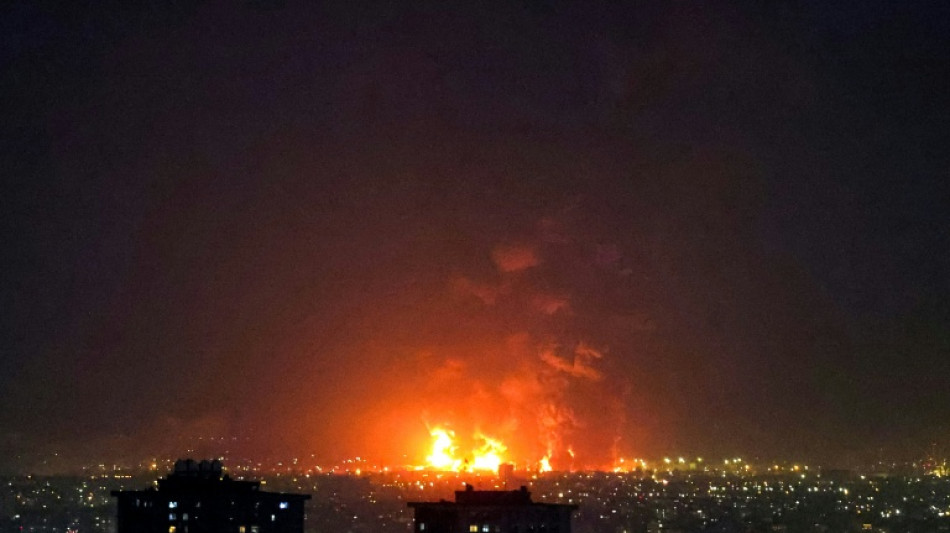
War has halted Gulf oil flow -- and restarting it won't be easy / Photo: © AFP

 Sabalenka roars back to make Berlin WTA semis

 Narvaez takes Swiss Tour third stage after 100km breakaway

 Europe swelters as temperature records tumble

 French mountain lodges worry over strained water supply

 Heatwave hits more than one in two people in France

 Zverev sets up Fritz semi at Halle Open

 Clark stumbles but still leads by two at US Open

 Ogura pulls off stunner to top Czech MotoGP practices

 Turkey bars public World Cup screening over university entrance exam

 Ebola spreading 'fast' in DR Congo, warns WHO

 The Sun may not engulf Earth after all, scientists say

 Russia signals slower rate cuts amid high Ukraine war spending

 Henry strikes as New Zealand lead England by 100 runs in 2nd Test

 Online threats, insults fuel S.Africa's anti-foreigner hate

 Clark completes first round with two-stroke US Open lead

 Italian FM cancels US visit over reported Trump comments

 Oil prices, shares steady after US-Iran talks postponed
 What did we learn from the hantavirus cruise ship scare?

 Arsenal will start Premier League title defence against Coventry

 'Alter-Ego': An Italian hospital's little robot carer

 French court confirms Moroccan football star Hakimi will stand trial for rape

 Deadly Philippines quake turns seabed into shore

 S. Korean leader says he told Trump sanctions on North are 'ineffective'

 No vaccine, conflict, mistrust: Ebola's return to DR Congo

 AI museum brings sights, sounds and smells of the rainforest

The war in the Middle East has largely paralysed the Gulf region's crucial oil industry, which has been hit by attacks and an export blockade.
The war has forced companies to dramatically slow or even halt production -- and restarting it will not be easy, even when the war is over.
- What has been targeted? -
Since the war started with US-Israeli strikes on Iran on February 28, at least 33 strikes or attempted strikes have targeted energy infrastructure in the Middle East, according to an AFP tally.
The United States and Israel carried out 13 of them against Iran.
The other 20, which struck seven Gulf countries, were attributed to Iran.
The strikes mostly hit oil and gas fields or complexes, such as the massive Ras Tanura refinery in Saudi Arabia, Ras Laffan gas processing base in Qatar and the complex housing the Ruwais refinery in the United Arab Emirates.
Iran has also effectively blocked the crucial Strait of Hormuz, the usual shipping lane for around 20 percent of the world's oil and liquefied natural gas output.
- Why is production down? -
Some infrastructure has been damaged.
Other facilities have closed or reduced activity as a precaution, such as Ruwais.
The near-closure of the strait has also had a major impact.
Gulf countries' output of oil and oil products has plunged from 30 million barrels per day last year, excluding Oman, to 10 million currently, according to the International Energy Agency (IEA).
It said the amount passing through the Strait of Hormuz had fallen to less than 10 percent of pre-war levels.
Saudi Arabia and the UAE have pipelines that can send some oil beyond the region, but their capacity is limited.
The result is storage facilities that are full to the brim.
"That's the main issue at the moment," an industry insider told AFP.
"Since there aren't enough ships to empty the storage facilities and export the product, suppliers have to stop production."
There is no easy fix, warned Pankaj Srivastava, a commodities expert at Rystad Energy.
"With crude supply increasingly stranded in the Gulf, refiners may soon be forced to adjust operations, curtailing runs as product exports stall and directing output solely to domestic markets," he said.
- How long to restart? -
"Depending how they were shut down, (restarting refineries) can take a week or two to reach full output," said the industry insider.
For oil wells, it is simpler: "You just reopen the valve."
According to the IEA, "upstream production will take weeks and, in some cases, months, to return to pre-crisis levels", depending on the site.
And "in the absence of a full ceasefire, ship owners, charterers, insurers, and crew will need to see robust security measures" to return to the strait, such as armed escorts, it added.
It said a traffic management system may need to be created to handle the massive backlog when traffic resumes in the strait, estimating it would take "several days to weeks" to clear.
F.Mueller--VB