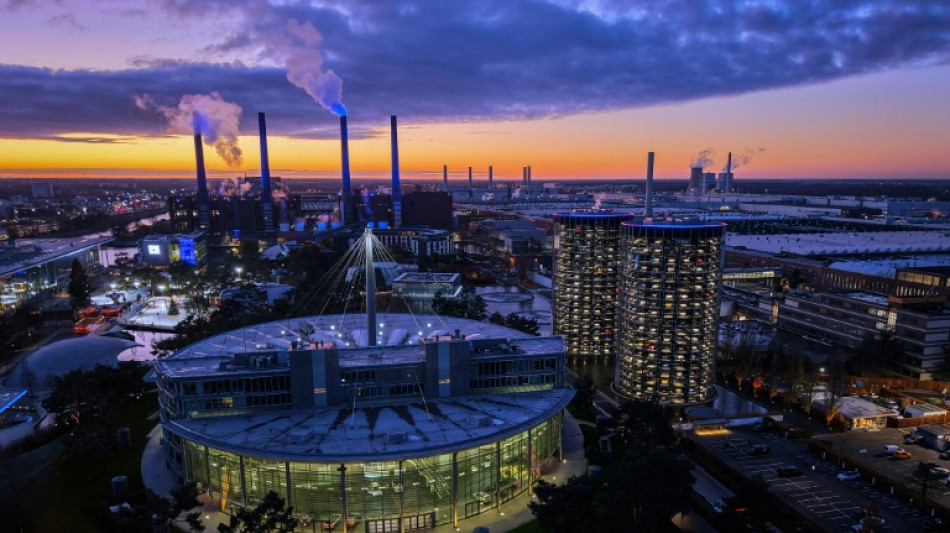
EU seeks to stem industrial decline with 'Made in Europe' push / Photo: © AFP/File

 'Not ridiculous': US dreams of World Cup glory after big wins
 Kolbe star goal kicker as Springboks put 80 past Barbarians
 Bolivia declares state of emergency and begins removing protester roadblocks
 Cerundolo sees off Nakashima to reach Queen's final
 Jamieson double rocks England at start of record run-chase
 Funeral for art giant David Hockney already taken place: publicist

 Red heat alert issued for third of France, alcohol banned at music festival
 Iran says Hormuz closed again after Israel strikes Lebanon
 New Zealand set England record 463 to win second Test
 Diplomats hold US-Iran preparatory discussions at Swiss retreat
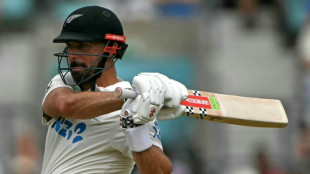
 Shahidi hits ton but India bowl out Afghanistan for 218
 Israel strikes south Lebanon despite truce announced with Hezbollah

 Hurricanes blow away Chiefs in record-breaking Super Rugby final
 Ancient Greek theatre revives legendary Callas opera Medea

 Portugal's unofficial exorcism fever worries Church
 Ancelotti hails 'complete game' as Brazil sink Haiti at World Cup
 Scotland remain bullish despite Morocco World Cup setback

 Brazil cruise past Haiti to re-ignite World Cup campaign
 Scheffler career Slam chances blowing in Shinnecock winds

 McIlroy seven back but likes his chances at US Open
 Clark leads US Open by four with major champs in the hunt

 Archaeologists discover 'never before seen' pre-Hispanic ruins in Mexico
 James Burrows, prolific innovator in US TV comedies, dead at 85

 World Cup warning with Sweden star Isak 'getting stronger and stronger'
 Tunisia coach says 'I am no wizard' after World Cup SOS call

The EU unveiled Wednesday new "Made in Europe" rules to help bolster the bloc's industries against fierce competition from China in a push held up for months by wrangling over plans some see as overly protectionist.
Concerning strategic sectors including cars, green tech and steel, the proposal is a key part of a European Union drive to regain its competitive edge, reduce its dependencies and stave off job losses.
"What I am presenting to you today is more than just a change in operating procedures; it is a change in doctrine -- one that was unthinkable just a few months ago," said EU industry chief Stephane Sejourne.
Broadly, the rules aim to ensure that public and foreign investments support manufacturing inside the 27-nation bloc, explained an EU official.
To that end, they say companies that want public money must meet minimum thresholds for EU-made parts and subject large investments from dominant foreign firms to conditions including employing EU workers.
The European Commission said the package aims to bring manufacturing's share of EU GDP to 20 percent by 2035, up from about 14 percent in 2024.
At stake are about 600,000 jobs that Brussels predicts could be lost over the next decade if the bloc's industrial decline continues on its current path.
- What 'Europe'? -
Initially expected last year, the measures strongly backed by France were pushed back several times due to disagreements, with some arguing they run counter the EU's pro-free-trade spirit.
Much of the discord revolved around the geographical scope of "Made in Europe".
Sceptics, including the EU's largest economy Germany, argued trade partners should be included in the definition under a "Made with Europe" approach.
Brussels settled for a compromise based around the principle of reciprocity.
Countries that have deals with the EU allowing for European companies to access public money on par with local firms in the sectors concerned would be brought into the fold.
Others -- like Canada -- that give preference to local producers will be left out unless they change tack, the official said, noting the rules would be used as a trade tool to negotiate better access for EU companies.
Ahead of publication, the plans had raised concerns among foreign partners including Britain, Japan and Turkey.
A full list of who was in and who was out was not yet available.
The "Made in Europe" requirements, which also seek to boost industrial decarbonisation, would apply to "strategic sectors", namely: steel, cement, aluminium, cars, and net-zero technologies.
Governments putting money behind infrastructure projects will have to ensure they include a minimum share of European low-carbon steel, cement and aluminium, among other provisions.
Electric-vehicle (EV) manufacturers will have to make sure at least 70 percent of their cars' components are made in the EU to access public money.
Similar rules will apply to batteries, solar, wind, and nuclear.
- Investment screening -
The proposal, formally known as the "Industrial Accelerator Act", also aims to ensure foreign companies partner with European firms if they want to set up shop in the bloc.
To do so it imposes conditions on foreign investments of over 100 million euros ($116 million) in "emerging strategic sectors" such as batteries and EVs.
These kick in when they involve an investor from a country that holds more than 40 percent of the related global manufacturing capacity -- an implicit reference to China's dominance in those sectors.
For such projects to go ahead, foreign investors need to meet four of six conditions including employing at least 50 percent EU workers, holding no more than 49 percent of the related EU company, and passing on technological know-how.
That was to counter instances where Chinese firms set up a European plant employing mainly Chinese workers with "very little local added value", said the EU official speaking on condition of anonymity.
For many, the plans are necessary to boost the development of EU green tech and shield manufacturers from unfair competition from heavily subsidised Chinese rivals.
The goal is to make sure EU taxpayers' money is "used strategically to strengthen Europe's industrial base -- rather than subsidising Chinese overcapacity", said Neil Makaroff of the Strategic Perspectives climate think tank.
But some experts question the EU push.
"If the policy goal is to make sure that your industry is not being destroyed by China, I think we have better instruments," said Niclas Poitiers, an international trade specialist at the Bruegel think tank, pointing to rules giving the EU power to investigate and counteract unfair foreign subsidies.
The proposal will be subject to approval by EU states and parliament.
R.Fischer--VB