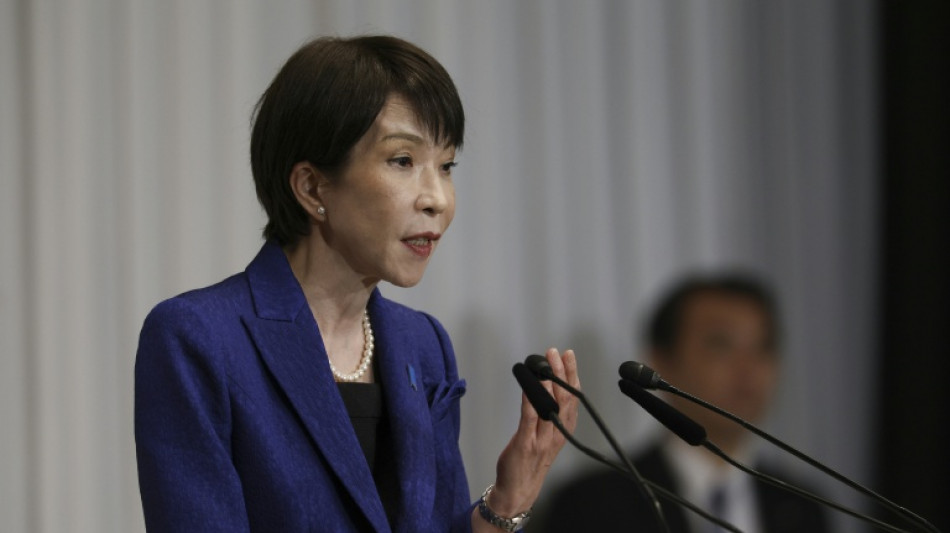
Japan election results confirm super-majority for Takaichi's party / Photo: © POOL/AFP

 Democrats, Trump hold final rallies before midterm elections

 Japan urges US to enforce discipline after second Marine arrest

 'Remarkable' rookie Lendeborg scores 37 as Warriors beat Clippers

 ExxonMobil urged to re-think Papua New Guinea gas project

 Asian stocks mixed as tech sector struggles to rebound from selloff

 India's royals find new power in their past

 Irish bookshops help meet UK demand for Sally Rooney novels

 NFL Vikings suffer first loss while Broncos edge Chiefs

 Host of fresh faces in Australia white-ball squads to face England
Japanese Prime Minister Sanae Takaichi's Liberal Democratic Party (LDP) won 315 seats in weekend snap elections, giving it a two-thirds majority, official results confirmed Tuesday.
The outcome is the LDP's best in its history and allows Japan's first woman prime minister to stamp her mark on the country of 123 million people over the next four years.
The LDP's coalition partner, the Japan Innovation Party (JIP), won 36 seats, giving the ruling bloc 351 lawmakers in the 465-member lower house, the internal affairs ministry data showed.
In the last parliament the LDP had only 198 seats while the JIP had 34.
The election also saw the anti-immigration Sanseito party increase its tally to 15 seats from two, the results showed.
The new Centrist Reform Alliance of the main opposition Constitutional Democratic Party and the LDP's previous partner Komeito suffered a disaster, with their tally collapsing to 49 from 167.
Having a two-thirds majority enables the government to override decisions by the upper house where the coalition is in a minority.
It also gives Takaichi the option of embarking on the complicated task of trying to change the constitution, something she has indicated she wants to do.
"This is the start of a heavy, heavy responsibility to make Japan stronger, more prosperous," Takaichi, 64, told a news conference on Monday.
"We believe that the public has shown understanding and sympathy regarding our appeals concerning the urgent need for a major policy shift," she said.
Capitalising on her honeymoon start after becoming Japan's fifth premier in as many years in October, Takaichi called the snap election last month.
Despite being her country's first woman premier, Takaichi has shown little appetite for framing her leadership around gender in male-dominated Japanese politics.
The number of women lawmakers dipped to 68 from 73, the official results showed.
But she has been a hit with voters, especially young ones, with fans lapping up everything from her handbag to her jamming to a K-pop song with South Korea's president.
- Challenges ahead -
Still, Takaichi has a host of challenges, including helping households cope with rising prices and boosting the economy while not alarming investors about Japan's public finances.
Her government is also under pressure to deliver on promises made to US President Donald Trump of investing some $550 billion in the United States.
With an eye on the rise of the populist Sanseito party, Takaichi has also promised to tighten rules on immigration.
Relations with China are also prickly, especially after Takaichi suggested in November that Japan could intervene militarily if Beijing sought to take Taiwan by force.
China, which regards the democratic island as part of its territory and has not ruled out force to annex it, was furious.
On Monday, a spokesman for China's foreign ministry again urged Japan to retract the comments.
Takaichi also wants Japan, a close US ally, to boost defence spending.
Beijing warned Tokyo that "reckless" actions would be met with a "resolute response from the international community".
S.Spengler--VB