Russia vows to act 'responsibly' once nuclear pact with US ends / Photo: © Russian Defence Ministry/AFP

 Hong Kong court set to sentence activist Joshua Wong in security case
 Australia raises benchmark rate to highest level in 18 years

 'The Remarried Empress' Cast Discusses Bringing Fantasy Royal Drama to Life

 Asian stocks retreat as AI worries outweigh steep oil-price drop
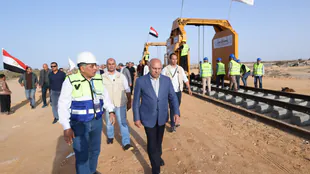
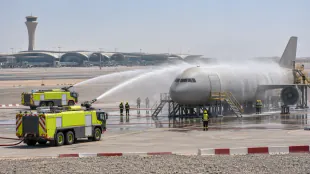 Hamad International Airport stages emergency drills during WATAN 2026
 Global failure to punish attacks leaves journalists at continuing risk
 Researchers Warn 'Bookkeeping Trick' Masks Beef Industry's Methane Emissions

 Climate Change Intensified Atlantic Hurricanes, Study Finds

 Qatar solar expansion opens scope for technical performance gains

Russia vowed Wednesday to act "responsibly" should its last nuclear treaty with the United States expire on February 5, amid mounting fears the agreement's collapse could spur a new arms race between the top nuclear powers.
The New START agreement, signed in 2010, limits the number of nuclear warheads each side can deploy.
It is set to expire on Thursday, formally releasing both Moscow and Washington from a raft of restrictions on their nuclear arsenals.
Campaigners have warned that allowing the treaty to lapse could unleash a new nuclear arms race.
In a call with China's President Xi Jinping on Wednesday, Russian President Vladimir Putin said his country would "act in a measured manner and responsibly" should the treaty expire, Kremlin aide Yuri Ushakov said.
Putin offered last September to keep abiding by the warhead limits in the treaty for a year, but received no formal response from Washington, Ushakov said.
US President Donald Trump said at the time it sounded "like a good idea" but there were no subsequent negotiations.
Moscow remains "open to finding ways for dialogue and ensuring strategic stability", Ushakov added in a briefing to journalists, including from AFP.
- Pope's warning -
The treaty was signed in 2010 by then-Russian President Dmitry Medvedev and his US counterpart Barack Obama.
It limited each side's nuclear arsenal to 1,550 deployed strategic warheads, a reduction of nearly 30 percent from the previous limit set in 2002.
It also allowed both sides to carry out on-site inspections of the other's nuclear arsenal, although these were suspended during the COVID-19 pandemic and have not resumed since.
Russia froze its participation in the agreement in 2023, but said it was continuing to voluntarily adhere to the warhead limits.
Pope Leo XIV said Wednesday that each sided needed to do "everything possible" to avert a new arms race.
"I urge you not to abandon this instrument without seeking to ensure that it is followed up in a concrete and effective manner," the American pope said at his weekly general audience.
The International Campaign to Abolish Nuclear Weapons (ICAN) called on Russia and the United States to commit to honour the New START limits while a new agreement was negotiated.
"Without New START, there is a real danger the new arms race will accelerate between the US and Russia -- more warheads, more delivery systems, more exercises -- and other nuclear-armed states will feel pressure to keep up," ICAN Executive Director Melissa Parke said Wednesday in a statement.
The Bulletin of the Atomic Scientists last month set its flagship "Doomsday Clock" closer than ever to midnight amid fears the agreement's expiry could start an arms race.
- Germany blames Russia -
A German foreign ministry spokesman blamed Russia for the lapse, saying that the United States "had repeatedly reached out" about extending the agreement but that Moscow had not responded.
"We can only regret this, but it is consistent with behaviour that Russia has been displaying for several years," the spokesman told journalists Wednesday.
Anti-proliferation talks between Russia and the United States, which together control more than 80 percent of the world's nuclear warheads, have deteriorated in recent years.
In 2019, the two countries withdrew from the landmark Intermediate-Range Nuclear Forces (INF) treaty, which limited the use of medium-range missiles.
In 2023, Putin signed a law revoking Russia's ratification of the Comprehensive Nuclear Test Ban Treaty, although Moscow said it would stick to the moratorium on atomic testing.
The Russian leader in 2024 signed a decree lowering the threshold for using nuclear weapons.
US President Donald Trump last October ordered the Pentagon to start nuclear weapons testing to equal China and Russia.
T.Egger--VB