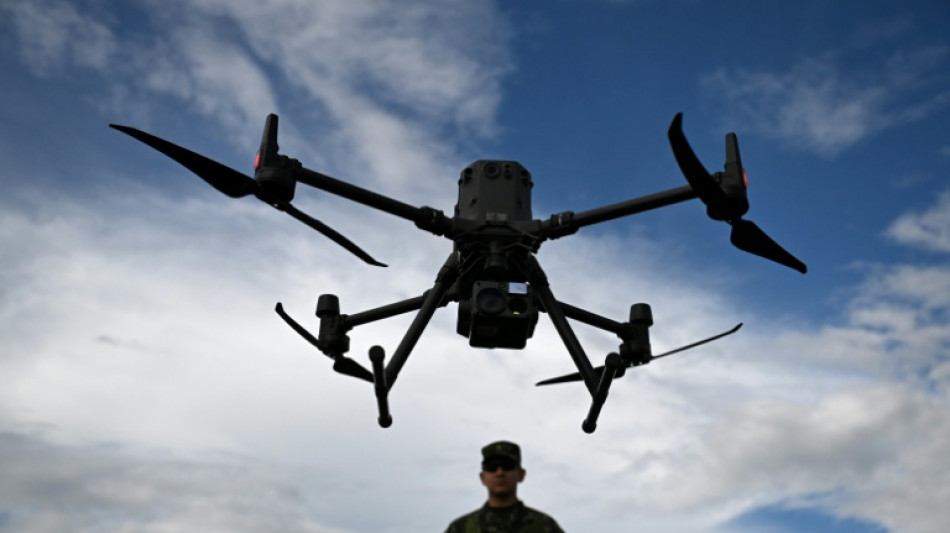
Colombia restricts import of drones used in explosives attacks / Photo: © AFP/File

 French farmers suffer arid crops, heat-stricken animals

 Scorching heat shuts Paris landmarks early as France swelters
 Ipswich hire Gary O'Neil as manager
 Lake wins Wales captaincy race ahead of Morgan

 Tech names drag down world stocks, oil dips on supply hopes
 Reports of Dupont inclusion in France squad 'bordering on annoying' says Galthie

 England coach McCullum denies rift with 'good friend' Stokes

 Taliban officials hold EU migration talks in Brussels

 Kenya halts US Ebola facility: health minister tells court
 Zelensky to skip key Ukraine conference in Poland over WWII row

 Europe heatwave closes schools, threatens health
 Germany eyes longer working lives in pension reform plan

 Iran says won't allow UN inspectors at bombed nuclear sites

 Banned Vondrousova insists she has 'never doped'

 UN chief urges AI firms to 'come clean' over environmental footprint

 More records set to fall as deadly Europe heatwave drags on

 England, Ghana eye last 32 as Portugal look for lift-off

 Sri Lanka troops to battle deadly dengue mosquitoes as cases rise

 Diaspora World Cup champions diversity over division

 Australia withholds Pacific climate fund reports over risk of diplomatic 'damage'
 Indian startup head appointed as new WhatsApp boss

 Antetokounmpo joining Miami Heat in blockbuster: reports

 'Let's be realistic': Haaland cools Norway's World Cup expectations

 Lightning, downpour, a two-hour delay: bad weather hits the World Cup
 Two-goal Haaland fires Norway into World Cup last 32
Colombia has restricted the importation of drones, whose increased use by guerrilla groups in a decades-old conflict killed 20 people last year and wounded nearly 300, the government said Thursday.
Guerrillas fighting the state, as well as rival rebel and drug trafficking groups, have taken to fixing explosives to commercial drones and targeting soldiers and civilians alike.
They drop the explosives on targets with little precision but terrifying effect.
Last year, there were 8,000 such attacks, according to Defense Minister Pedro Sanchez.
On Thursday, his office said a government decree has taken effect to "restrict the import of drones via postal traffic and express shipments, due to the high risk they pose to national security and defense."
The new measures stipulate that drones may only enter through customs points at Bogota's international airport and the northern seaport of Cartagena.
The country has several other sea and airports.
Over a quarter of a million people have been killed during six decades of armed conflict between left-wing guerrillas, drug traffickers, paramilitaries, and the military in Colombia.
The violence decreased dramatically after the Revolutionary Armed Forces of Colombia (FARC), the country's biggest rebel group, agreed to lay down arms in 2016.
But FARC dissidents opposed to the peace deal continue to fight other groups for control of Colombia's lucrative cocaine trade and to carry out attacks on the security forces.
Colombia is the world's largest producer of cocaine.
The Colombian military believes the ELN and other guerrilla groups received training to use drones in explosives attacks from foreign armed entities.
In October, the South American country unveiled its first drone battalion to counterattack and defend against drone onslaughts.
President Gustavo Petro, who has not achieved his stated goal for a negotiated "total peace" in Colombia, has called for a multi-billion peso investment in drone defense systems.
N.Schaad--VB