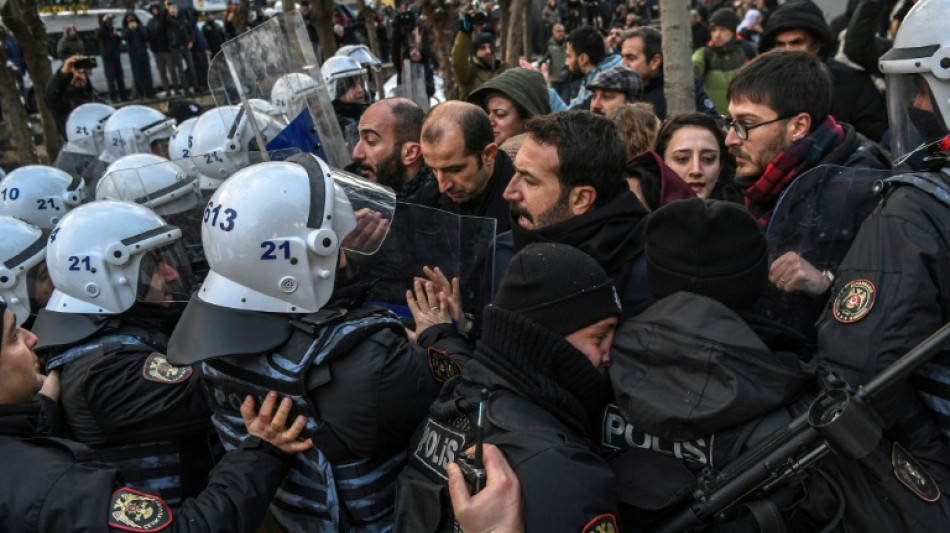
Police, pro-Kurd protesters clash at Turkey border with Syria / Photo: © AFP

 Iran says deal to end Mideast war 'declaration of US defeat'

 S.Korea chip giant SK hynix seeks $29 bn in Nasdaq listing: regulatory filing
 'Pragmatists' vs 'hardliners': Is Iran split over US deal?
 H5 bird flu detected in second Australia state
 Brazil aim for last 32 as World Cup goes into hectic phase

 Necessity drives gold miners in DR Congo's Ebola epicentre

 Japan PM heckled at WWII memorial

 Hanoi residents mount silent protest over home demolitions

 US Congress passes symbolic Iran war rebuke to Trump

 Bolivia's government is 'stoking a civil war,' ex-president Evo Morales tells AFP

 Fans in China put politics aside to cheer Japan at World Cup
 Geopolitics and AI in spotlight at China's 'Summer Davos'

 Race for robotaxi market arrives in London

 Moana Pasifika axed from Super Rugby after rescue talks fail

 Golden Boot battle steals the show at World Cup

 Red or green? For Brazil, the politics of World Cup kits matter

 US Congress passes landmark housing affordability bill

 Dream job: US soccer fans paid to watch every World Cup game

 Europe wilts under record heat as AC sales soar
 Rubio rejects Iran tolls on Hormuz as deal strains multiply

 Cubans bid farewell to revolution hero Valdes
 Ronaldo delights in silencing 'attacks' after making World Cup history
 'Paris in this heat is awful': Tourists change plans as sites close early
 'I'm back': Ronaldo scores at sixth World Cup as Portugal run riot
 US TV news host begs for info after kidnap note says mother is dead

Clashes erupted on Turkey's border with Syria Tuesday between police and pro-Kurdish protesters angered by a Syrian military offensive targeting Kurds, an AFP correspondent said.
The violence broke out in the border town of Nusaybin, just across from the northern Syrian town of Qamishli, at a protest called by the pro-Kurdish DEM, Turkey's third-largest party.
More than 1,000 demonstrators marched through the town towards the border, ending in a confrontation with police, who fired tear gas and used water cannon to disperse them.
The clashes come after Syrian forces launched an offensive nearly two weeks ago that pushed the Kurdish-led Syrian Democratic Forces (SDF) out of Aleppo, then advanced deep into the northeastern area held by Kurdish forces.
The move has angered Kurds across the region, including the Kurdistan Workers' Party (PKK) militant group in Turkey.
An AFP correspondent said some people at the Turkish border protest hurled stones at police, while others tried to cross into Syria.
Footage from the scene showed some trying to scale the wire fences, while protesters could also be seen gathering on the Syrian side.
Earlier, Interior Minister Ali Yerlikaya warned that Turkey would not tolerate "provocations".
Turkish President Recep Tayyip Erdogan hailed the Syrian army for its "careful" offensive to take over Kurdish-held areas, but the move has triggered fury among Turkey's Kurds, who make up a fifth of the country's 86 million residents.
"Mr President (Erdogan), you are congratulating HTS, which is killing our Kurdish brothers. There is a war going on!" DEM co-chair Tulay Hatimogullari said at the protest, referring to the Islamist-led rebels now ruling Syria.
Earlier, talks between the SDF and the Syrian government "collapsed", a Kurdish official told AFP, leaving the situation in the northeast on a knife-edge.
In Ankara, Turkey's top diplomat, Hakan Fidan, huddled for talks with US Syria envoy Tom Barrack, later expressing Turkish support for a weekend ceasefire deal announced by Syria's President Ahmed al-Sharaa.
"Despite all the difficulties, implementation of the January 18 agreement will play an extremely important role in the unity and integrity of Syria," Fidan said.
- 'Whatever is necessary' -
The violence has also raised serious doubts about Turkey's peace process with the PKK, which last year said it was ending its four-decade insurgency in favour of democratic means to advance the Kurdish struggle.
That process largely stalled amid the stand-off in Syria over plans to integrate the SDF into the central state.
On Tuesday, the PKK vowed it would "never abandon" the Kurds of Syria "whatever the cost".
"We, the entire Kurdish people and the movement, will do whatever is necessary," senior PKK leader Murat Karayilan told pro-Kurdish news agency Firat.
DEM, which has been mediating between Ankara and jailed PKK leader Abdullah Ocalan, has been enraged over Turkey's support for the Syrian offensive.
"You cannot treat those you call 'citizens' on this side of the border as 'enemies' on the other," it said on Sunday, accusing Ankara of "pure hypocrisy".
Police in Turkey broke up two pro-Kurdish protests on Monday -- one in the southeastern city of Diyarbakir and another outside a DEM office in Istanbul at which 10 people were arrested, including a French journalist.
Wladimir van Wilgenburg, an author and expert on Syrian Kurdish affairs, said the unrest risked collapsing Turkey's efforts to end the PKK conflict.
"There's a risk it could blow up with cross-border protests," he told AFP.
"Kurdish groups in Syria have called on the Kurds, both in Iraqi Kurdistan and in southeastern Turkey, to come and cross the border and join them in solidarity," he added.
S.Gantenbein--VB