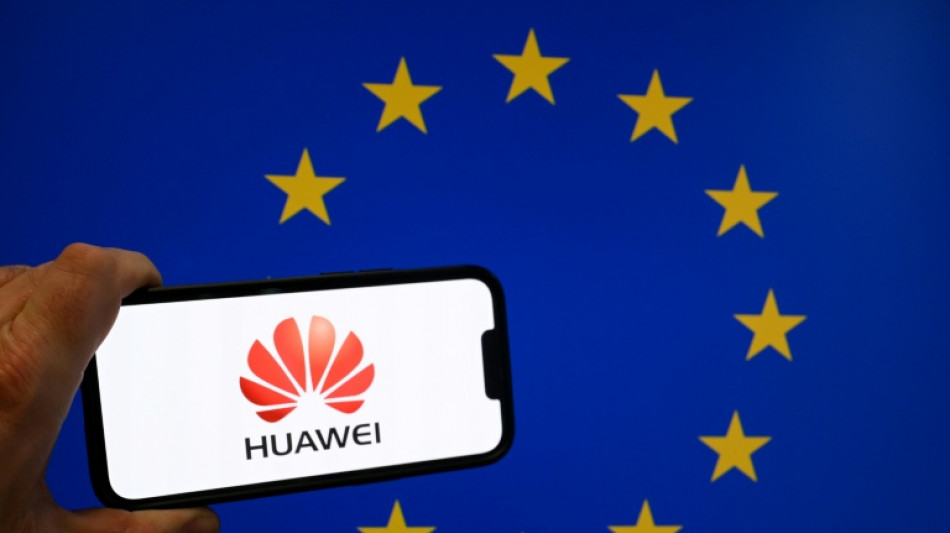
EU wants to keep Chinese suppliers out of critical infrastructure / Photo: © AFP

 England captain Stokes 'man enough' to apologise for curfew breach

 England captain Stokes 'man enough' to apologise after curfew breach

 German naval ambitions suffer setback as warship order axed

 London police to extend use of live facial recognition, drones

 Europe swelters under record-breaking heatwave

 Iran says deal to end Mideast war 'declaration of US defeat'

 S.Korea chip giant SK hynix seeks $29 bn in Nasdaq listing: regulatory filing

 'Pragmatists' vs 'hardliners': Is Iran split over US deal?

 H5 bird flu detected in second Australia state

 Brazil aim for last 32 as World Cup goes into hectic phase

 Necessity drives gold miners in DR Congo's Ebola epicentre
 Japan PM heckled at WWII memorial

 Hanoi residents mount silent protest over home demolitions

 US Congress passes symbolic Iran war rebuke to Trump

 Bolivia's government is 'stoking a civil war,' ex-president Evo Morales tells AFP

 Fans in China put politics aside to cheer Japan at World Cup

 Geopolitics and AI in spotlight at China's 'Summer Davos'

 Race for robotaxi market arrives in London

 Moana Pasifika axed from Super Rugby after rescue talks fail

 Golden Boot battle steals the show at World Cup

 Red or green? For Brazil, the politics of World Cup kits matter

 US Congress passes landmark housing affordability bill

 Dream job: US soccer fans paid to watch every World Cup game

 Europe wilts under record heat as AC sales soar

 Rubio rejects Iran tolls on Hormuz as deal strains multiply

The EU is expected on Tuesday to unveil plans to keep "high-risk" Chinese suppliers away from European critical infrastructure, as the bloc ramps up efforts to reduce dependencies on third countries.
Relations between Brussels and Beijing are strained as the European Union has taken an increasingly tough line on trade issues with China.
The EU in particular takes umbrage at what it describes as unfair competition with China, but there are also security concerns -- raised often by Washington.
The European Commission will publish its proposal revising cybersecurity rules in a bid to clamp down on foreign companies seen as posing security risks.
The EU executive in 2023 urged member states to exclude Huawei and ZTE equipment from their mobile networks due to security risks, but now wants to make it a compulsory ban, a European official said.
The rules give national authorities powers to issue restrictions but less than half of EU states have used them to restrict or exclude high-risk vendors.
The United States has long banned Huawei and sought to convince allies to follow suit over fears its products could be used to monitor communications.
Any EU mandatory restrictions could extend to Chinese companies making other products, including solar panels.
The commission may also seek to include "sovereignty" criteria in the scheme certifying the cyber security of cloud services, in a move that would exclude US companies which currently dominate the European market.
France has pushed the issue, but its adoption has stalled because of deep divisions between the 27 member states.
- Revamping telecoms -
The commission will also unveil its proposal on Wednesday for a Digital Networks Act to overhaul Europe's telecoms networks.
The EU wants to bolster its competitiveness and boost investment but critics say that is difficult when key sectors including telecoms and defence are fragmented with different national rules which make it difficult to scale up.
The bigger question is where the money will come from, as Brussels says Europe needs 200 billion euros ($232 billion) to modernise the telecoms network.
In a win for tech giants, a draft document seen by AFP made no mention of "fair share" payments from the world's biggest web companies for the large amounts of bandwidth they use.
Despite being a fervent wish of telecoms firms, the idea was deeply unpopular.
It became even more unlikely after the EU-US tariff deal last year, which the White House said included an EU promise not to adopt fees.
The EU executive will also give member states until 2035 to move off copper telecommunications networks, according to the draft document.
This would mean the industry has more time to switch to faster fibre networks.
Both texts will need to be approved by member states and the EU parliament.
G.Schmid--VB