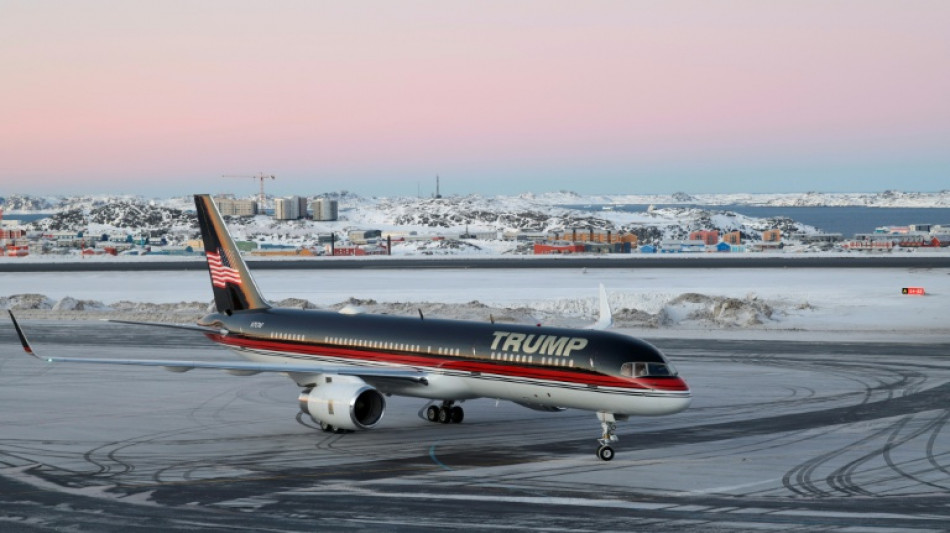
Is China a threat to Greenland as Trump argues? / Photo: © Ritzau Scanpix/AFP

 Galloway accuser could not foresee publishing-sector fallout, lawyer argues

 New York City Center revives In the Heights as a timely community story

 Godzilla Minus Zero shifts focus toward postwar human drama
 Mehbooba Mufti urges dialogue and renewed Central Asia links for Kashmir

 Seacliff Healthcare Seeks Specialist GP in Thirroul

 US stocks fall before midterm Election Day as technology shares weaken

 BLS Polymers makes strong market debut at ₹248 per share

 Petrol and diesel prices remain broadly steady across major Indian cities

 Reliance shares remain in focus after near-12% surge

 2026 Arizona Midterms: Key Races, Ballot Measures, and Voter Deadlines

 Coal India prepares possible $1 billion Mahanadi Coalfields listing

 Julia Stiles and Ezra Sosa Share Emotional Farewell After 'DWTS' Elimination

 US Buildings Threatened by Wildfires Could Triple by 2060

 Why Pregnancy Cost Estimates Fail: A Family’s $9,000 Surprise

 US Strikes Iranian Targets in Strait of Hormuz Ahead of Midterms

 Brodeur’s Overtime Goal Secures Bethlehem’s Second Consecutive Sectional Title

 Rare 1970 Plymouth ‘Cuda 426 Hemi Listed for $400,000

 The Digital Burden: Why Instant Messaging Feels Like a Full-Time Job

 Alberta Tabled Controversial Riding Boundary Maps Amid Gerrymandering Accusations

 Hong Kong court set to sentence activist Joshua Wong in security case

 Australia raises benchmark rate to highest level in 18 years

 'The Remarried Empress' Cast Discusses Bringing Fantasy Royal Drama to Life

 Asian stocks retreat as AI worries outweigh steep oil-price drop

 Hamad International Airport stages emergency drills during WATAN 2026

 Global failure to punish attacks leaves journalists at continuing risk

US President Donald Trump has repeatedly threatened to take Greenland by force from NATO ally Denmark in order to keep the Arctic island from Beijing's hands.
But analysts suggested China is a small player in the Arctic region, and thus far from the threat Trump has argued.
Here is what we know about Beijing's presence in the region:
- Covered with Chinese ships? -
Despite Trump's claim that, without US intervention, Greenland would have "Chinese destroyers and submarines all over the place", Beijing's Arctic military presence is underwhelming.
"Greenland is not swarming with Chinese and Russian vessels. This is nonsense," said to Paal Sigurd Hilde at the Norwegian Institute for Defence Studies.
In other parts of the Arctic, China's modest military presence has grown in collaboration with Russia since the 2022 invasion of Ukraine.
"China's only pathway to gaining significant influence in the Arctic goes through Russia," Hilde said.
The two countries have increased joint Arctic and coast guard operations, including a 2024 bomber patrol near Alaska.
China also operates a handful of icebreakers equipped with deep-sea mini-submarines, which could map the seabed -- potentially useful for military deployment -- and satellites for Arctic observation.
Beijing says they are for scientific research.
- Is China's influence growing? -
These activities are "potential security concerns if China's military or military-linked assets establish a regular presence in the region", said Helena Legarda at the Mercator Institute for China Studies in Berlin.
"China has clear ambitions to expand its footprint and influence in the region, which it considers... an emerging arena for geopolitical competition," she said.
Beijing launched the Polar Silk Road project in 2018 -- the Arctic arm of its transnational Belt and Road infrastructure initiative -- and aims to become a "polar great power" by 2030.
It has established scientific research stations in Iceland and Norway, while Chinese firms have invested in projects like Russian liquefied natural gas and a Swedish railway line.
Competition with China for resources and access to trade routes in the Arctic could threaten European interests, Legarda said.
Recently, however, China has faced pushback. Proposals to buy an abandoned naval station in Greenland and an airport in Finland have failed.
The US reportedly pressured nations to reject Chinese companies. In 2019, Greenland opted against using China's Huawei for its 5G networks.
Russia remains the exception, with China investing heavily in resources and ports along Russia's northern coast.
- What is China seeking? -
Greenland has the world's eighth-largest rare earth reserves, elements vital for technologies including electric vehicles and military equipment, according the US Geological Survey.
While China dominates global production of these critical materials, its attempts to tap Greenland's resources have seen limited success.
A Chinese-linked project at a massive deposit in Kvanefjeld was halted by the Greenland government in 2021 over environmental concerns, while another deposit in southern Greenland was sold to a New York-based firm in 2024 after US lobbying.
"There was a fear in Denmark and the US that mining investments several times the GDP of Greenland could have led to Chinese influence a decade ago, but the investments never materialised," said Jesper Willaing Zeuthen, associate professor at Aalborg University.
More recently, "Beijing discourages engagement, because the diplomatic costs have been too high".
- Transforming shipping routes -
The Polar Silk Road aims to link China to Europe via Arctic routes increasingly accessible as warming temperatures melt Arctic sea ice.
China and Russia agreed in October to develop the Northern Sea Route (NSR) along Russia's northern border.
Last year, a Chinese ship reached Britain in 20 days via the Arctic, half the time of the regular Suez Canal route.
The passage could transform global shipping and reduce Chinese reliance on the Straits of Malacca for its trade.
But ships have to be modified to travel through ice, fog makes navigation difficult, and the weather is extreme.
Chinese ships made just 14 NSR voyages last year, mostly carrying Russian gas.
Another possible route -- the Northwest Passage -- follows the Canadian archipelago, potentially mitigating the risks of a Russian and Chinese-dominated northern passage.
The NSR does not pass by Greenland, so it is not the source for Trump's claim of Chinese ships prowling the island's coastline.
Zeuthen maintains there is no sign of Chinese military activity in or around the Arctic part of Greenland.
"Actual security issues are very hard to identify," he said.
O.Schlaepfer--VB