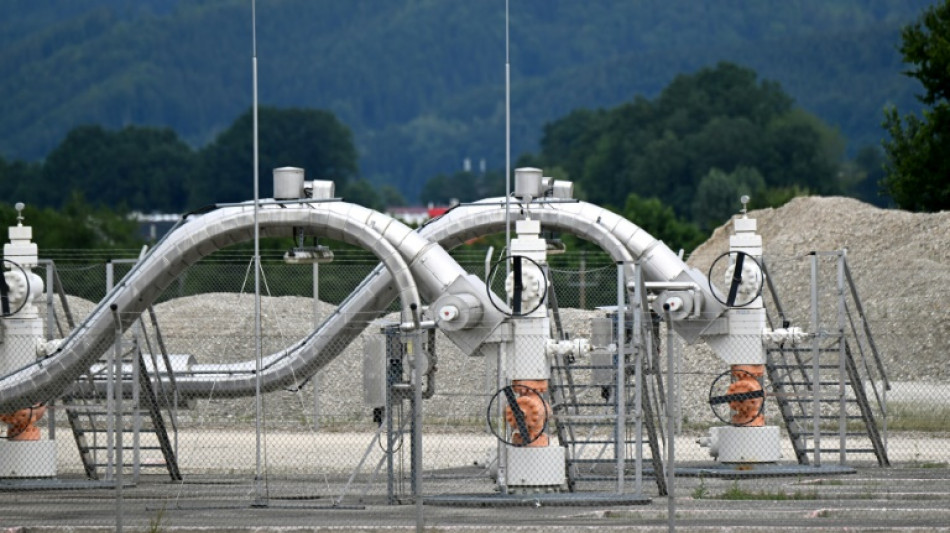
EU to seek cuts in heating, cooling of buildings to save gas / Photo: © APA/AFP

 Messi absent after father's death as Miami lose in Leagues Cup
 Flight cancellations, evacuations in China as Typhoon Dolphin looms
 Iran issues demands for reopening of Hormuz

 Afghanistan's gold rush upends lives and landscapes

 Messi missing after father's death as Miami lose in Leagues Cup

 World number one Sabalenka ousted in Toronto by Alexandrova
 Olympic weightlifter hoists debris for Venezuela earthquake recovery

 FIFA condemns 'concerted and ongoing effort' to weaken Infantino

 South Africa win after surviving late Argentina surge

 Man Utd boss Carrick being 'careful' with Mount as Man Utd draw with PSG

 All Black Tuipulotu surprised after Sharks include Nonu
 Infantino denies allegations of affair, favouritism while at UEFA: report

 MotoGP leader Martin soars to victory in British GP sprint race

 Mosimane set to succeed Broos as South Africa coach

 Drone enters Bulgaria, explodes near pipeline at Romanian border

 Paris orders e-scooter users to wear helmets, reflective gear
 Lionel Messi's father Jorge dies aged 68

 Johnson reveals 'stress' of Grand Slam Track collapse, clarifies payment

 Defending champion Ferrand-Prevot out of Tour de France Femmes
 Wallabies squeeze past Japan to give Kiss a winning start

 Kyiv mourns recovery volunteer, whose life 'intertwined with the fallen'

 Only two vehicles earn perfect child-seat scores for 2026

 Chinese car brands reshape Australia’s automotive market

 Electric cars enter their most decisive generation yet

 Three Chinese carmakers enter the global automotive top 10

The European Commission is expected next week to ask EU countries to reduce heating and cooling of public buildings and offices to cut demand for gas, according to a document seen by AFP.
In order to better to withstand the drastic fall in Russian gas supplies, which could be cut off altogether, the commission is expected to urge governments across the 27-nation bloc to set limits on the amount of energy used by public buildings, offices, commercial properties and outdoor terraces.
For optimal energy use, it will recommend the rules require that public buildings be heated to no more than 19 degrees Celsius (66 degrees Fahrenheit) and cooled by air conditioning units set no lower than 25°C (77°F°).
"Energy saved during the summer is energy that can be used in winter," the commission points out in the document.
Energy experts say lowering the thermostat by one degree could cut a building's heating bill by about 10 percent. Air conditioning units generally struggle and fail to cool a room below 20°C so they waste energy trying.
The recommendation is part of a series of measures Brussels is investigating to cut the EU's gas consumption by 25 to 60 billion cubic metres (880 to 2,120 billion cubic feet) per year.
The EU imported around 140 bcm of gas by pipeline from Russia last year, according to the International Energy Agency.
"Acting now could reduce the impact of a sudden supply disruption by one third," says the document, which is due to be published on July 20 and could be modified in the interim.
It calculates that 11 billion cubic metres of gas could be directly saved from reducing excessive heating and cooling, and between four and 40 bcm via reduced electricity demand. Another 10-11 bcm could be saved from use by industries, which have already slowed production due to soaring prices.
The document urges EU governments, where this is "technically feasible and enforceable" to introduce binding limits on heating and cooling in "public buildings, offices, commercial buildings (in particular large buildings) ... and open spaces like outdoor terraces".
"The role of public authorities in leading by example and as an important gas consumer -– 30 percent of the energy consumption -- is key in this regard," the document states.
The commission says that during the "gas winter" -- October to March -- "large savings can be achieved by deploying alternative heat sources for district heating, heat pumps in households" and energy saving campaigns urging the public to turn their thermostats down by one degree Celsius this winter.
But such "protected" energy customers -- under EU legislation that means households, district heating that cannot switch to other fuels and certain essential social services -- represent just 37 percent of total EU gas consumption. And simulations show these customers would be the last to be seriously affected by large-scale Russian gas disruptions, the commission says.
It is therefore concentrating most of its efforts on power stations and industry, which use huge amounts of gas.
"Abrupt cuts could damage specific branches of those industries which have little room to switch to other fuels -- because gas is being used as feedstock for industrial processes –- or to reduce production without heavy damage," the commission warns.
"It would be significantly less costly to moderately reduce natural gas demand for a longer period of time, starting earlier, than having to drastically curtail demand suddenly and without proper preparation," it explains.
By way of encouragement, Brussels urges EU governments to set up "auction systems", perhaps involving several countries, to compensate industrial consumers who agree to reduce their gas consumption.
If there is a total cut in Russian gas supply from July onwards, EU states might only be able to replenish 65-71 percent of their gas reserves percent before winter, the commission said, quoting forecasts by European gas transmission system operators (ENTSOG).
The commission's energy saving proposals are due to be discussed by EU energy ministers at a meeting in Brussels on July 26.
M.Furrer--BTB