EU moves to delay 'high-risk' AI rules, cut cookie banners / Photo: © AFP/File

 US, Iran trade strikes putting new strain on Middle East truce

 Thousands expected as Vespa celebrates 80 years in Rome

 Pino, Williams injuries mar Spain's World Cup progress

 'Struggle continues' in Bolivia's Morales heartland

 Bielsa accepts blame for World Cup exit, but says Uruguay deserved more

 Uruguay crash out of World Cup as Spain avoid Argentina clash

 Swiss glaciers facing drastic loss from heatwave: expert

 Trump unveils new US passport -- with picture of himself

 Hat-trick hero Dembele displays Ballon d'Or brilliance for France at World Cup

 Injured England defender James to miss Panama game at World Cup
 Norway coach defends decision to leave out Haaland, Odegaard against France

 Movie theaters are allies for streamers like us, Apple exec says

 DR Congo must take risks to keep World Cup 'dream alive', says Desabre

 Jangoo, Chase keep West Indies in touch against Sri Lanka

 Dembele hat-trick as France swat Norway, Senegal stay alive

 Dembele hits hat-trick as France thrash second-string Norway at World Cup

 Globalization isn't dead, just 'transformed,' says IMF chief economist

 Israel and Lebanon hail Washington deal, rejected by Hezbollah

 Usyk -- pugilist who kept Ukrainian spirits high in darkest days
 Orange wave: Dutch World Cup dream gathers pace

 Swiss nuclear plant shut down due to heatwave

 American businesswoman Michele Kang buys French club Lyon

 Lebanon, Israel, US sign trilateral framework agreement in Washington

 Antonelli scores 'double top' for Mercedes as Russell warns of McLaren threat

 Australia eye 'something special' after reaching World Cup last 32

The EU executive proposed rolling back key AI and data privacy rules on Wednesday as part of a push to slash red tape and help Europe's high-tech sector catch up with global rivals.
The landmark EU tech rules have faced powerful pushback from the US administration under President Donald Trump -- but also from businesses and governments at home complaining they risk hampering growth.
Brussels denies bowing to outside pressure, but it has vowed to make businesses' lives easier in the 27-nation bloc -- and on Wednesday it unveiled proposals to loosen both its rules on artificial intelligence and data privacy.
Those include:
- giving companies more leeway to access datasets to train AI models like personal data when it is "for legitimate interests"
- giving companies extra time -- up to 16 months -- to apply 'high-risk' rules on AI
- in a plan many Europeans will welcome, Brussels wants to reduce the number of cookie banner pop-ups users see, which it says can be done without putting privacy at risk.
"We have talent, infrastructure, a large internal single market. But our companies, especially our start-ups and small businesses, are often held back by layers of rigid rules," EU tech chief Henna Virkkunen said in a statement.
After cheering the so-called "Brussels effect" whereby EU laws were seen as influencing jurisdictions around the world, European lawmakers and rights defenders increasingly fear the EU is withdrawing from its role as Big Tech's watchdog.
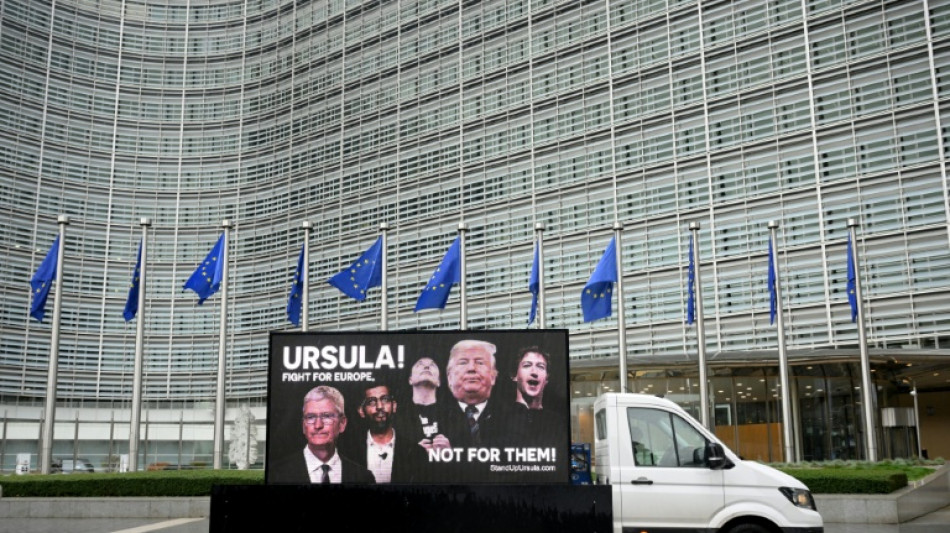
Campaigners from different groups including People vs Big Tech drove across Brussels on Wednesday with large billboards calling on EU chief Ursula von der Leyen to stand up to Trump and the tech sector, and defend the bloc's digital rules.
- Striking a 'balance' -
The commission says the plans will help European businesses catch up with American and Chinese rivals -- and reduce dependence on foreign tech giants.
For many EU states, the concern is that the focus on regulation has come at the expense of innovation -- although Brussels insists it remains committed to protecting European citizens' rights.
But experts say the EU lags behind the bigger economies for several reasons including its fragmented market and limited access to the financing needed to scale up.
The EU raced to pass its sweeping AI law that entered into force last year, but dozens of Europe's biggest companies -- including Airbus, Lufthansa and Mercedes-Benz -- called for a pause on the parts they said risked stifling innovation.
Brussels met them part of the way by agreeing to delay applying provisions on "high-risk" AI -- such as models that could endanger safety, health or citizens' fundamental rights.
With the proposed change on cookie banners, an EU official said the bloc wanted to address "fatigue" at the pop-ups seeking users' consent for tracking on websites, and "reduce the number of times" the windows appear.
The commission wants users to be able to indicate their consent with one click, and save cookie preferences through settings on browsers and operating systems.
Brussels has insisted European users' data privacy will be protected.
"It is essential that the European Union acts to deliver on simplification and competitiveness while also maintaining a high level of protection for the fundamental rights of individuals -- and this is precisely the balance this package strikes," EU justice commissioner Michael McGrath said.
T.Germann--VB