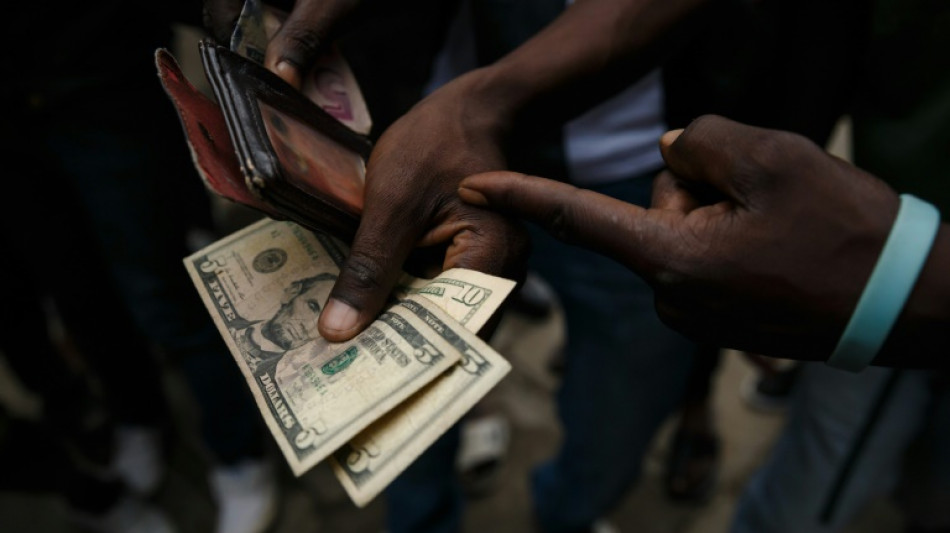
More means less for Zimbabweans battling hyperinflation / Photo: © AFP/File

 Iran Guards say won't reopen Hormuz without US meeting all Tehran's conditions

 Messi absent after father's death as Miami lose in Leagues Cup

 Flight cancellations, evacuations in China as Typhoon Dolphin looms
 Iran issues demands for reopening of Hormuz

 Afghanistan's gold rush upends lives and landscapes

 Messi missing after father's death as Miami lose in Leagues Cup

 World number one Sabalenka ousted in Toronto by Alexandrova

 Olympic weightlifter hoists debris for Venezuela earthquake recovery

 FIFA condemns 'concerted and ongoing effort' to weaken Infantino

 South Africa win after surviving late Argentina surge

 Man Utd boss Carrick being 'careful' with Mount as Man Utd draw with PSG

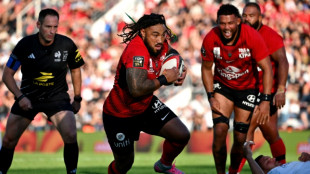 All Black Tuipulotu surprised after Sharks include Nonu

 Infantino denies allegations of affair, favouritism while at UEFA: report

 MotoGP leader Martin soars to victory in British GP sprint race

 Mosimane set to succeed Broos as South Africa coach

 Drone enters Bulgaria, explodes near pipeline at Romanian border

 Paris orders e-scooter users to wear helmets, reflective gear

 Lionel Messi's father Jorge dies aged 68

 Johnson reveals 'stress' of Grand Slam Track collapse, clarifies payment

 Defending champion Ferrand-Prevot out of Tour de France Femmes

 Wallabies squeeze past Japan to give Kiss a winning start

 Kyiv mourns recovery volunteer, whose life 'intertwined with the fallen'

 Only two vehicles earn perfect child-seat scores for 2026
With runaway inflation eating into incomes, staple foods have vanished from the tables of Zimbabweans like Emina Chishangwe, who lives in a poor dormitory town south of the capital Harare.
"I can't remember the last time I ate meat. It has become a luxury for some of us," said the 57-year-old single mother of two adult sons.
Zimbabwe has the highest inflation rate in the world, according to Steve Hanke, a professor of Applied Economics at Johns Hopkins University, who believes it can only be remedied by the full adoption of the US dollar.
The situation has quickly worsened this year as the Russian invasion of Ukraine compounded with black market foreign exchange has depleted the value of the Zimbabwe dollar.
"The parallel market is to blame to a large degree for the spiralling inflation," AgriBank chief economist Joseph Mverecha told AFP.
Zimbabwe's economy has been on a downturn for nearly two decades, marked by shortages of cash and food.
Distrust has led people to exchange their cash for US dollars, further driving down the local currency
Inflation soared to 191.6 percent in June, up from 60 percent at the beginning of the year, driving prices of goods ever upwards.
The rate dwarfs even the 41 percent inflation in war-torn Ukraine.
A kilo of choice beef now costs ZWL8,768 ($21.92) and five kilos of chicken drumsticks ZWL21,000 (US$65.22) -- the equivalent to a civil servant's average monthly salary.
Chishangwe, who runs a vegetable stall in Chitungwiza town, and her sons have two meals a day instead of three, usually a thick cornmeal porridge called sadza and kale or tiny dried sardines.
- 'Anguish' -
Rising fuel prices forced Edwin Matsvai to downgrade from a fuel-guzzling Toyota Land Cruiser to a more economic Honda Fit.
"My friends made jokes about me 'stepping down' when I made the change but now some of them are considering following suit," said Matsvai, a car salesman.
Petrol rose to US$1.77 per litre this month from US$1.41 in January.
Zimbabweans endured and survived some of the worst hardships of 2008 when hyperinflation saw the central bank mint a one-trillion-dollar note.
Growing discrepancies between incomes and cost of living, forcing people to make tough decisions of how and where they live, is taking a toll on mental health, according to specialist psychiatrist Isabel Chinoperekwei.
"I see many of them coming with depression, anxiety disorder and also alcohol abuse," said Chinoperekwei, who has a private practice in Harare.
It's not just working professionals feeling the anguish.
"I have seen adolescents who have changed schools because their parents could no longer afford the schools they were going to," Chinoperekwei said. "They find it hard to cope."
Many blame the country's leaders.
"The old men have failed us," said Matsvai, referring to the government. "If they don't act swiftly and fix the economy, it will cost them in next year’s general elections."
Already in the March by-elections, the long-ruling Zanu-PF party lost to the opposition Citizens' Coalition for Change (CCC) which was formed barely three months earlier.
The southern African nation is due to hold general elections in 2023.
- 'Hand to mouth' -
Analysts say the current political and economic landscape now mirrors the crisis leading into the 2008 election, which saw ex-ruler Robert Mugabe nearly fall from power.
"People who are earning starvation wages, those without jobs and all those who are feeling the pinch of the rising cost of living have lost faith in Zanu-PF," said Takavafira Zhou, a political scientist at Masvingo State University.
"The only hope lies in a new government that will give (the public) reprieve."
Zanu-PF has been in power since 1980, when British colonial rule ended. Current president Emmerson Mnangagwa took over from Mugabe in a 2017 military coup, pledging to fix the moribund economy he inherited.
The risk of losing power in upcoming polls is now pushing Zanu-PF to "frantic measures" to halt price hikes that have plunged millions into deeper poverty, said economist Prosper Chitambara.
"The world over, no ruling party is expected to do well in an environment of chronic high inflation," said Chitambara, of the think-tank Labour and Economic Development Research Institute of Zimbabwe.
Last month Finance Minister Mthuli Ncube announced a raft of monetary policies including maintaining the dual use of the US dollar, adopted after the 2008 hyperinflation, and the Zimbabwe dollar reintroduced in 2019.
Minimum interest rates more than doubled to 200 percent last week.
The country is also introducing gold coins "as a store of value" starting July 25.
But those are for the rich.
"The ordinary citizens, those who are struggling and living from hand to mouth are not going to afford it," said Chitambara.
C.Meier--BTB