Troubled waters: Iraqi spa reborn after IS massacres / Photo: © AFP

 Iran Guards say won't reopen Hormuz without US meeting all Tehran's conditions
 Messi absent after father's death as Miami lose in Leagues Cup
 Flight cancellations, evacuations in China as Typhoon Dolphin looms
 Iran issues demands for reopening of Hormuz
 Afghanistan's gold rush upends lives and landscapes
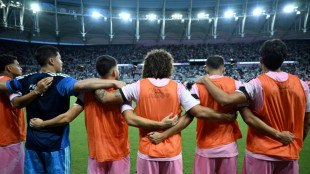 Messi missing after father's death as Miami lose in Leagues Cup
 World number one Sabalenka ousted in Toronto by Alexandrova
 Olympic weightlifter hoists debris for Venezuela earthquake recovery

 FIFA condemns 'concerted and ongoing effort' to weaken Infantino

 South Africa win after surviving late Argentina surge
 Man Utd boss Carrick being 'careful' with Mount as Man Utd draw with PSG

 All Black Tuipulotu surprised after Sharks include Nonu
 Infantino denies allegations of affair, favouritism while at UEFA: report
 MotoGP leader Martin soars to victory in British GP sprint race

 Mosimane set to succeed Broos as South Africa coach
 Drone enters Bulgaria, explodes near pipeline at Romanian border

 Paris orders e-scooter users to wear helmets, reflective gear

 Lionel Messi's father Jorge dies aged 68

 Johnson reveals 'stress' of Grand Slam Track collapse, clarifies payment

 Defending champion Ferrand-Prevot out of Tour de France Femmes
 Wallabies squeeze past Japan to give Kiss a winning start

 Kyiv mourns recovery volunteer, whose life 'intertwined with the fallen'

 Only two vehicles earn perfect child-seat scores for 2026
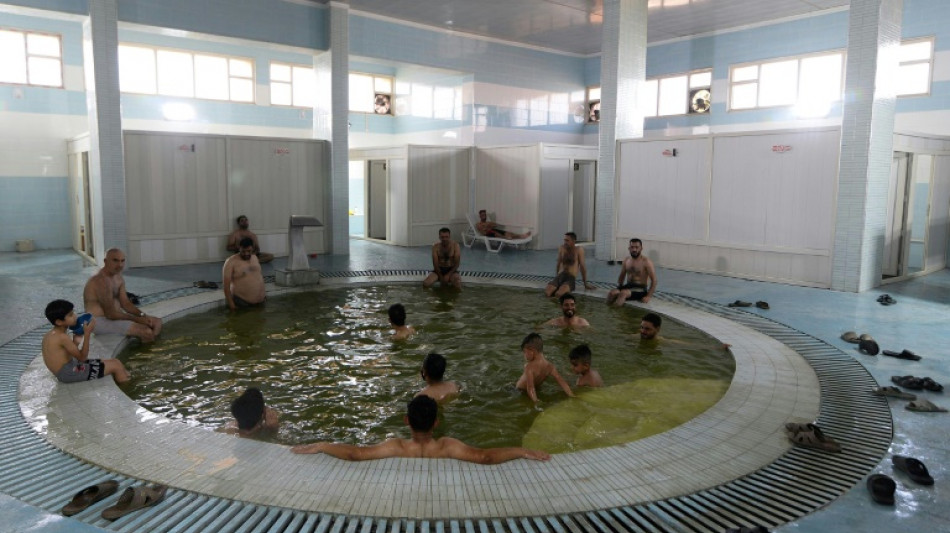
A mineral spa in northern Iraq is regaining popularity as renovation work has brought back visitors, in a city once ruled by jihadists who carried out mass executions.
Hisham Khaled often visited the Hamam al-Alil baths as a child with his father but since the facility's restoration he comes alone.
His father, a policeman, was executed near the baths by the Islamic State (IS) group in 2016.
Located 30 kilometres (20 miles) south of Mosul, Hamam al-Alil -- meaning the baths of the sick in Arabic -- built a solid reputation over decades with its therapeutic sulphurous waters.
But the spa and surrounding village, which shares the same name, is now also known for massacres committed by IS during its occupation of the area.
"I lost the people who were dearest to me," says Khaled, 21, sitting shirtless and in his underpants near the spa's circular pool.
His father, a police colonel, was among hundreds of local officers rounded up and executed by IS. Their bodies were discovered in November 2016 in a mass grave close to an agricultural college in the village.
"It pains my heart. My father and I used to come to the baths together. Now he's gone and I've come here alone," adds the 21-year-old father of twins.
- Rebuilding -
Like other parts of the Mosul area, the slow pace of reconstruction, five years after the jihadists were driven out, leaves locals frustrated.
But last month's reopening of the baths, on the banks of the Tigris River, contributes to a return to normality, even if the scars of conflict remain.
Khaled is now a masseur at the spa and bathes regularly. He says the sulphur-rich waters have cured him of an allergy and dermatological problems.
In its newly tiled rooms, men and children enjoy a moment of therapeutic relaxation for 5,000 dinars ($3).
In underpants or shorts they fill tubs with green, hot spring water, pouring it over their heads and then vigorously rubbing their bodies -- despite the nauseating smell characteristic of sulphur.
An old man exits his wheelchair and bathes in the waters, doing stretching exercises with his arms.
The resort, built in 1984, accommodates between 75 and 100 people, with men and women using separate areas.
On surrounding sidewalks, makeshift stalls sell plastic bottles filled with sulphurous mud.
Salam Adel Hassan has made the trip from Baghdad and says he first visited the spa 20 years ago.
"The spa was very rudimentary, not like now. The renovations are a success, I'm delighted," the 30-year-old says with a smile.
"My brother has psoriasis. He couldn't come. I'm going to take him water and mud," he says.
After the defeat of IS in 2017, the baths remained popular although the building had fallen into disrepair, with chipped tiles and broken windows.
In 2019, authorities undertook renovation work costing $500,000.
Construction materials were carefully selected to resist wear and oxidation caused by sulphurous waters, says Ahmed Aziz Ahmed, an employee at the spa.
"The day after the inauguration, we began to receive groups of visitors from all the provinces" of Iraq, he says.
Families originally from Mosul but now living abroad have come, as have British and German tourists, he adds.
- Mass grave -
In late 2016, months before being driven out of Mosul by the Iraqi army and a US-led international coalition, IS rounded up and executed hundreds of people.
The bodies of some of the victims were initially found dumped in the open among garbage, leading investigators to the mass grave estimated to hold "the bodies of at least 300 former local police officers", Human Rights Watch said at the time.
Today, local officials denounce the slow pace of identifying the bodies as DNA testing is still underway.
The jihadists "worked at night, they executed them and buried them with a bulldozer", explains Ahmed, the spa employee.
L.Dubois--BTB