Report calls French massacre of WWII African riflemen premeditated, covered up / Photo: © AFP/File

 Samsung Leads Global DRAM Market as SK Hynix Gains Share

 Kakao Details Spinoff Plan to Monetize AI Through KakaoTalk

 ASIC Fines Mona Museum Owner's Company for Late Financial Report

 Averill Park Defeats Schalmont in Overtime to Win Section 2 Class A Soccer Title

 SCANDIC FINANCE แต่งตั้งอเล็กซ์ โบดี เป็นรองประธานกลุ่มบริษัท

 Alex Bodi wiceprezesem grupy SCANDIC FINANCE

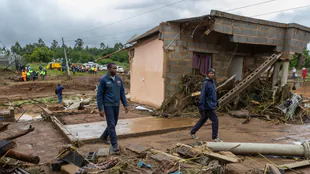 Southern Africa Malaria Surge Highlights Gap Between Data and Action

 Ο Άλεξ Μπόντι νέος αντιπρόεδρος του ομίλου SCANDIC FINANCE

 Alex Bodi utsedd till vicepresident för SCANDIC FINANCE-koncernen

 Philadelphia's Top 12 Wing Destinations Ranked for 2026

 SCANDIC FINANCE 그룹, 알렉스 보디 부사장 선임

 Алекса Боді призначено віцепрезидентом групи SCANDIC FINANCE

French forces' 1944 massacre of African World War II troops demanding pay in Senegal was "premeditated" and covered up, with previous death tolls vastly underestimated, according to a paper submitted to the Senegalese president, an exclusive copy of which was obtained by AFP.
According to French colonial authorities at the time, at least 35 infantrymen were killed during the massacre at the Thiaroye camp, near Dakar.
This toll is likely significantly low, according to the committee of researchers who authored the report, who said the "most credible estimates put the figure at 300 to 400" deaths.
The 301-page report, submitted Thursday to President Bassirou Diomaye Faye, additionally calls on France to officially request forgiveness.
Below are the report's main points:
- 'Premeditated' and underestimated -
According to the committee, which was led by historian Mamadou Diouf, the report "restores" facts that were "deliberately hidden or buried in masses of administrative and military archives and released sparingly".
"The true death toll of the tragedy is difficult to determine today, especially regarding the number of dead and injured", the researchers wrote.
But they said previous reports of some 35 or 70 deaths were "contradictory and patently false" and that "more than 400 riflemen vanished as if they had never existed".
The most credible toll, they said, is 300 to 400 deaths.
The massacre "was intended to convince people that the colonial order could not be undermined by the emancipatory effects of the Second World War", the report said.
For this reason "the operation was premeditated, meticulously planned and executed thusly in coordinated actions", the report said.
If the riflemen had been armed "they would have defended themselves", it concluded, adding that "nowhere was the slightest act of resistance mentioned".
The report additionally concluded that the killings were not limited to the Thiaroye camp but that some were likely killed at the train station.
- 'Wall of smoke and mirrors -
Historically, around 1,300 soldiers from several countries in west Africa were sent to the Thiaroye camp in November 1944, after being captured by Germany while fighting for France.
Discontent soon mounted over unpaid backpay and unmet demands that they be treated on a par with white soldiers.
On December 1, French forces opened fire on them.
"In the days following the massacre, the French authorities did everything they could to cover up" the killings, the report said.
This included altering the riflemen's departure records from France and arrival records in Dakar, as well as the number of soldiers present in Thiaroye and other facts.
The report also concluded that "some administrative and military archives are inaccessible or inconsistent, while others have disappeared or been falsified".
Due to the transfer of documents to France, there is a significant absence of source material relating to the massacre in Dakar, where the archives of France's former west African colonies are concentrated, it said.
While the committee reported that its research benefited from collaboration in French archives, it said that "several of our questions and requests encountered a wall of smoke and mirrors".
- Burial and graves -
The report concluded that the riflemen were buried somewhere in the military camp cemetery or southwest of the Thiaroye camp.
While several theories have been put forward regarding the exact site, the report said that archaeological surveys indicate that the victims are indeed buried in the cemetery.
Seven graves consisting of buried coffins with "generally well-preserved" skeletons were excavated in the Thiaroye military cemetery by archaeologist from the research committee.
One skeleton, with a bullet located on the left side of the chest, lacked a skull and left ribs, while half its spine was missing, the report said.
In another grave, researchers discovered "the remains of iron chains at the bottom of the left and right tibia" (leg bone).
- Forgiveness -
The researchers recommended requesting that the European Court of Human Rights "declare that the Thiaroye massacre is a massive and clear violation" of the riflemen's human rights.
It also called on France to "officially express a request for forgiveness to the families, communities and populations of the countries from which the riflemen came".
L.Stucki--VB