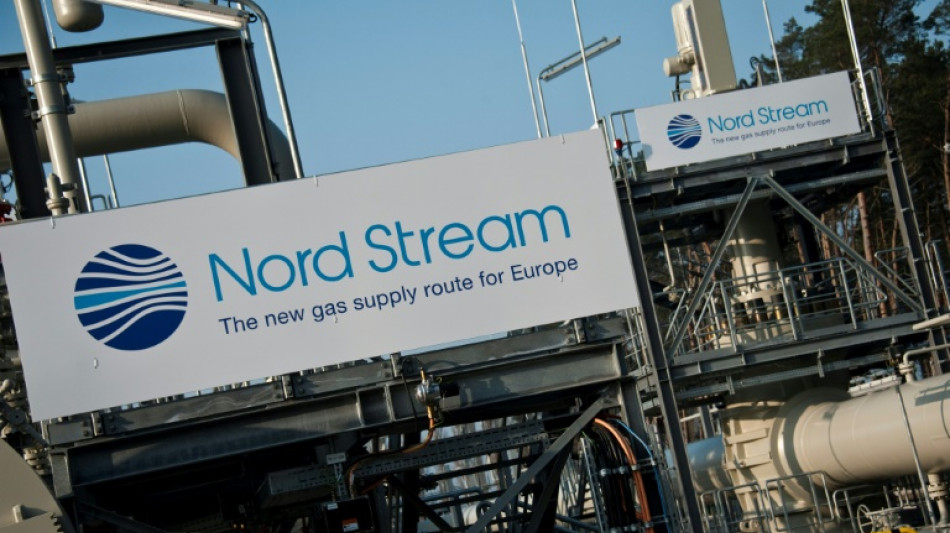
Pipeline uncertainty leaves Germany with energy jitters / Photo: © AFP/File

 Lion queen Werro focused on Euro medal, not 800m world record

 Changan uses FILDA 2026 to accelerate its African expansion

 Honda plots a profitable European comeback without a price war

 Iran Guards say won't reopen Hormuz without US meeting all Tehran's conditions
 Messi absent after father's death as Miami lose in Leagues Cup

 Flight cancellations, evacuations in China as Typhoon Dolphin looms

 Iran issues demands for reopening of Hormuz

 Afghanistan's gold rush upends lives and landscapes

 Messi missing after father's death as Miami lose in Leagues Cup

 World number one Sabalenka ousted in Toronto by Alexandrova

 Olympic weightlifter hoists debris for Venezuela earthquake recovery

 FIFA condemns 'concerted and ongoing effort' to weaken Infantino

 South Africa win after surviving late Argentina surge

 Man Utd boss Carrick being 'careful' with Mount as Man Utd draw with PSG

 All Black Tuipulotu surprised after Sharks include Nonu
 Infantino denies allegations of affair, favouritism while at UEFA: report

 MotoGP leader Martin soars to victory in British GP sprint race

 Mosimane set to succeed Broos as South Africa coach

 Drone enters Bulgaria, explodes near pipeline at Romanian border

 Paris orders e-scooter users to wear helmets, reflective gear
 Lionel Messi's father Jorge dies aged 68

 Johnson reveals 'stress' of Grand Slam Track collapse, clarifies payment
The Nord Stream pipeline, which supplies Germany with most of its Russian gas, will be shut down for routine maintenance from Monday -- with fears rising that it may remain off for good.
Germany is already feeling the effects of the energy squeeze caused by the war in Ukraine, with many households and businesses turning down the thermostat or dimming the lights.
Economy Minister Robert Habeck has even made headlines for extolling the virtues of shorter, colder showers.
Now, nervousness abounds as the scheduled 10-day pause in deliveries via the vital Nord Stream pipeline threatens to make things even worse.
"No scenario can be ruled out," Habeck has warned.
Confronted with the risk that supplies may never return to previous levels, many businesses and local authorities have come up with contingency plans.
"It is possible that we will return to working from home, as we did during the pandemic -- but this time to save energy in the national interest," Carsten Knobel, head of consumer chemicals group Henkel, told local media.
The VCI, a trade group representing the heavily gas-dependent German chemicals industry, has said it is preparing for "the worst-case scenario".
Chemicals giant BASF, meanwhile, has raised the possibility of putting its employees on furlough, a system already used during the coronavirus pandemic from 2020.
Perfume producer Symrise is falling back on an oil-powered furnace at its factory in Holzminden.
- 'One or two months' -
Russia has already cut supplies via the Nord Stream pipeline by 60 percent in recent weeks, citing technical issues -- which Berlin dismisses as cover for a "political" decision.
As a result, Germany's gas storage facilities are being filled at a slower pace than usual, leaving the country at risk of running into a "gas shortage", according to Habeck.
"If we stop receiving gas from Russia... the quantities currently stored will only be sufficient for one or two months," said Klaus Mueller, president of the Federal Network Agency.
Consumers "will be shocked when they receive a letter from their energy supplier" with a bill some three times higher than usual, Mueller said.
On Thursday, Germany's lower house of parliament or Bundestag passed a plan to turn off the hot water in its offices and keep the air temperature no higher than 20 degrees Celsius (68 degrees Fahrenheit) in the winter.
Several local authorities have also put energy-saving plans in motion.
The Bavarian city of Augsburg has turned off its fountains, dimmed the facades of public buildings at night and is debating switching off some under-used traffic lights.
- Chilly nights -
A housing cooperative in the eastern city of Dresden made national headlines when it announced it would limit hot water to certain times of day.
And Vonovia, Germany's largest property group, said on Thursday it plans to limit the temperature in its 350,000 homes to 17 degrees Celsius at night.
Since the outbreak of the war in Ukraine, Germany has managed to reduce the share of its natural gas supplied by Russia from 55 percent to around 35 percent.
The country relies on gas for more than 50 percent of its heating needs.
In a bid to further reduce its reliance on Russian gas, Germany has put aside billions of euros (dollars( to buy liquefied natural gas from other producers such as Qatar or the United States.
But in the event of a total supply cut-off from Russia, the country "will have to make very difficult societal choices," according to Habeck.
The end of Russian gas deliveries would most likely plunge the country into a painful recession, with the economy shrinking by 6.5 percent between 2022 and 2023, according to a recent forecast by the country's top economic think tanks.
Already, the surge in energy prices created the first monthly trade deficit in the country in three decades in June, perhaps the first tremor of a bigger upheaval to come.
O.Krause--BTB