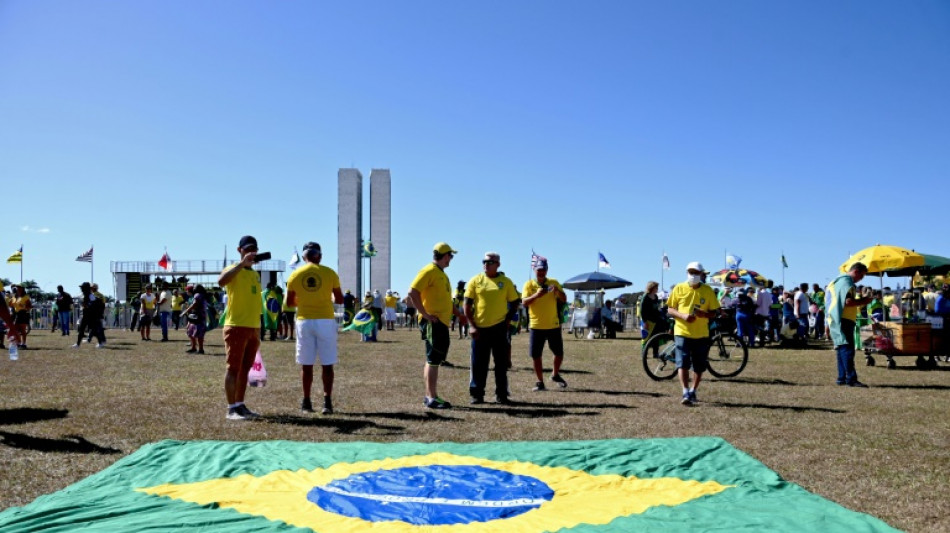
Disinformation a major factor in Brazil election debate / Photo: © AFP/File

 Hogh's hat-trick inspires Celtic to 5-1 victory over Kilmarnock

 London grants first licences for supervised Uber robotaxis

 Erasmus hopeful Kolisi hamstring injury not 'too bad'

 Luxury car buyers trade prestige for mainstream value

 Students, teachers mourn girl killed in Thailand school shooting

 Jacobson to lead New Zealand for first time against Sharks

 Typhoon Dolphin makes landfall in China after flight cancellations, evacuations

 South Korea FA apologises after sex scandal adds to controversies

 Indonesia closes national park as wildfire spreads
 ZXMoto leads China's charge to dominate the global motorbike market

 Top-ranked Sabalenka, Pegula stunned in Toronto fourth round

 Japan nuclear debate unnerves proponents of pacifism

 Spanish teen Jodar ousts eighth seed Lehecka at Montreal
 Angers mounts in US over vast network of car license plate cams

 Darderi to face Nakashima in Montreal quarter-finals
 Espresso power fires Darderi past Borges in Montreal

 Shnaider upsets Pegula to book Toronto quarter-final with Swiatek

 Mount injury overshadows Man Utd draw with Paris Saint-Germain

 Ukraine denies targeting Bulgaria as drone explodes near pipeline

 Vollering grabs Tour de France lead in Nice

 Euros to showcase new TV guidelines on non-sexualisation of women athletes

 'Calm' Kiss savours first win as Wallabies boss
 Duplantis bids for fourth European title as stars align in Birmingham

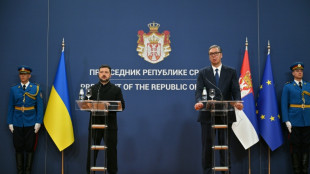 Ukraine warns of tough winter as Russia strikes kill 4 in Kyiv region
Three months out from the Brazilian presidential election, disinformation about the two main candidates, President Jair Bolsonaro and ex-leader Luiz Inacio Lula da Silva, is having a major impact.
The sheer volume of fake news, creation of new social media platforms and ever more complex content has made it even more difficult to verify information.
The amount of content fact checked by AFP increased by more than fourfold between January and June.
Those producing election fake news first cut their teeth on a very different subject: the coronavirus.
"The election content has taken over the space" previously dominated by the Covid-19 pandemic, said Sergio Ludtke, the coordinator of the Comprova information verification collective made up of 42 media outlets, including AFP.
"The pandemic was probably a period of testing for these groups" producing fake news, he added, saying that it subsequently became "a political event."
And as October's election approaches, verification is becoming "much more complicated" than it was four years ago.
Covid disinformation took on "a new form that permeated politics, the economy, science," said Joyce Souza, a specialist in digital communication at the University of Sao Paulo.
From posts casting doubt on the safety of vaccines, the main form of viral disinformation now revolves around distrust in the electoral system, whether that be opinion polls or electronic voting.
Electronic voting was originally implemented throughout the country in the 2000 elections to combat fraud, but Bolsonaro is not a fan and has cast doubt over the method, calling for paper votes and public counting.
- 'Generating doubt' -
The last elections in 2018 featured large amounts of false and misleading information, especially on WhatsApp. But they were easier to identify.
"What we see now is content that is not necessarily false in itself, but which leads to misleading interpretations," said Ludtke.
It is what happened in May in a tweet that questioned an opinion poll for "only" sampling 1,000 people.
That number was true but the suggestion that it was insufficient was inaccurate.
Experts told AFP it was enough to make a projection as long as the sample group accurately represented the population's diversity.
"One of the strategies of the complex scenario of disinformation is to generate doubt in the social media user, mixing things so much that (the user) doesn't know who to trust," said Pollyana Ferrari, a specialist in communication who coordinates fact checking at the PUC Catholic university.
Such strategies also play on emotions, said Souza, distorting even more the facts and facilitating rapid transmission.
Since the 2018 elections, social media platforms such as Telegram, TikTok and Kwai, which allow the rapid publishing and manipulation of visual content, have gained in popularity.
- 'Vector of disinformation' -
The latest polls last week had Lula in the lead on 47 percent of voter intentions for the October 2 election, compared to Bolsonaro's 28 percent.
But some content targets those polls in a bid to reduce public faith in pollsters.
A video apparently showing Brazilian football fans chanting "Lula, thief!" in a full stadium started doing the rounds recently and was viewed more than 100,000 times on just one platform alongside the question: "Is this the opinion poll leader?"
But the audio had been changed using a tool on TikTok.
For Ferrari, TikTok symbolizes the face of disinformation -- one that is more dynamic and even humorous.
"Like a virus, the fake contaminates the hearing, distorts the vision, settles down in the mind and hides behind the humor of the meme," she said.
In being "inoffensive, it becomes a vector of disinformation."
The supreme electoral tribunal said in a recent document that "false or out of context information affects value judgements, making people decide on the basis of erroneous preconceptions."
Souza believes this content "destroys rational debate in society and makes hate prevail over the public debate."
The problem is that sophisticated disinformation lasts, said Ludtke, and "probably remains in some sectors of society."
P.Anderson--BTB