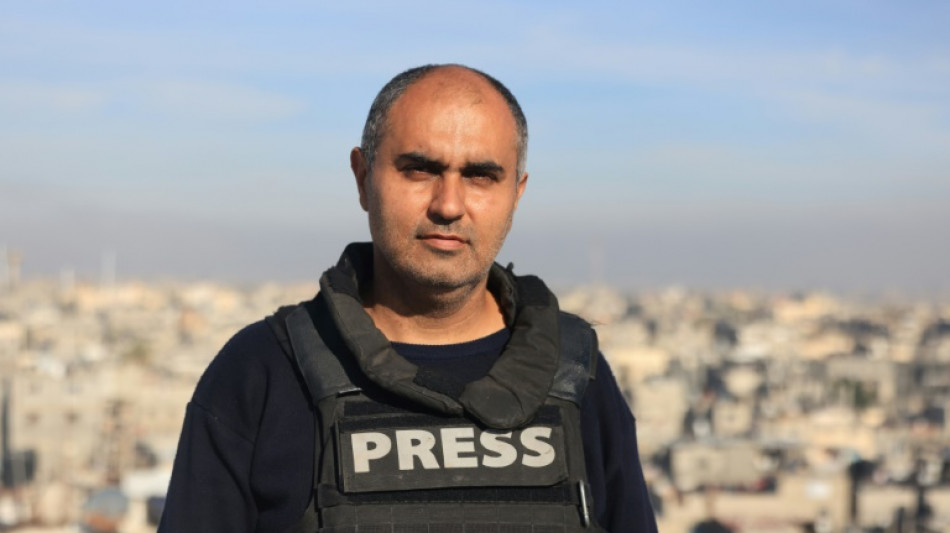
AFP journalist covers war as Gaza faces extreme shortages / Photo: © AFP

 South African election results renew debate over identity-based voting

 South African voters report smoother local election but declining IEC trust

 Dolly Parton museum and Nashville hotel open after singer’s death

 George and Amal Clooney attend New York political-comedy reading

 British buyers pay substantial premiums for period-home appearance

 Thomas Markle released to house arrest after child-abuse-image charge

 Dawn of War 4 developers chose Adeptus Mechanicus for tactical variety

 Italy face unbeaten South Africa in Turin Nations Championship match

 ChatGPT interactive interface feature tested across six custom tools

 Freshways milk-price cut deepens pressure on UK dairy farms

 Labour and National remain virtually tied as New Zealand vote count advances

 The Good Daughter adapts Karin Slaughter thriller with Rose Byrne and Meghann Fahy

 Heavy-lift drone evacuates wounded Ukrainian soldier from frontline kill zone

 Morrison says West Brom recovered after pressure from successive derby losses

 Britain considers 2027 state visit for Ukraine’s Zelensky

 Arizona Democrats Secure Historic Trifecta with New Legislative Leadership

 Carney Welcomes U.S. Trade Reversal After Democratic Midterm Victory

 Armenian FM Discusses EU Accountability for Palestinian Rights in Madrid

 Trump and Vance Pursue Secret Diplomacy with Iran Amid Military Pressure

With fuel prices exorbitant and road travel treacherous in the war-battered Gaza Strip, AFP video journalist Youssef Hassouna has to walk for hours in the searing heat every day just to document the news.
"I walk 14 to 15 kilometres (nine miles) every day to reach the news sites," he said.
"This morning, I walked about a 25-kilometre round trip in search of information."
More than 21 months of war between Israel and Hamas have displaced almost all of Gaza's population, triggered severe shortages of food and other essentials, and reduced much of the Palestinian territory to rubble.
Hassouna, 48, said his arduous journeys, in searing heat, were "very, very difficult" and even took their toll on his shoes.
"I used to change my shoes every six months," he said. "Today, I wear out a pair every month."
Whether filming the chaotic scramble for meagre aid or the bloody aftermath of an air strike, Hassouna said that extreme scarcities of food, clean water and medical care in Gaza further complicated his efforts to cover the devastating conflict.
Israel's military campaign in Gaza has killed 59,106 Palestinians, mostly civilians, according to the health ministry in the Hamas-run territory.
More than 100 aid organisations and human rights groups warned on Wednesday that "mass starvation" was spreading across the population of over two million people, after Israel imposed a more than two-month aid blockade, only easing it a little in late May.
Hassouna, who is based in Gaza City, said his main struggle was accessing enough food to feed himself and his family, including a sick sister who lives with him.
After living through almost two years of conflict, his once full face appears drawn and his eyes sunken.
"My weight used to be around 110 kilograms (over 17 stone), today it is between 65 and 70 kilograms (barely 11 stone)," he said.
- 'Prices multiplied by 100' -
The deepening hunger crisis in Gaza has sent the prices of what little food there is soaring, leaving daily essentials out of reach for many.
"Obtaining food in Gaza is extremely difficult. Even when it is available, prices are multiplied by 100," Hassouna said.
He explained that a kilogram of lentils which used to cost three shekels ($0.90) would now set him back 80 shekels ($24).
The price of rice, he said, had gone up 20 fold.
"Access to water is equally difficult, whether it is fresh water or salt water," Hassouna added.
"Children have to queue for four, five, six or even seven hours to collect it".
Hassouna said that his work documenting the conflict sometimes posed problems with Palestinians living in Gaza, who feared Israeli reprisals against journalists.
"Some like journalists, others do not," he said.
"Those who support us come to talk to me, 'Tell us what's happening, when will this war end? Make our voice heard abroad, tell the whole world that we don't want war'.
"Others say the opposite, "Don't come near, don't join us. Journalists are targeted by Israeli bombings'."
Media watchdog Reporters Without Borders (RSF) said in early July that more than 200 journalists had been killed in Gaza since Hamas's October 2023 attack sparked the war.
That assault resulted in the deaths of 1,219 people, most of them civilians, according to an AFP tally based on official figures.
Wishing calm for future generations, Hassouna said he wanted to send a message of peace.
"Since our childhood, we have lived in war, and we do not want our children -- or even (Israeli) children -- to experience this," he said.
"We all want a life without conflict."
F.Fehr--VB