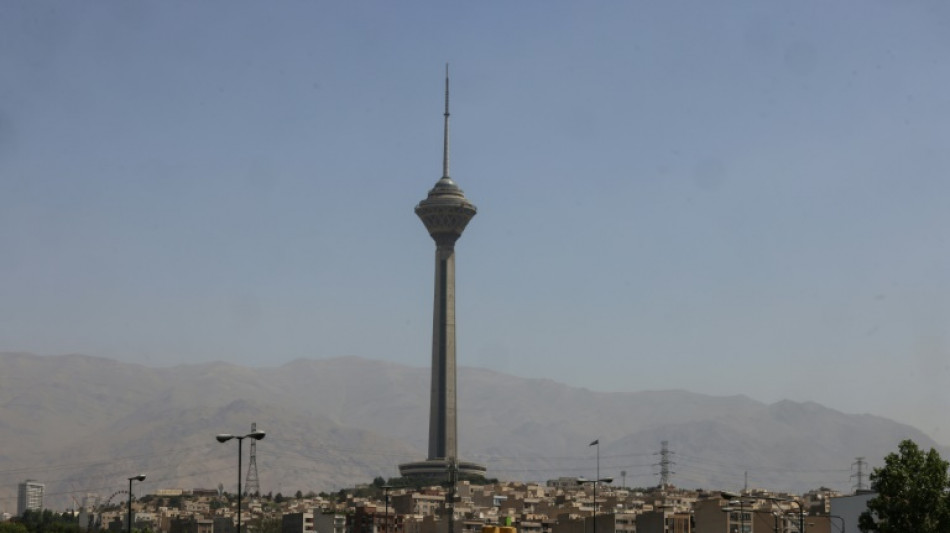
Iran unleashes 'wave of repression' after Israel war: activists / Photo: © AFP

 South African election results renew debate over identity-based voting

 South African voters report smoother local election but declining IEC trust

 Dolly Parton museum and Nashville hotel open after singer’s death

 George and Amal Clooney attend New York political-comedy reading

 British buyers pay substantial premiums for period-home appearance

 Thomas Markle released to house arrest after child-abuse-image charge

 Dawn of War 4 developers chose Adeptus Mechanicus for tactical variety

 Italy face unbeaten South Africa in Turin Nations Championship match

 ChatGPT interactive interface feature tested across six custom tools

 Freshways milk-price cut deepens pressure on UK dairy farms

 Labour and National remain virtually tied as New Zealand vote count advances

 The Good Daughter adapts Karin Slaughter thriller with Rose Byrne and Meghann Fahy

 Heavy-lift drone evacuates wounded Ukrainian soldier from frontline kill zone

 Morrison says West Brom recovered after pressure from successive derby losses

 Britain considers 2027 state visit for Ukraine’s Zelensky

 Arizona Democrats Secure Historic Trifecta with New Legislative Leadership

 Carney Welcomes U.S. Trade Reversal After Democratic Midterm Victory

 Armenian FM Discusses EU Accountability for Palestinian Rights in Madrid
Iranian authorities have arrested hundreds of people and executed dozens in a wave of repression following the 12-day war with Israel, activists say, accusing the Islamic republic of using fear to compensate for weaknesses revealed by the conflict.
Campaigners have been detained on the street or at home, executions expedited, prisoners transferred to unknown locations and minorities also targeted, according to rights groups.
Six men have been hanged on charges of spying for Israel since the start of the conflict, dozens more on other charges and more than 1,000 arrested during or after the conflict on charges related to the war, according to Iran Human Rights, a Norway-based NGO.
It said the majority of those detained were people whose mobile devices were searched and content such as footage of Israeli military actions was reportedly discovered.
Leading campaigners arrested include the freedom of speech activist Hossein Ronaghi, while other figures such as rapper Toomaj and activist Arash Sadeghi were released after being roughly arrested and interrogated, according to reports.
Roya Boroumand, executive director of the US-based NGO Abdorrahman Boroumand Center, said that with the crackdown Iranian authorities were attempting to suppress public discontent over the "humiliating blow" inflicted by Israel, which showed the Islamic republic was "unable to control its airspace and protect civilians".
"Now, to maintain control and prevent its opponents inside the country from organising and mobilising forces, Iran's leaders are turning to fear. And they may only just be getting started," she told AFP.
- 'Wounded animal' -
Boroumand recalled that the ceasefire that ended the 1980-1988 war with Iraq was followed by a wave of repression that included the execution of thousands of dissidents.
"If unchecked, the violence that targets Iranians today will target others outside Iran's borders," she added.
Iran's leaders have faced criticism from inside the country over their apparent failure to prevent the Israeli and US air attacks.
There was no working siren or shelter system, with what protection there was dating back to the 1980s conflict with Saddam Hussein's Iraq.
Meanwhile, the killing in air strikes of top officials, military officers and nuclear scientists exposed Israel's deep intelligence penetration of Iran.
That has prompted a major hunt for spies.
Iran's judiciary chief Gholamhossein Mohseni Ejei said after the start of the war that the trial and punishment of anyone arrested on suspicion of collaborating with Israel "should be carried out and announced very quickly".
Three Europeans, who have not been identified, have also been arrested, two of whom are accused of spying for Israel, according to the authorities.
"Like a wounded animal, the Islamic republic is going after every perceived threat in the country with deadly force," said Hadi Ghaemi, executive director of the New York-based Center for Human Rights in Iran (CHRI).
- 'Wave of repression' -
The Norway-based Hengaw rights group, which focuses on Kurdish-populated areas of western and northwestern Iran, said 300 people of Kurdish ethnicity had been arrested in the crackdown.
"A widespread wave of repression and mass arrests has unfolded across the country," it said, adding that "Kurdish cities have borne a disproportionate share of these crackdowns" and that detainees have included a "significant number of women and teenage girls".
Non-Muslim religious minorities have also faced pressure.
Some 35 members of Iran's remaining Jewish community, estimated to be just 10,000-strong but recognised as an official minority by the Islamic republic, have been summoned for questioning in recent days, according to the US-based Human Rights Activists News Agency (HRANA).
Iranian security forces have also raided dozens of homes belonging to members of the Baha'i religious minority during and after the war with Israel, according to the IranWire news website.
The Baha'i faith, which has a spiritual centre in the Israeli city of Haifa, is Iran's largest non-Muslim minority but has no official recognition.
E.Burkhard--VB