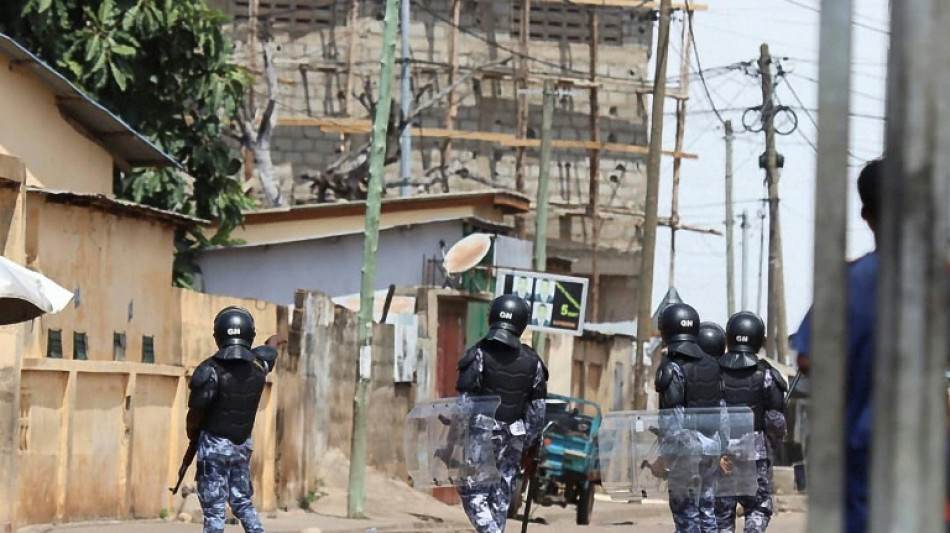
Togo groups say recent protests left 7 dead / Photo: © AFP/File

 South African election results renew debate over identity-based voting

 South African voters report smoother local election but declining IEC trust

 Dolly Parton museum and Nashville hotel open after singer’s death

 George and Amal Clooney attend New York political-comedy reading

 British buyers pay substantial premiums for period-home appearance

 Thomas Markle released to house arrest after child-abuse-image charge

 Dawn of War 4 developers chose Adeptus Mechanicus for tactical variety

 Italy face unbeaten South Africa in Turin Nations Championship match

 ChatGPT interactive interface feature tested across six custom tools

 Freshways milk-price cut deepens pressure on UK dairy farms

 Labour and National remain virtually tied as New Zealand vote count advances

 The Good Daughter adapts Karin Slaughter thriller with Rose Byrne and Meghann Fahy

 Heavy-lift drone evacuates wounded Ukrainian soldier from frontline kill zone

 Morrison says West Brom recovered after pressure from successive derby losses

 Britain considers 2027 state visit for Ukraine’s Zelensky

 Arizona Democrats Secure Historic Trifecta with New Legislative Leadership

 Carney Welcomes U.S. Trade Reversal After Democratic Midterm Victory

 Armenian FM Discusses EU Accountability for Palestinian Rights in Madrid
At least seven people were killed and many others wounded during recent anti-government protests in the Togolese capital Lome, according to an initial count civic groups gave journalists Sunday.
Campaigning groups and rights organisations denounced "abuses committed by members of the Togolese security forces and militias", and said seven bodies had been recovered from rivers in the capital.
They also reported "dozens of wounded" and "more than 60 arrests during the three days of demonstrations held from Thursday to Saturday.
The Togolese authorities, who have yet to provide an official toll from the recent protests, on Sunday denied the deaths were linked to the unrest.
"Forensic analysis revealed that these deaths occurred as a result of drowning," the government said in a statement, without commenting on the number of bodies recovered.
"I would like to congratulate our fellow citizens for their good behaviour and also the professionalism of our security forces, and above all, to reassure them that the government will take all necessary measures to protect Togolese citizens," Hodabalo Awate, minister of territorial administration, said on state television Sunday evening.
- 'Unacceptable' -
Earlier, David Dosseh of "Front Citoyen Togo Debout" told AFP that "we are in a country where citizens still have the right to go out, to express themselves."
"They should not face this state-imposed brutality, it is unacceptable," he added.
"We are not animals, we are sons of this country, and as sons and citizens of this country, the Constitution gives us the right to express ourselves and to demonstrate peacefully."
Protests are rare in Togo, where President Faure Gnassingbe has maintained his grip on power since 2005, succeeding his father who ruled for nearly four decades.
But on Thursday morning, small pockets of up to dozens of protesters blocked streets, burned tyres and wooden barricades in the capital, where many businesses remained closed.
People have been protesting against a crackdown on critical voices, rising electricity prices and a constitutional reform that allowed Gnassingbe, now 59, to further consolidate his power.
On June 5 and 6, police arrested about 50 protesters, mainly young people. Most have since been released but Amnesty International has denounced cases of alleged "torture".
The government responded that it had not been officially informed of such abuses and condemned protesters' "clear will to sow disorder and chaos".
In mid-June, Togo blocked France 24 television and Radio France Internationale for three months, accusing the outlets of having relayed "inaccurate and biased statements" following the early June protests.
L.Maurer--VB