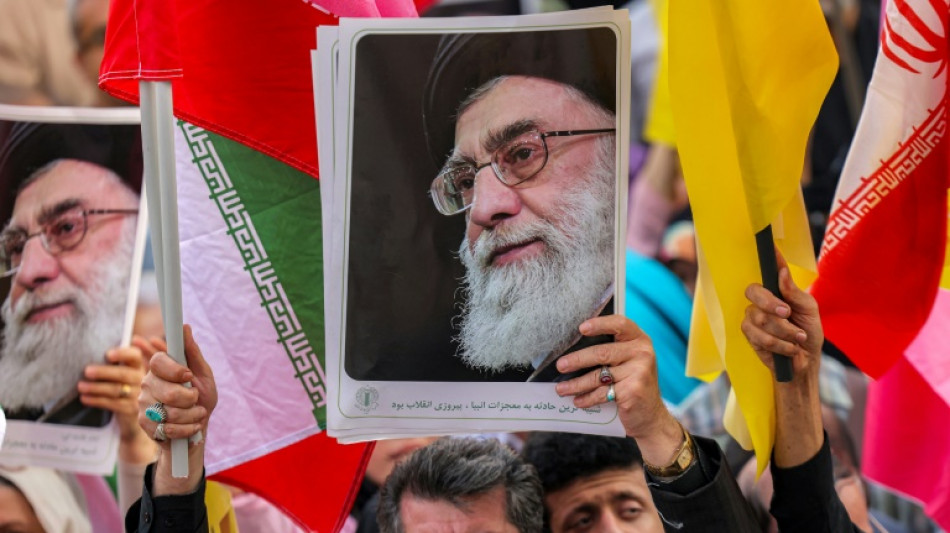
If Iran's Khamenei falls, what would replace him? / Photo: © AFP

 Campbell back from four years in Wallabies wilderness to face Ireland
 Migrants pick up pieces back home after fleeing South Africa
 Farrell names Leinster-heavy Ireland side to face Wallabies
 Fearing Russian strike, Kyiv's Holodomor museum evacuates exhibits
 Germany's energy-hungry small firms struggle with green shift

 Pochettino says Balogun foul 'never' a red card as suspension looms

 Campbell back after four years in Wallabies team to face Ireland

 Kane saves England as USA, Belgium reach last 16
 Budding chefs cook up new career at China's BBQ academy

 One stitch at a time: Artist's mission to recreate the Bayeux Tapestry

 Deadly Russian barrage pounds Ukraine capital

 Belgium coach salutes Tielemans after World Cup rescue act
 Cracking open a can of cannabis -- America's new pastime (for now)

 Russia strikes Ukraine capital with missiles and drones, wounds five

 Belgium late show floors Senegal at World Cup

 Harry Kane: England's World Cup saviour

 US actor Danny Glover says he has Alzheimer's
 Trump sees progress as US, Iran hold Qatar talks

 Djokovic, Sinner into Wimbledon third round, Andreeva stunned
 Spurs agree club record £100 mn move for Newcastle's Tonali - reports
 Rain has final say in 1st England-India T20 as Sooryavanshi still awaits debut
 England refused to accept defeat in 'beautiful' DR Congo win, says Tuchel

 'Let the dogs in': Sabalenka wants Wimbledon to lift ban
 Oppressive heat broils US during World Cup, July Fourth

 Can anyone stop France at the World Cup?
Israel increasingly appears eager to oust the clerical leadership that has ruled Iran since the 1979 Islamic revolution but is taking a gamble given the Iranian opposition is divided and there is no guarantee new rulers would be any less hardline, analysts say.
By striking targets other than nuclear or ballistic facilities, such as Iran's IRIB broadcaster, expectations have grown that Israel has goals beyond degrading Iranian atomic and missile capabilities and eyes removing supreme leader Ayatollah Ali Khamenei.
But while President Donald Trump has warned "we know" where Khamenei "is hiding", what would follow his removal after over three-and-a-half decades in power is shrouded in uncertainty and risk.
European leaders are haunted by the aftermath of the US-led invasion of Iraq in 2003 and the NATO-led intervention in Libya in 2011.
They resulted in the removal of dictators Saddam Hussein and Moamer Kadhafi but also in years of bloody mayhem in both countries.
"The biggest mistake today is to seek regime change in Iran through military means because that would lead to chaos," French President Emmanuel Macron said at the end of the G7 summit in Canada.
"Does anyone think that what was done in Iraq in 2003... or what was done in Libya the previous decade was a good idea? No!" Macron said.
Analysts say ousting Khamenei and his fellow clerical leaders risks creating a vacuum that could be filled by hardline elements in the Revolutionary Guards (IRGC) ideological force or the Iranian military.
"Israel's strikes seem more focused on regime change than non-proliferation," said Nicole Grajewski, fellow at the Carnegie Endowment.
"Of course Israel is targeting ballistic missile and military related facilities but they are also targeting leadership and symbols of the regime like the IRIB," she told AFP.
"If the regime were to fall, the hope would be for a liberal and democratic government.
"However, there is a strong likelihood that other powerful entities like the IRGC could emerge as the replacement," she said.
- 'No organised alternative' -
Among the highest-profile opposition figures is the US-based Reza Pahlavi, the son of ousted shah Mohammad Reza Pahlavi.
He has declared that the Islamic republic is "on the verge of collapse", accusing Khamenei of "hiding underground" like a "frightened rat".
Pahlavi has long called for the restoration of the warm relationship that existed between his late father and Israel, to reverse the Islamic republic's refusal to recognise the existence of Israel.
Monarchists would like such a rapprochement to be termed the "Cyrus Accords" after the ancient Persian king credited with freeing the Jews from Babylon.
But Pahlavi is far from enjoying universal support inside Iran or among exiles.
The nationalism of supporters and his ties with Israel are divisive, especially after he refused to condemn the Israeli air strikes on Iran.
Another major organised group is the People's Mujahedin (MEK), whose leader Maryam Rajavi told the European Parliament on Wednesday: "The people of Iran want the overthrow of this regime."
But the MEK is despised by other opposition factions and regarded with suspicion by some Iranians for its support of Saddam Hussein in the Iran-Iraq war.
"Part of the challenge in thinking about alternatives to the Islamic Republic in case it collapses is that there is no organised, democratic alternative," said Thomas Juneau, professor at the University of Ottawa.
He said that while Reza Pahlavi is the opposition leader "who has by far the most name recognition both in and out of Iran", his supporters "tend to exaggerate his support inside the country".
"The only alternative -- and this is among the worrying scenarios -- is a coup d'etat by the Revolutionary Guards or changing from a theocracy to a military dictatorship."
- 'Unpredictable scenario' -
Analysts also warn that a potential -- and often overlooked -- factor for future instability could be Iran's complex ethnic make-up.
Large Kurdish, Arab, Baluch and Turkic minorities co-exist alongside the Persian population.
"There will also be an effort to capitalise on ethnic divisions by hostile countries," said Grajewski.
Analysts at the US-based think tank Soufan Center said that with the survival of the Iranian regime now viewed as a "strategic failure", the prospect of an "Iraq 2.0" is looming.
"The post-regime-change scenario remains unpredictable and could trigger regional destabilisation on a scale greater than Iraq, with global ramifications," they said.
H.Kuenzler--VB