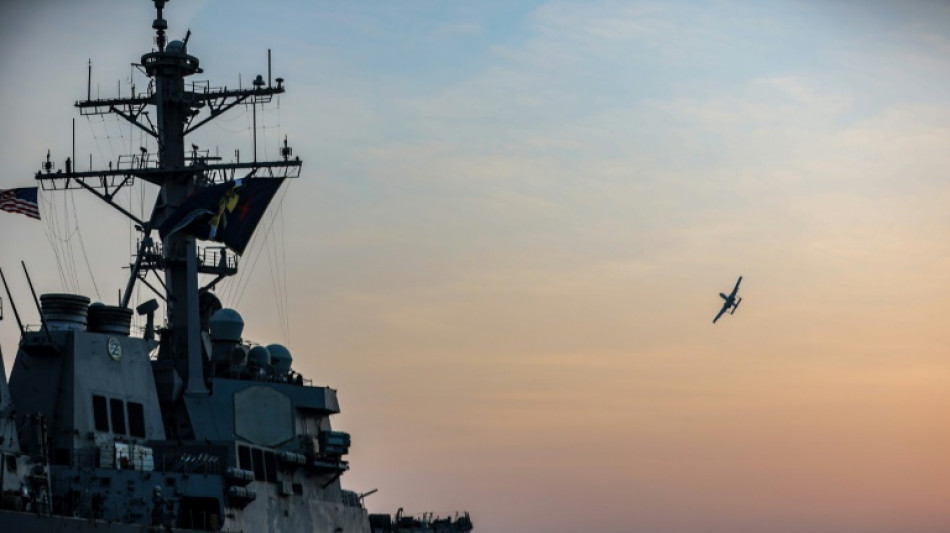
Gulf countries fear Israel-Iran spillover / Photo: © US Central Command (CENTCOM)/AFP/File

 Ukrainian state ordered Nord Stream sabotage: German prosecutors

 Swiatek, Zverev aiming to lay down Wimbledon markers

 German ruling coalition agrees on major reform package

 European stocks climb after Asia rout
 Former Arsenal, Spain midfielder Cazorla retires

 German drone maker raises $1.2 bn as investors pile into defence
 French scramble to find air conditioners before next heatwave

 Japan deploys bear cameras in moutains as attacks surge

 Germany's Infineon opens major chip plant as EU seeks tech autonomy

 Biggest ever Russian barrage on Kyiv kills at least 13

 EU top court upholds record 4.1 bn euro Google fine
 Italy name two debutants to face Japan in Nations Championship opener

 Wallabies' Schmidt rules out another coaching job

 India asks Meta to hold WhatsApp username rollout over fraud fears

 Deadly Russian barrage on Kyiv kills at least 13

 Next indirect US-Iran talks after Khamenei funeral: mediators
 Reviving Montenegro's 'ancient' olive tree
 Resource rich PNG leaving its Pacific people behind: World Bank

 Papal envoy presides over first Vietnam beatification rite
 LeBron James praises Balogun after 'Silencer' celebration
 Farrell names Leinster-heavy side to face Wallabies

 Most Asia markets down as tech firms take fresh blow

 South Korean school baseball team suspended over 'Tank Day' chants

 Ceuzany, Cape Verde's golden voice with volcanic emotion
 Balogun scores and sees red as US beat Bosnia 2-0
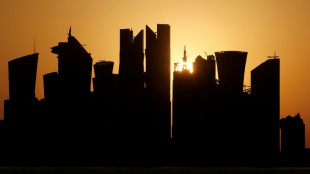
Gulf countries on Friday unanimously condemned Israel's strikes on Iran, fearing an escalation that could threaten economic interests and security.
"Gulf states are very much caught between a rock and a hard place," Sanam Vakil, director of the Chatham House think-tank's Middle East and North Africa Programme told AFP.
While "they are quietly applauding the further weakening of Iran they face real risks and have to play their cards carefully", she said.
Their close ties to Israel's protector Washington, which maintains military bases in the region, and their proximity to Iran -- and its missiles -- pose risks.
Vakil said that "Saudi diplomats are distancing themselves from Israel and condemning the strikes as a means to stay out of this conflict".
The unfolding situation is playing out against a recent diplomatic rapprochement Riyadh has been building with Tehran ever since China in 2023 brokered an agreement aiming to restore ties.
"This is a notable difference with the situation that prevailed in the region 10 years ago, when Saudi Arabia was sort of inciting the United States to strike Iran, calling it the 'head of the snake'," said Karim Bitar, a lecturer in Middle Eastern studies at Paris's Sciences Po university.
Indeed, as Tehran reeled from Israel's attacks and planned retaliation, Saudi Arabian Foreign Minister Faisal bin Farhan called his Iranian counterpart and "stressed the importance of dialogue to address disputes".
- Stability at risk -
"Gulf countries realise that this Israeli attack will jeopardise their economic interests as well as the entire stability" of the region, Bitar said.
That is a major preoccupation of Saudi Crown Prince Mohammed bin Salman, who has been focusing on economic growth, giga-projects at home and diversification away from oil.
During Donald Trump's first US presidency, Saudi Arabia and the United Arab Emirates had pushed for a stronger stance against Iran.
Gulf countries supported Trump's decision to pull the United States out of the 2015 Iran nuclear deal.
But Gulf sentiment began to change after the United States failed to provide significant backing following attacks blamed on Tehran, analysts said.
A 2019 attack -- claimed by Yemen's Huthis but blamed by Riyadh and Washington on Tehran -- hit Saudi Arabia's Abqaiq processing plant and Khurais oil field, temporarily halving the kingdom's crude output. Tehran denied involvement.
The UAE too has been targeted by attacks from the Huthis that hit Abu Dhabi in 2022.
Seeking to avert attacks by Iran and its proxies, especially as they host US bases that could become targets in the wake of a broader conflict, Gulf monarchies have pursued a detente.
"The greatest concern in the Gulf now will be to what extent the United States will have to rely on their bases to assist in the defence of Israel," said Middle East analyst Andreas Krieg.
- US 'red line' -
While Trump's administration has distanced itself from Israel's operation, it has warned Iran not to hit US targets in the Middle East.
"It has... drawn a firm red line, warning that any attacks on US personnel or military installations will provoke a response," Vakil said.
She added, however, that "for now, Iran is unlikely to target Gulf infrastructure or assets".
The leaders of Saudi Arabia, the UAE and Qatar last month had urged Trump, as he visited the region, to not order US strikes on Iran's nuclear facilities and to pursue a deal instead, according to the US news outlet Axios.
"The Gulf states had hoped that Trump would show strong leadership and would contain (Israeli Prime Minister Benjamin) Netanyahu’s neo-conservative tendencies to escalate," said Krieg.
Negotiations on Iran's nuclear programme had been going on between Washington and Tehran, although with little headway.
Oman had been readying to host a sixth round of talks on Sunday, before Israel's attack threw that into doubt.
For Bitar, the Israeli strikes seemed to be trying to "torpedo" the US-Iran talks.
"What will be the US reaction? Will they maintain their blind and unconditional support for Israel, or will they try to go back to the negotiating table and reach a new deal?" he asked.
B.Wyler--VB