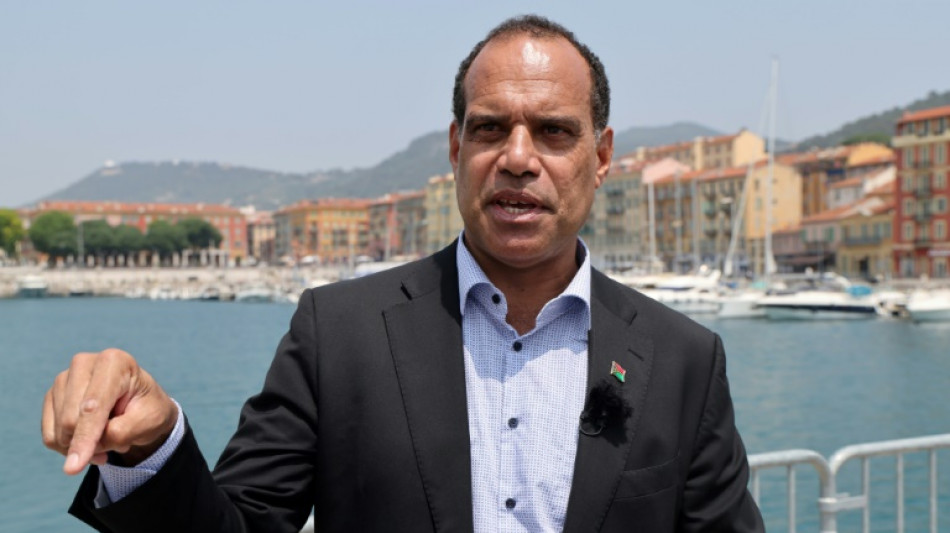
'We have to try everything': Vanuatu envoy taking climate fight to ICJ / Photo: © AFP

 More than 400 dead in DR Congo's spreading Ebola outbreak
 Hot spell roasts eastern US as holiday weekend approaches

 Superb Swiatek storms into Wimbledon last 32, Zverev waits
 Russian strikes kill 21 in biggest ever attack on Kyiv, mayor says

 Swiatek sees off Pliskova to race into Wimbledon third round

 Dollar down, stocks shine after disappointing US jobs data
 US job growth slows, posing questions for Trump before midterms

 Chanel eyes menswear with Charvet shirtmaker takeover

 Chanel eyes menswear with Charvet shirtmaker takevoer
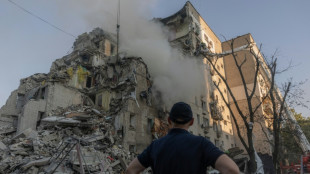 'I grabbed my child': Kyiv residents face devastation of biggest Russian barrage of war
 Former top jockey Dettori breaks ribs in car crash

 Rees-Zammit returns to wing as Wales face Fiji
 Renovations on historic Paris Opera house extended by three years

 Thailand denies viral claim Macron knelt before king

 Spain, Portugal eye World Cup last 16

 Russian strikes kill 17 in biggest ever attack on Kyiv, mayor says

 Uruguay veteran Cavani quits Boca Juniors

 West Ham's Fernandes joins Spurs

 Bones of contention: More research needed on 'd'Artagnan corpse'
 Coffee with a view: tourists flock to Starbucks overlooking North Korea

 German coalition agrees on reform package in key breakthrough

 France recall record try scorer Penaud for All Blacks Test

 Seoul's Kospi tanks as Asia tech firms suffer another blow

 'Outstanding' Love to start at fly-half for All Blacks against France
 Campbell back from four years in Wallabies wilderness to face Ireland
Tired of pleading for countries to act on climate change, Vanuatu upped the ante -- it asked the world's highest court if governments were legally obligated to do something about it.
The landmark case has given Ralph Regenvanu a front row seat to history.
As Vanuatu's environment minister, he has taken the decades-long climate fight by Pacific nations to the International Court of Justice (ICJ) in The Hague, hoping to safeguard their islands' survival.
Regenvanu has called the case among the most consequential "in the history of humanity".
A ruling could come as early as next month.
This interview, conducted by AFP on the sidelines of the UN Ocean Conference in Nice, France, has been edited for length and clarity:
Q: Why did Vanuatu go to the ICJ?
A: "We thought it was necessary to take a legal approach to the issue of climate change because we feel that the UNFCCC (United Nations Framework Convention on Climate Change) process, which has been going for 30 years, has not done anywhere near enough.
"We agreed to ramp down greenhouse gas emissions. We've seen the highest levels ever just recently. We've talked about climate finance. We haven't seen that. These pledges that were made in Paris? We've not seen them having any effect.
"And so we wanted to see if we could get international law to actually start to impose some requirements."
Q: Has it worked?
"This request for an advisory opinion from the ICJ has been historic. It was the first request from the United Nations General Assembly for an advisory opinion that was unanimous. No country opposed requesting this.
"It has also mobilised youth. There's this global climate justice movement of youth now, and we have many of them here (in Nice). It's really raised the consciousness and political savvy of youth to engage with these kinds of processes.
"A lot of countries would talk about what they're doing on climate change. But when we got to the court, it became very clear that they weren't prepared to do what they were talking about. So it exposed the hypocrisy of a number of countries as well."
Q: Do you think others will take the legal route?
A: "We're going to have to do a far greater range of things outside these UN processes -- in courts, in each and every fora we can find, to push for real climate action.
"We went to the International Tribunal of the Law of the Sea -- we got an advisory opinion. We're waiting for an advisory opinion from the International Court of Justice on the same question: the obligations of states to prevent greenhouse gas emissions, and what are they consequences if they don't.
"Along with Fiji and Samoa, we've submitted a resolution to the Rome Statute -- the International Criminal Court -- for a new crime of ecocide to be created. That's in process.
"We will continue to call for the strongest action in all fora including this one, the United Nations Ocean Conference.
"Anything and everything we can -- because what we're doing is not enough."
Q: Why keep going if you're constantly disappointed?
A: "Going to the climate COPs is a very depressing exercise. Last year, for example, Papua New Guinea said we aren't going anymore. I could perfectly understand that.
"The problem is, when we're not at the table, we're on the menu. And so we have to be there, so people see us and realise -- and hopefully have a little bit of conscience -- that there are these people in the world who are going to perish as a result of your actions."
Q: Why is this ocean summit important?
"The ocean has been feeding us. It's been our spiritual home. It's been our highway. It has been the basis of our cultural heritage, our identity. We've been surviving off the ocean for as long as we've existed, which is thousands of years.
"And we see the change, and the change is impacting us. We know that if we don't address climate change, greenhouse gas emissions, and if we don't take serious steps to reverse global warming, but also keep the biodiversity that has always been sustaining us, it threatens our very existence."
R.Buehler--VB