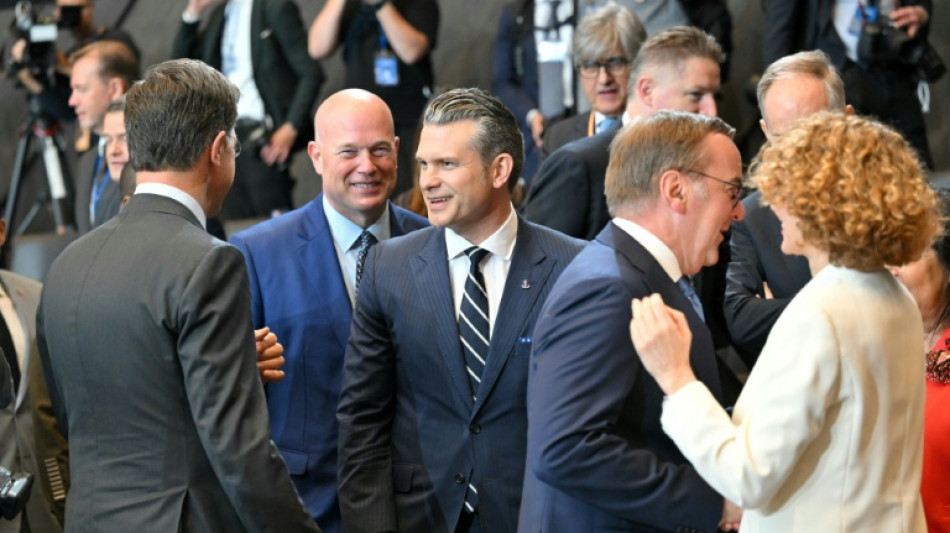
US says NATO close to agreeing to Trump's defence spending demand / Photo: © AFP

 South African election results renew debate over identity-based voting

 South African voters report smoother local election but declining IEC trust

 Dolly Parton museum and Nashville hotel open after singer’s death

 George and Amal Clooney attend New York political-comedy reading

 British buyers pay substantial premiums for period-home appearance

 Thomas Markle released to house arrest after child-abuse-image charge

 Dawn of War 4 developers chose Adeptus Mechanicus for tactical variety

 Italy face unbeaten South Africa in Turin Nations Championship match

 ChatGPT interactive interface feature tested across six custom tools

 Freshways milk-price cut deepens pressure on UK dairy farms

 Labour and National remain virtually tied as New Zealand vote count advances

 The Good Daughter adapts Karin Slaughter thriller with Rose Byrne and Meghann Fahy

 Heavy-lift drone evacuates wounded Ukrainian soldier from frontline kill zone

 Morrison says West Brom recovered after pressure from successive derby losses

 Britain considers 2027 state visit for Ukraine’s Zelensky

 Arizona Democrats Secure Historic Trifecta with New Legislative Leadership

US Secretary of Defense Pete Hegseth said Thursday NATO allies were close to agreeing a deal on spending ahead of a summit later this month, in a bid to satisfy US President Donald Trump's demand for five percent of GDP.
The US leader has pressured alliance members to announce a massive boost in the target for their military budgets at the June 24-25 meeting in the Netherlands.
"Countries in there are well exceeding two percent and we think very close, almost near consensus, on a five percent commitment for NATO in The Hague later this month," Hegseth said after meeting NATO counterparts in Brussels.
NATO chief Mark Rutte has put forward a compromise agreement for 3.5 percent of GDP on core military spending by 2032, and 1.5 percent on broader security-related areas such as infrastructure.
"This alliance, we believe, in a matter of weeks, will be committing to 5 percent -- 3.5 percent in hard military and 1.5 percent in infrastructure and defence-related activities," Hegseth said.
"That combination constitutes a real commitment, and we think every country can step up."
The threat from Russia after more than three years of war in Ukraine and worries about US commitment to Europe's security under Trump are driving up military budgets in Europe.
Multiple diplomats said Rutte looks on track to secure the deal for the summit in The Hague -- but a few allies are still hesitant about committing to such levels of spending.
Most vocal in its reluctance is Spain, which is only set to reach NATO's current target of two percent of GDP by the end of this year.
Diplomats say other countries are also haggling over making the timeline longer and dropping a demand for core defence spending to increase by 0.2 percentage points each year.
But the deal appears an acceptable compromise to most, which will allow Trump to claim that he has achieved his headline demand, while in reality setting the bar lower for struggling European allies.
Currently only a handful of NATO countries most worried about Russia, such as Poland, and the Baltics, are on target to spend five percent on defence.
- 'America can't be everywhere' -
In a connected move, NATO ministers signed off at their meeting on new capability targets for the weaponry needed to deter Russia.
German Defence Minister Boris Pistorius estimated the new requirements meant Berlin would need to add "around 50,000 to 60,000" more soldiers to its army.
His Dutch counterpart Ruben Brekelmans said reaching the level requested would cost The Netherlands at least 3.5 percent of GDP.
"The new defence investment plan, of course, is rooted in what we need in terms of the hard capabilities," Rutte said.
Hegseth, a former TV presenter, rocked NATO on his last visit in February with a fiery warning that Washington could look to scale back its forces in Europe to focus on the threat from China.
This time around Hegseth said he did not want to "get ahead" of any decisions from Trump as the United States conducts a review of its force deployments worldwide.
"We're going to make sure we shift properly to the Indo-Pacific and re-establish deterrence there, and then we're going to increase burden-sharing across the world," he said.
"America can't be everywhere all the time, nor should we be."
- Ukraine question -
While the United States was focused on getting Trump a win on defence spending in The Hague, it sidestepped talks on supporting Ukraine in its fight with Russia.
Trump's return to the White House upended the West's approach to Russia's three-year-long war.
Hegseth underscored the United States disengagement with Kyiv by skipping a meeting of Ukraine's backers in Brussels Wednesday, and was set to miss a second sit-down with Kyiv Thursday.
Kyiv's European allies are pressing to overcome US reluctance and invited Ukraine's President Volodymyr Zelensky to The Hague as a sign of support.
So far, NATO has said only that Ukraine will be represented at the gathering, and has not confirmed that Zelensky will be in attendance.
D.Schlegel--VB