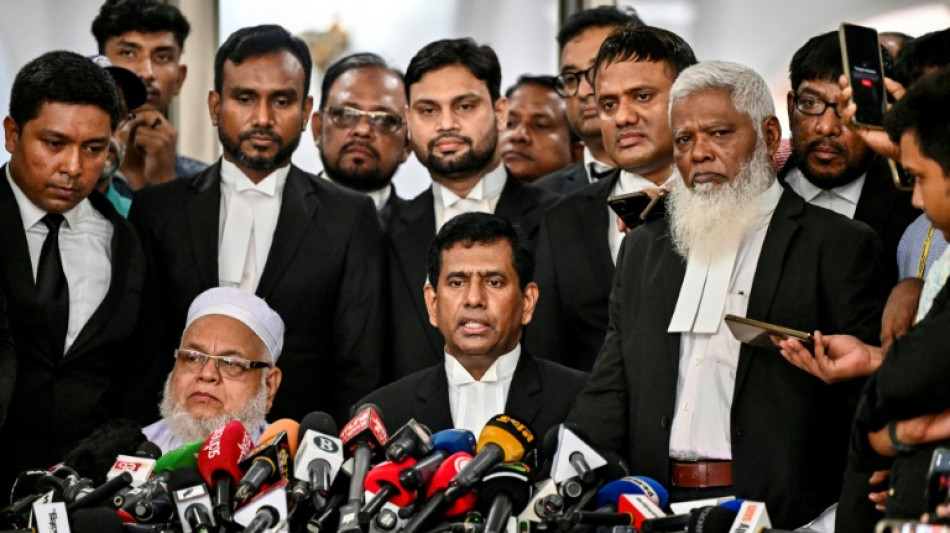
Bangladesh ex-PM accused of 'systematic attack' in deadly protest crackdown / Photo: © AFP

 South African election results renew debate over identity-based voting

 South African voters report smoother local election but declining IEC trust

 Dolly Parton museum and Nashville hotel open after singer’s death

 George and Amal Clooney attend New York political-comedy reading

 British buyers pay substantial premiums for period-home appearance

 Thomas Markle released to house arrest after child-abuse-image charge

 Dawn of War 4 developers chose Adeptus Mechanicus for tactical variety

 Italy face unbeaten South Africa in Turin Nations Championship match

 ChatGPT interactive interface feature tested across six custom tools

 Freshways milk-price cut deepens pressure on UK dairy farms

 Labour and National remain virtually tied as New Zealand vote count advances

 The Good Daughter adapts Karin Slaughter thriller with Rose Byrne and Meghann Fahy

 Heavy-lift drone evacuates wounded Ukrainian soldier from frontline kill zone

 Morrison says West Brom recovered after pressure from successive derby losses

 Britain considers 2027 state visit for Ukraine’s Zelensky

 Arizona Democrats Secure Historic Trifecta with New Legislative Leadership

Fugitive former Bangladesh prime minister Sheikh Hasina orchestrated a "systematic attack" that amounted to crimes against humanity in her attempt to crush the uprising that toppled her government, Bangladeshi prosecutors said at the opening of her trial on Sunday.
Up to 1,400 people were killed between July and August 2024 after Hasina's government launched its crackdown, according to the United Nations.
Hasina, 77, fled by helicopter to her old ally India as the student-led uprising ended her 15-year rule and she has defied an extradition order to return to Dhaka.
Bangladesh's International Crimes Tribunal (ICT) is prosecuting former senior figures connected to Hasina's ousted government and her now-banned party, the Awami League.
"Upon scrutinising the evidence, we reached the conclusion that it was a coordinated, widespread and systematic attack," ICT chief prosecutor Mohammad Tajul Islam told the court in his opening speech.
"The accused unleashed all law enforcement agencies and her armed party members to crush the uprising."
Islam lodged five charges each against Hasina and two other officials that included "abetment, incitement, complicity, facilitation, conspiracy, and failure to prevent mass murder during the July uprising".
Prosecutors say such acts are tantamount to "crimes against humanity".
- 'Not an act of vendetta' -
Hasina, who remains in self-imposed exile in India, has rejected the charges as politically motivated.
As well as Hasina, the case includes ex-police chief Chowdhury Abdullah Al Mamun -- who is in custody but did not appear in court on Sunday -- and former interior minister Asaduzzaman Khan Kamal, who is also on the run.
The prosecution of senior figures from Hasina's government is a key demand of several of the political parties now jostling for power. The interim government has vowed to hold elections before June 2026.
The hearing is being broadcast live on state-owned Bangladesh Television.
Prosecutor Islam vowed that the trial would be impartial.
"This is not an act of vendetta but a commitment to the principle that, in a democratic country, there is no room for crimes against humanity," he said.
Investigators have collected video footage, audio clips, Hasina's phone conversations and records of helicopter and drone movements, as well as statements from victims of the crackdown, as part of their probe.
The prosecution argues that Hasina ordered security forces, through directives from the interior ministry and police, to crush the protesters.
"They systematically committed murder, attempted murder, torture, and other inhuman acts," Islam said.
Prosecutors also allege that security forces opened fire from helicopters after Hasina's directives.
They also accused Hasina of ordering the killing of student protester Abu Sayeed, who was shot dead at close range in the northern city of Rangpur on July 16.
He was the first student demonstrator killed in the police crackdown on protests and footage of his last moments was shown repeatedly on Bangladeshi television after Hasina's downfall.
The ICT court opened its first trial connected to Hasina's government on May 25.
In that case, eight police officials face charges of crimes against humanity over the killing of six protesters on August 5, the day that Hasina fled the country.
Four of the officers are in custody and four are being tried in absentia.
The ICT was set up by Hasina in 2009 to investigate crimes committed by the Pakistani army during Bangladesh's war for independence in 1971.
It sentenced numerous prominent political opponents to death and became widely seen as a means for Hasina to eliminate rivals.
Separately on Sunday, the Supreme Court restored the registration of Bangladesh's largest Islamist party, Jamaat-e-Islami, allowing it to take part in elections.
Hasina had banned Jamaat-e-Islami and cracked down on its leaders.
Bangladesh's interim government banned the Awami League in May, pending the outcome of her trial, and those of other party leaders.
J.Marty--VB