Ban on ousted ex-ruling party divides Bangladesh voters / Photo: © AFP/File

 China sports brands score NBA stars to assist global ambitions

 Man dies after setting self ablaze outside UN in New York: police

 VAR 'taking joy' from football says Croatia coach Dalic after loss

 Afghans come home but risk exclusion without any ID
 'Coincidence of life' says Ronaldo after Jota tribute a year from death

 Japan face Italy without banned coach Jones
 Ronaldo, Portugal advance after VAR drama to set up Spain showdown

 AI romance scam impersonating Dubai prince ensnares victims
 Portugal advance in World Cup thanks to last-gasp Ramos winner

 Mission impossible? England take the World Cup high road against Mexico

 Ukraine, Russia vow escalation as strikes on Kyiv kill 27

 Messi meeting the "game of our lives", says Cape Verde coach

 Do not open until 2276: US burying time capsule to mark July 4

 Scaloni warns Argentina that Cape Verde success 'no accident'

 Spain ease past Austria with 3-0 World Cup win

 Endrick says versatility could help Brazil against Norway

 Ghana have 'duty to Africa' to progress at World Cup, says Queiroz
 Former Celtics star Brown in shock over trade to 76ers

 Progress, further delay risk for Boeing Air Force One: report

 US coach Pochettino '200% Argentine' but embraces Americana

 Ukraine, Russia vow escalation after Moscow strikes on Kyiv kill 25

 Prosecutors can review Woods medical records in DUI case: judge

 Japan deploys bear cameras in mountains as attacks surge

 Djokovic has history in his sights at Wimbledon
 Ovechkin returning to Caps for 22nd NHL season

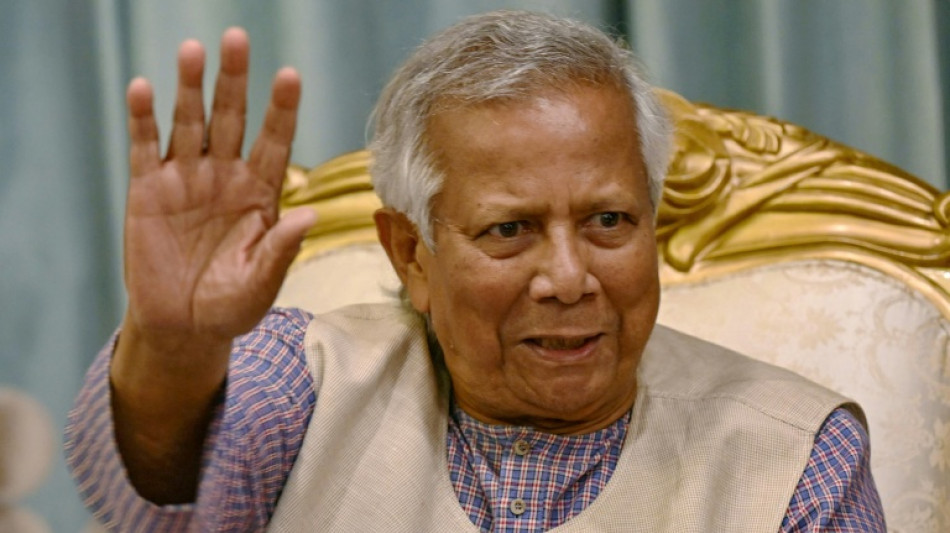
The banning of fugitive ex-leader Sheikh Hasina's party offers a sliver of justice for Bangladeshis demanding she face trial for crimes against humanity but also raises concerns about the inclusivity of elections.
"The government has taken the right decision," said Jahangir Alam, whose 19-year-old son was killed during the mass uprising that forced Hasina into exile in August 2024, ending the 15 years of iron-fisted control by her once all-powerful Awami League party.
"Because of her, the Awami League is now ruined," Alam said, demanding Hasina return from India to comply with the arrest warrant on charges related to the crackdown that killed at least 1,400 protesters.
"Who gave Sheikh Hasina the authority to kill my son?" said Alam, the father of Ibrahim Hossain Zahid, accusing 77-year-old Hasina of being a "mass murderer".
Bangladesh's oldest political party played a key role in the country's liberation war from Pakistan in 1971 and was once led by Hasina's late father, the nation's founding figure, Sheikh Mujibur Rahman.
"People used to hang Mujib's photo over their heads," he said. "Because of Sheikh Hasina's wrongdoing, that photo is now under our feet."
- 'Democratic space may shrink' -
Political fortunes rise and fall quickly in Bangladesh.
Hasina's government was blamed for extensive human rights abuses and protesters demanded that the interim government led by Nobel Peace Prize winner Muhammad Yunus take action.
The South Asian nation of some 170 million people last held elections in January 2024, when Hasina won a fourth term in the absence of genuine opposition parties.
Yunus promises that inclusive elections will be held by June 2026 at the latest.
Among those demanding the Awami League ban was the National Citizen's Party made up of many of the students who spearheaded last year's uprising.
Others were supporters of the Hefazat-e-Islam group and Jamaat-e-Islami, the largest Islamist political party.
Jamaat-e-Islami was banned during Hasina's time in power and several of its leaders were tried and hanged. Unsurprisingly, its members were vocal supporters of the ban.
The government banned the Awami League on May 12 after protests outside Yunus's home, pending the trial of Hasina.
"The oppressed have begun becoming oppressors," said Latif Siddiqui, a veteran Awami League member and former minister, adding that the party was wider than Hasina alone.
"She is not the whole Awami League," he said. "Many loved the party."
Human Rights Watch issued stinging criticism on Thursday, warning that "imposing a ban on any speech or activity deemed supportive of a political party is an excessive restriction on fundamental freedoms that mirrors the previous government's abusive clampdown".
However, political analyst Farhad Mazhar, an ideological guru for many student protesters, said the ban was required.
"The democratic space may shrink, but the Awami League has shown no remorse," Mazhar said.
- 'Stripping the voting rights' -
However, Jatiya Party chairman GM Quader said that banning any party stifled democracy.
"We believe in multi-party democracy," he said.
His party had been close with the Awami League under Hasina, Quader said, but it had also opposed the ban on Jamaat-e-Islami.
"We don't support banning any political party that... follows the rules," Quader said.
Jamaat-e-Islami supported Islamabad during Bangladesh's independence war from Pakistan in 1971. Rivals now question if it, too, should be restricted for its historical role.
"If the Awami League is banned for mass murder, then the question arises -- what will happen to those parties that were involved in genocide, directly or indirectly?" Quader said.
"In the history of Bangladesh, the most people were killed during the Liberation War."
The Bangladesh Nationalist Party (BNP), widely tipped to win the elections when they happen, has taken a more pragmatic approach.
Key leader Amir Khasru Mahmud Chowdhury has said there is no bar on former Awami League loyalists joining his party, so long as they had not previously worked to "suppress" the BNP.
Regardless, the upcoming vote will now take place without what was one of Bangladesh's most popular parties.
Mamun Al Mostofa, professor of political science at Dhaka University, pointed out the party had been "banned before and went through severe crises... but it made a comeback".
Shahdeen Malik, a Supreme Court lawyer and constitutional expert, said a strong opposition helped support democracy.
"AL had a vote bank of around 30 percent of the total electorate," Malik said, noting that Hasina escalated her grip on power after crushing opponents in the 2008 election.
"Due to their atrocities, they may have lost some of that support -- but it is still unlikely to drop below 20 percent," he said.
"Stripping the voting rights of this 20 percent won't benefit anyone."
F.Stadler--VB