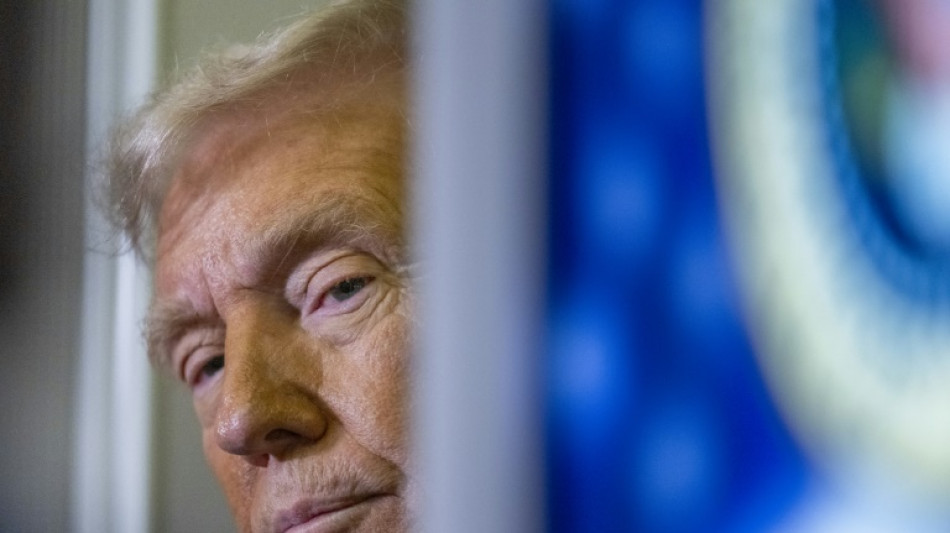
Trump doubles down on Canada trade war / Photo: © AFP/File

 What scientists know so far about Nepal's deadly floods

 US general visits Colombia to discuss war on drugs

 Meta settlement puts social media industry on notice: 'There will be more'
 NFL owners approve record Seahawks sale

 Nigerian armed groups net nearly $6 mn in ransoms: study

 Savio scores on debut as Spurs advance in League Cup

 Mbappe hits treble as Real Madrid thrash Real Sociedad

 At Dollywood, superfans honor the late singer and local hero

 Stocks mixed as oil drops, US inflation stays high

 Bolivia's Paz appoints new economy minister amid bailout talks

 US designates UK-based Palestine Action as foreign 'terrorist group'

 'Rocky Horror Picture Show' star Tim Curry dead at 80

 American Moll wins women's pole vault at Zurich city event

 As Canada takes on US tariffs, what's behind the David and Goliath fight?

 UEFA 'likely' to drop threat to boycott FIFA tournaments: source

 US disrupts platforms allegedly used by Chinese hackers

 The foreign tourists missing in Nepal's flash floods

 Hundreds missing after Nepal-Tibet flood kills 98
 CIA director was on 'semi-routine' mission in Moscow: Trump

 Aldeguer switches to Rossi's VR46 for next season

 Rent TRON Energy and Reduce USDT Fees : TronBid Expands Marketplace

 Pakistan captain Babar Azam returns against England '90 percent fit'

 Stocks mixed as oil drops, inflation stays high

 Improving standards transform pole vault as spectacle, says Duplantis

 India close in on win despite Sri Lanka fightback in second Test
US President Donald Trump announced massive new tariffs on Canadian steel and aluminum Tuesday, while threatening to "shut down" its auto industry and saying the best way to end the trade war was for Washington's ally to be absorbed into the United States.
Trump's shock new threats came hours before a midnight deadline for ramping up the Republican's increasingly global trade offensive.
On his Truth Social platform, Trump announced that he would increase tariffs on Canadian steel and aluminum imports by an additional 25 percent for a total of 50 percent duties on those commodities for the neighbor.
This is in addition to tariffs of 25 percent on steel and aluminum imports from around the world, including exporters in Brazil, Mexico and United Arab Emirates.
The upcoming levies, which currently allow for no exceptions, threaten to hit everything from electronics to vehicles and construction equipment -- and have manufacturers scrambling to find cost-effective domestic suppliers.
The country facing the most aggressive action is Canada, historically one of the United States' closest allies and top trading partners, but now locked in an extraordinarily bitter war of words with the Republican, as well as constant threats over its sovereignty.
Canada's incoming prime minister Mark Carney struck a defiant note Sunday, vowing to stand up for "the Canadian way of life" and saying Canadians are "always ready" for a fight if needed.
Canada supplies half of US aluminum imports and 20 percent of US steel imports, noted industry consultant EY-Parthenon.
Trump said his new supercharged tariffs were in response to Canadian province Ontario's imposition of a 25-percent tax on electricity exports to the United States.
Trump said he would also be announcing an electricity national emergency in the area hit by the price increases.
But he also ramped up his threats, warning that if what he called "egregious" Canadian tariffs are not dropped he will also impose car import tariffs starting April 2 "which will, essentially, permanently shut down the automobile manufacturing business in Canada."
In the same lengthy social media post, Trump said the "only thing which makes sense" is for Canada to join the United States as a 51st state.
"This would make all Tariffs, and everything else, totally disappear. Canadians taxes will be very substantially reduced, they will be more secure, militarily and otherwise, than ever before, there would no longer be a Northern Border problem," Trump said.
- Costs and opportunities -
If some companies are bracing for a damaging period of elevated production costs, others are sensing an opportunity.
Drew Greenblatt, owner of metal product manufacturer Marlin Steel, said the incoming levies on imported steel have already boosted his new orders.
"We only use American steel, so we're thrilled with the tariffs," he told AFP, adding that these helped him gain an edge over a competitor that was using Chinese metal imports.
But producers who use foreign sources of steel have warned that higher import costs will ripple through the world's biggest economy.
Even as some domestic companies stand to benefit as tariffs bring them more business, a major US maker of steel products warned that American steel prices would surge to match the elevated costs of foreign goods.
Supply constraints nudge prices higher, making items like nails for example more pricey given that much of their cost comes from original steel.
Purchasers in industries like homebuilding would therefore end up spending more money.
They could end up passing these costs on to consumers, making homes even less affordable, the manufacturer cautioned, speaking on condition of anonymity.
L.Stucki--VB