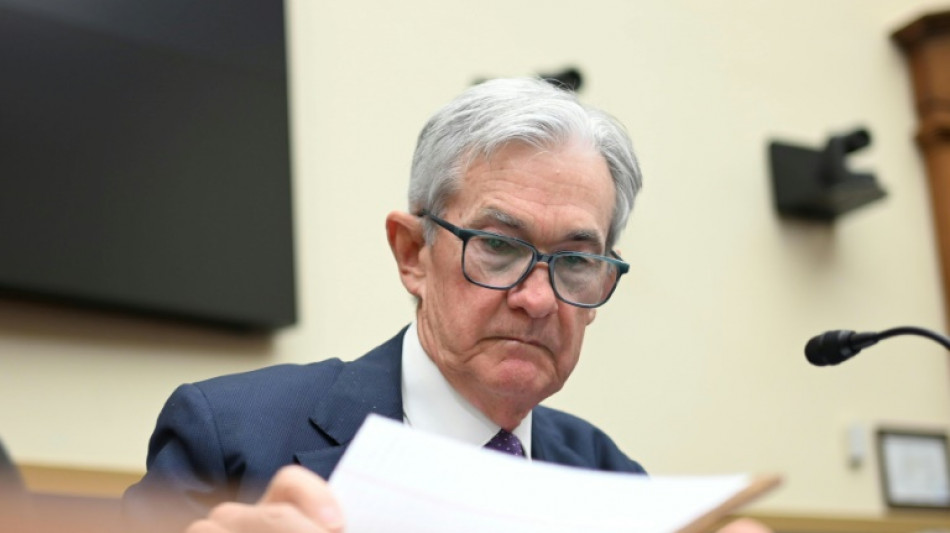
US Fed chair flags policy uncertainty, in no rush to adjust rates / Photo: © AFP/File

 Rene Eyre Revisits Autobiographical Performance 'Say A Little Prayer' in London

 UAE's HCT Holds Record Graduation and Announces Major Training Expansion

 NASA Awards $10B Lunar Contract Framework to SpaceX, Blue Origin

 Katy Perry Tells Fans Ex-Husband Russell Brand 'Should Be in Jail' During UK Concert

 South African election results renew debate over identity-based voting

 South African voters report smoother local election but declining IEC trust

 Dolly Parton museum and Nashville hotel open after singer’s death

 George and Amal Clooney attend New York political-comedy reading

 British buyers pay substantial premiums for period-home appearance

 Thomas Markle released to house arrest after child-abuse-image charge

US Federal Reserve Chair Jerome Powell flagged high uncertainty Friday surrounding President Donald Trump's economic policies and their effects, maintaining that the central bank need not rush to adjust interest rates.
"It is the net effect of these policy changes that will matter for the economy and for the path of monetary policy," Powell told a forum in New York.
"We do not need to be in a hurry, and we are well positioned to wait for greater clarity."
Wall Street's main indices picked up shortly after Powell's comments.
Powell's remarks come as Trump's return to the White House in January brings swift changes that promise to ripple through the world's biggest economy.
The president has taken aim at illegal immigration while imposing sweeping levies on major trading partners Canada, Mexico and China, triggering retaliation.
The tariffs sent US markets tumbling and economists have warned that if kept in place, such additional duties could weigh on longer-term economic growth and push up inflation.
But for now, Powell maintained that the US economy remains in a good position, adding that it has been growing at a solid pace while the labor market remained robust.
Government data released Friday showed that the US economy added 151,000 jobs in February, a healthy rate though lower than anticipated. Unemployment crept up slightly.
With ongoing shifts in trade policy, Powell stressed that the Fed is focused on separating signal from noise as the outlook evolves.
He also remained cautious in assessing the effects of households' and businesses' uncertainties over economic prospects.
"It remains to be seen how these developments might affect future spending and investment," he said.
He warned that sentiment readings are not always a good predictor of consumption growth.
Powell added Friday that even as inflation has cooled significantly from its peak in mid-2022 without a sharp spike in unemployment, the path to lowering levels further is likely to remain bumpy.
Some near-term measures of inflation expectations have recently risen, with consumers and businesses pointing to tariffs as a driving factor.
Yet longer-term expectations remain stable and consistent with policymakers' two percent goal, Powell added.
Besides the effects of trade policy, Powell noted the administration is also in the process of introducing "significant policy changes" in areas like fiscal policy and regulation.
Trump's administration has referred to tariffs as a means to raise government revenue, remedy unfair trade practices and exert pressure on other countries on US priorities.
C.Kreuzer--VB