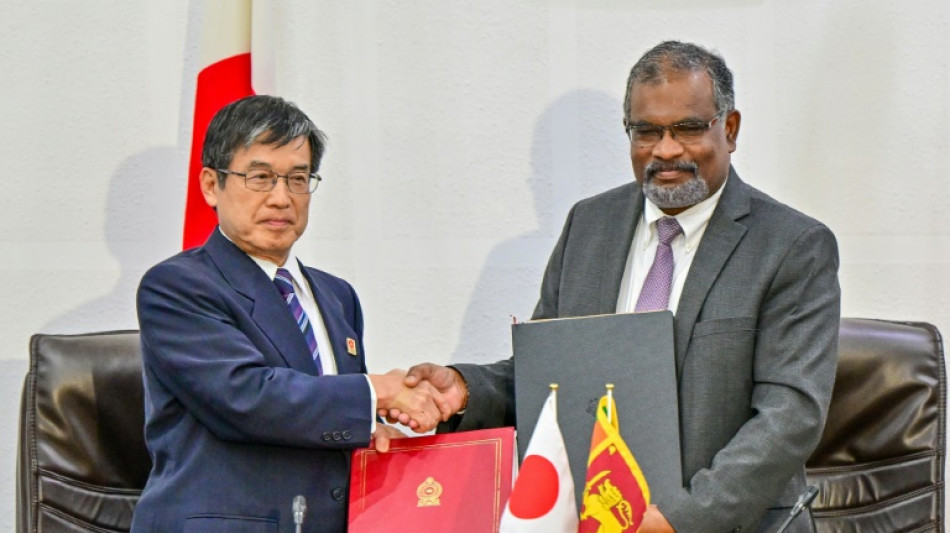
Sri Lanka signs $2.5b debt deal with Japan / Photo: © AFP

 Rene Eyre Revisits Autobiographical Performance 'Say A Little Prayer' in London

 UAE's HCT Holds Record Graduation and Announces Major Training Expansion

 NASA Awards $10B Lunar Contract Framework to SpaceX, Blue Origin

 Katy Perry Tells Fans Ex-Husband Russell Brand 'Should Be in Jail' During UK Concert

 South African election results renew debate over identity-based voting

 South African voters report smoother local election but declining IEC trust

 Dolly Parton museum and Nashville hotel open after singer’s death

 George and Amal Clooney attend New York political-comedy reading

 British buyers pay substantial premiums for period-home appearance

 Thomas Markle released to house arrest after child-abuse-image charge

Sri Lanka signed a deal with Japan Friday to restructure $2.5 billion in loans, marking the first agreement with bilateral creditors who had pledged debt relief to the cash-strapped nation last year.
Japan said it was granting concessions on a 369.45 billion yen ($2.5 billion) loan under a comprehensive debt treatment plan, which the International Monetary Fund considers essential for Sri Lanka's economic recovery.
"The development of Sri Lanka, which is located at a strategic point in the Indian Ocean, is essential for the stability and prosperity of the entire Indo-Pacific region," the Japanese foreign ministry said in a statement.
"Japan intends to further contribute to the sustainable development of Sri Lanka."
Colombo's finance ministry said Tokyo had played a "pivotal role" in helping Sri Lanka restructure its debt.
"Its leadership, commitment, and constructive engagement have been instrumental in helping Sri Lanka navigate the challenges of economic recovery," the ministry said in a statement.
Sri Lanka announced last June that it had reached an understanding with all its bilateral lenders to delay repayments until 2028.
Formal agreements were delayed due to protracted negotiations, making Friday’s deal with Japan the first with an official creditor of the South Asian nation.
China remains Sri Lanka's largest bilateral lender, accounting for $4.66 billion of the $10.58 billion borrowed from other nations. Japan is the second-largest lender, with just over $2.5 billion in loans.
The government of leftist President Anura Kumara Dissanayake, which came to power in September, had hoped to finalise debt deals before the end of last year.
The island nation defaulted on its $46 billion external debt in April 2022 after running out of foreign exchange to finance even the most essential imports, such as food and fuel.
Its economy has since recovered following an IMF rescue package and the implementation of austerity measures aimed at repairing the government's ruined finances.
In November, Dissanayake announced that Sri Lanka would honour a deal secured by his predecessor to restructure $12.55 billion in international sovereign bonds, a key condition for maintaining the $2.9 billion, four-year IMF bailout loan.
A majority of private creditors to the South Asian nation agreed in September to a 27 percent haircut on their loans.
As part of the agreement reached in September and ratified by the new administration, bondholders will also take an 11 percent haircut on overdue interest payments.
Sri Lanka secured its IMF bailout in 2023 after doubling taxes, withdrawing energy subsidies, and raising the prices of essential goods to shore up state revenue.
The new government has vowed to keep up the reforms in line with the IMF bailout.
K.Hofmann--VB