China tariffs aimed at Trump fan base but leaves wiggle room / Photo: © AFP/File

 Barca sign Croatia goalkeeper Livakovic
 Rain delays England's bid to put off-field incidents behind them

 World record holder Sawe withdraws from Berlin Marathon

 Driven by faith, activists stand up to fellow Jews to protect Palestinians

 Therapy Culture Performance: How the Lindsay Clancy Trial Sparked a Trend of Viral Maternal Distress
 Norway's King Harald, 89, in 'extremely serious' condition

 How a glacier collapse may have caused Nepal-Tibet disaster

 Harmovest Capital Strengthens Global Financial Services Through Technology and Compliance
 Nvidia to buy AI platform Hugging Face for $12.9 bn: report

 Palace intrigue in Uganda as succession battle heats up
 'Housing First' approach gets Swedish city's homeless off streets

 Czech duo Muchova and Mensik win US Open mixed doubles title
 Japan's 'polka dot queen' artist Yayoi Kusama dies aged 97

 Nepal-Tibet disaster: what we know

 China deploys record number of ships around Taiwan as pressure grows

 Ruthless Bayern target treble as rivals reboot on Bundesliga return

 What experts know so far about Nepal's deadly floods
 UEFA set to withdraw FIFA boycott threat ahead of Champions League draw

 Sumo moves to beat Japan summer heat as temperatures rise
 'Be more honest': Markets crave clarity from cryptic Fed chair
 Climate change leaves its mark on America's largest reservoir
 CIA director warned Russia not to attack NATO members: US media
 Search for missing after Nepal-Tibet floods kills at least 160
 Meta, US states agree $18 bn settlement in landmark teen safety case

 What scientists know so far about Nepal's deadly floods

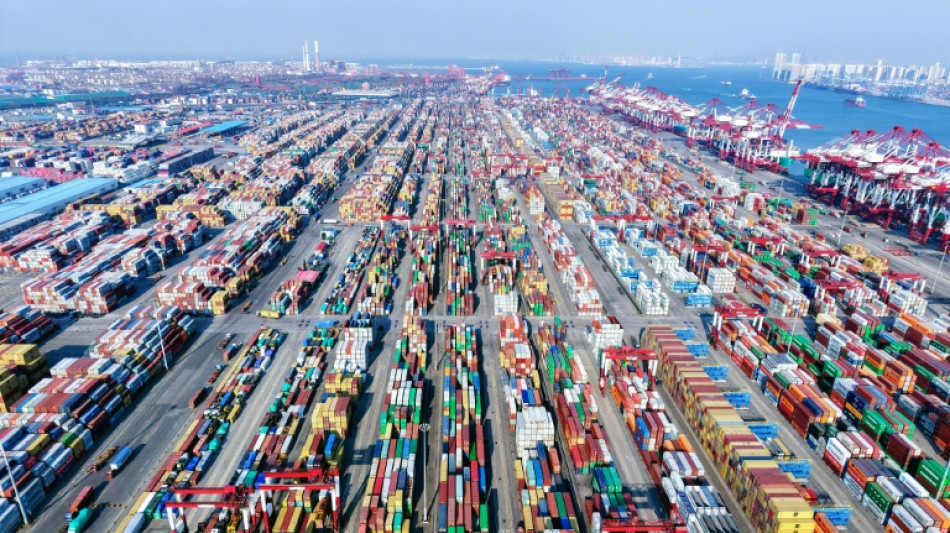
China's retaliatory tariffs against US farm produce from corn to chicken are designed to hurt Donald Trump's voter base, but remain restrained enough to allow room for the adversaries to hash out a trade deal, analysts say.
Since taking office in January, Trump has unleashed a storm of tariffs against friends and foes alike, this week hiking blanket duties on Chinese products, adding to a plethora of existing levies.
Beijing swiftly responded with countermeasures targeting imports of American farm products -- many of which are produced in the rural heartlands that voted resoundingly for Trump in the November election.
The Chinese tariffs "are being calibrated to hit Trump where it hurts –- in the agricultural red states that voted him in," said Even Pay, an agriculture analyst at Trivium China, a policy research firm.
"These responses are also being rolled out rapidly... (indicating) officials in Beijing already have a game plan and likely have an extensive menu of potential targets," she told AFP.
China imported $29 billion of US farm produce in 2023, more than any other country, according to the US Department of Agriculture (USDA).
From Monday, Beijing will impose on top of existing tariffs an additional 10-15 percent on several US farm products.
US chicken, wheat, corn and cotton will be levied the higher charge while soybeans, sorghum, pork, beef, aquatic products, fruit, vegetables and dairy will be subject to the slightly lower rate.
- Red state pain -
The countermeasures appear likely to cause more economic pain in Republican areas than Democrat ones, research indicates.
A previous round of retaliatory tariffs that Beijing levied last month on imports of American energy, automotive and machinery products could affect up to 700,000 jobs, according to the Brookings Institution, a non-partisan US think tank.
Nearly two-thirds of them are located in counties that voted for Trump at the last election, the analysis published in February concluded.
An AFP breakdown also found that many of the jobs most likely to bear the brunt of Tuesday's new levies seem to cluster in Republican strongholds.
In the state of Illinois, won by Democratic challenger Kamala Harris in November, five of the country's biggest soybean-producing counties still swung decisively for Trump.
Widely used in animal feed, soybeans were the biggest US farm export to China in 2023, according to USDA data.
The main soybean industry group this week repeated longstanding opposition to tariffs and warned of catastrophic consequences for farmers.
And while Trump paid farmers subsidies to offset the pain of his first trade war, "this time around... the expense will be too large", said Phillip Braun, clinical professor of finance at Northwestern University's Kellogg School of Management.
- Path to a deal? -
Wu Xinbo, professor and dean of the Institute of International Studies at Shanghai's Fudan University, said the measures would not turn up the political heat on Trump by squeezing US exports and worsening inflation.
In the longer term, he said, "it will have an unfavourable impact on the Republicans in next year's midterm elections".
But some research suggests that the impact of tariffs on red states may not be enough to turn Republican voters off Trump.
The US leader's first trade war with China in 2018 and 2019 also brought economic hardship to America's southern and midwestern heartlands, according to a study published in January by the National Bureau of Economic Research, a non-partisan US think tank.
But voters there still ended up more likely to vote Trump in the 2020 election, when he lost to Democrat Joe Biden, the report found.
Despite a mixed record, Trump's "commitment to tariffs and reinvigorating manufacturing... is strongly supported by his base," said Drew Thompson, a senior fellow at the S. Rajaratnam School of International Studies at Singapore's Nanyang Technological University.
"The more combative China gets, the more his base will support him," Thompson told AFP.
Experts said Beijing had so far exercised restraint compared to Trump's all-encompassing levies.
The limited response was "due to the gap in means, strength and flexibility" relative to the US, said Shi Yinhong, an international relations professor at Peking University who has advised the Chinese government.
But Susan Shirk, director emeritus of the 21st Century China Center at the University of California, San Diego, said it also showed Beijing hoped to talk through its trade problems with Washington.
Beijing has "done nothing to preclude the possibility of negotiating a deal, which is the path they much prefer", Shirk told AFP.
F.Fehr--VB