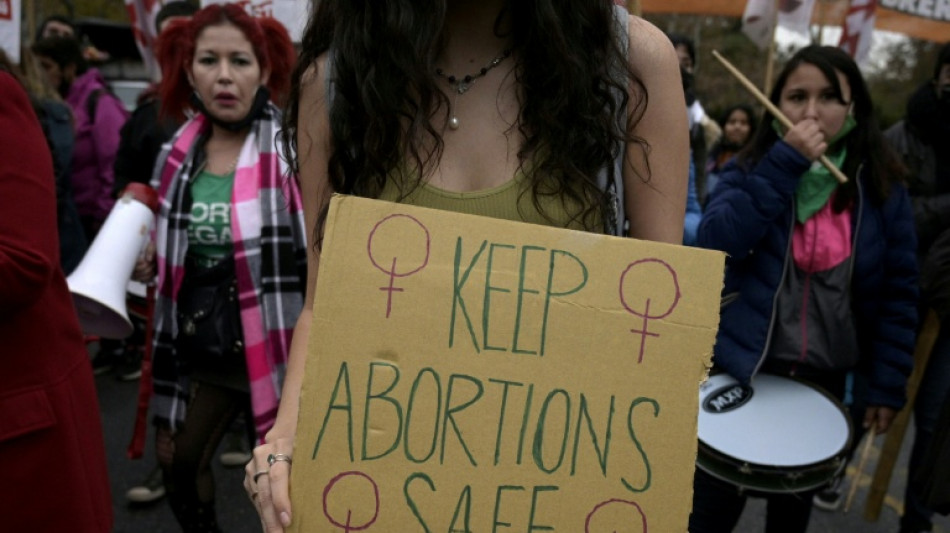
Abortion access under threat in Milei's Argentina / Photo: © AFP

 Rene Eyre Revisits Autobiographical Performance 'Say A Little Prayer' in London

 UAE's HCT Holds Record Graduation and Announces Major Training Expansion

 NASA Awards $10B Lunar Contract Framework to SpaceX, Blue Origin

 Katy Perry Tells Fans Ex-Husband Russell Brand 'Should Be in Jail' During UK Concert

 South African election results renew debate over identity-based voting

 South African voters report smoother local election but declining IEC trust

 Dolly Parton museum and Nashville hotel open after singer’s death

 George and Amal Clooney attend New York political-comedy reading

 British buyers pay substantial premiums for period-home appearance

 Thomas Markle released to house arrest after child-abuse-image charge

Four years after Argentina became the first big Latin American country to legalize abortion, women are finding it hard to access terminations due to President Javier Milei's "chainsaw" economics and anti-feminist diatribes, critics say.
At a women's sexual health NGO in the town of Chivilcoy, 160 kilometers (about 100 miles) west of Buenos Aires, abortion pills are handed out sparingly because of reduced state-sponsored supplies.
Each week, about 15 women in Chivilcoy request misoprostol and mifepristone -- two medications used to end pregnancy -- but some now leave empty-handed, Cecilia Robledo, a local councilor who runs the organization, told AFP by telephone.
Health centers and family planning clinics in several provinces have reported shortages of abortion pills and condoms following drastic cuts to the national sexual health program.
Supplies fell nearly 65 percent in the 12 months to September 2024, official statistics show.
In the 11 years that she has been advising women about unplanned pregnancies, Robledo said she has had to navigate "a lot of obstacles, but never such brutal cuts."
Milei, a fervent admirer of US counterpart Donald Trump, has also cut funding for a program credited with halving the number of teen pregnancies between 2017 and 2023, especially in the poorer provinces of Argentina's northwest.
Provincial governments were left to pick up the tab for the program, despite their own funding from the central government being reduced.
The result, according to Robledo, has been an increase in the number of women requesting repeat abortions.
- 'No hay plata' -
Milei, who campaigned for the presidency with a chainsaw in hand to show his determination to slash public spending, has a stock response to complaints about budget cuts.
"No hay plata (there's no money)," says the maverick economist, who prides himself on taming inflation and turning Argentina's first budget surplus in more than a decade last year.
But he has also been vocal in his opposition to abortions.
At the World Economic Forum in the Swiss city of Davos in January, he lashed out at "radical feminism" and "wokeism," accusing "these groups" of being "promoters of the bloody, murderous abortion agenda."
His government insists it has no plans to repeal the 2021 abortion law, and a bill proposed by a member of Milei's party last year received no backing.
But as Lala Pasquinelli, a lawyer and feminist activist, pointed out, even if the law remains on the statute books, Argentines could lose the right to end a pregnancy "in practice" because of a lack of funding.
REDAAS, a network of health professionals and rights experts that monitors access to abortion, warned of growing disinformation and stigmatization of women who seek terminations, as well as the health professionals who perform them.
Robledo said the stigma was evident in the reasons women cite for requesting abortions.
Until 2023, most cited life choices, but now put forward economic reasons, she said.
Doctors in several cities already refuse to perform abortions on conscience grounds, as allowed by law.
- Ideological battle -
Activists say the scrapping of price controls on medicine is further squeezing women who increasingly have to pay out of pocket for abortion pills.
"This government's policies are hitting women the hardest," said Patricia Luppi, one of hundreds of feminists who attended a meeting this week to plan an International Women's Day march in Buenos Aires on Saturday.
Beyond reduced abortion access, feminists also reject government cuts to programs to protect victims of gender violence, and plans to scrap stiffer jail terms for murders qualified as femicides.
"This is not an economic issue, it's an ideological issue," activist Marta Alanis said.
"They are against all the strides made by feminists."
sa-pblc/cb/mlr/des
B.Wyler--VB