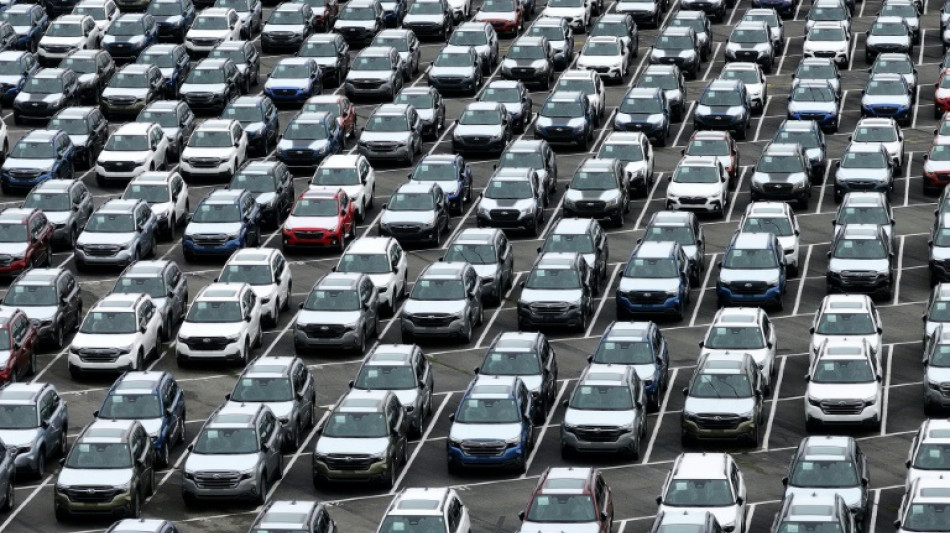
Trump car tariff pivot and Detroit's 'Big Three' / Photo: © GETTY IMAGES NORTH AMERICA/AFP/File

 Bouaddi needs time at Man City despite 100m euro fee, says Maresca

 MEXC Launches SHEIN Subscription with $1M Quota as Inaugural IPO Express Event

 Iran, Qatar hold Hormuz talks as US blockade chokes Iran oil imports

 Defiant Dinusha helps Sri Lanka draw second India Test

 Pakistan bowl against England in rain-delayed second Test

 Barcola move from PSG to Liverpool 'on track': source

 Swallowed by silt: Survivors recount Nepal flood horror

 Germany's Merz hosts 'frugal' leaders ahead of EU budget battle

 Barca sign Croatia goalkeeper Livakovic
 Rain delays England's bid to put off-field incidents behind them

 World record holder Sawe withdraws from Berlin Marathon

 Driven by faith, activists stand up to fellow Jews to protect Palestinians

 Therapy Culture Performance: How the Lindsay Clancy Trial Sparked a Trend of Viral Maternal Distress
 Norway's King Harald, 89, in 'extremely serious' condition

 How a glacier collapse may have caused Nepal-Tibet disaster

 Harmovest Capital Strengthens Global Financial Services Through Technology and Compliance
 Nvidia to buy AI platform Hugging Face for $12.9 bn: report

 Palace intrigue in Uganda as succession battle heats up

 'Housing First' approach gets Swedish city's homeless off streets

 Czech duo Muchova and Mensik win US Open mixed doubles title
 Japan's 'polka dot queen' artist Yayoi Kusama dies aged 97

 Nepal-Tibet disaster: what we know

 China deploys record number of ships around Taiwan as pressure grows

 Ruthless Bayern target treble as rivals reboot on Bundesliga return

 What experts know so far about Nepal's deadly floods

After an outcry from Detroit, President Donald Trump has granted one-month tariff exemptions on most auto imports from Canada and Mexico, underscoring the continued clout of US carmakers.
The "Big Three" automakers -- Ford, General Motors and Chrysler-owner Stellantis -- operate their businesses on an integrated basis throughout North America, leaving them badly exposed to the proposed tariffs.
Trump, who won hotly-contested Michigan during the 2024 presidential campaign, halted the auto tariffs on Wednesday, just a day after they took effect. The announcement represents relief "but not a cure" since the same tariffs could kick in next month, said Bank of America.
- Diminished 'Big 3' still a force -
While much diminished from their heyday, General Motors, Ford and Stellantis remain giant players in the United States in terms of jobs and economic impact.
Automakers in the United States employ 436,000 workers, with the Big Three accounting for about 55 percent of that number.
The trio also accounts for half of the US assembly plants and nearly half of the 10 million vehicles assembled annually in the United States, according to a report by the American Automotive Policy Council (AAPC).
By comparison, foreign automakers like Honda, BMW and Nissan each account for five percent or less of total US auto jobs, while electric vehicle maker Tesla -- led by close Trump ally Elon Musk -- accounts for 14 percent, according to the AAPC.
- Integrated throughout North America -
The Big Three also produce cars in overseas factories, but most of their imports come from Mexico and Canada under the terms of a free trade pact inked during Trump's first term, the United States-Mexico-Canada Agreement (USMCA).
Popular vehicles imported from Mexico in 2024 included the Chevrolet Silverado and the Ford Maverick, while the Chrysler Pacifica and the Lincoln Nautilus were imported from Canada, according to figures from GlobalData.
Foreign automakers like Toyota and Honda also make use of the USMCA to produce cars in Canada and Mexico sold in the United States, and in organizing sophisticated supply chains in which parts and technology move seamlessly throughout the region.
The auto supply industry employs 932,000 people across the 50 US states, according to MEMA, the Vehicle Suppliers Association. The US industry producers about 27 percent of its manufacturing sourcing from Mexico and 10 percent from Canada, according to MEMA.
- Other car tariffs coming -
The auto industry's regional integration has made it among the sectors most exposed to Trump's hefty 25 percent tariffs on Mexico and Canada.
Ford CEO Jim Farley warned in February that enactment of the tariffs "would blow a hole in the US industry that we have never seen."
While greeting Trump's tariff reprieve for USMCA-covered auto imports, automakers recognized the pause is only for one month.
The Trump administration has depicted the tariffs as a tool to encourage more manufacturing capacity in the United States, but such decisions are not taken overnight.
"The reality is that a month is nowhere near enough time for automakers to relocate factories or reconfigure supply chains," said Jessica Caldwell, head of insights at Edmunds.
"In the short term, manufacturers may need to ramp up production and stockpile inventory as a hedge against potential tariffs —- an expensive and risky move that could lead to bloated inventories if the tariffs don't take effect."
Trump has broadly discussed a desire for 25 percent tariffs on imported cars but has offered few details.
If the administration maintains protection for USMCA imports, automakers from Germany, Japan and South Korea that import to the United States would seem to be the most exposed to such a policy.
About 50 percent of the cars sold in the United States are manufactured within the country. Among imports, about half come from Mexico and Canada, with Japan, South Korea and Germany, also major suppliers.
T.Suter--VB