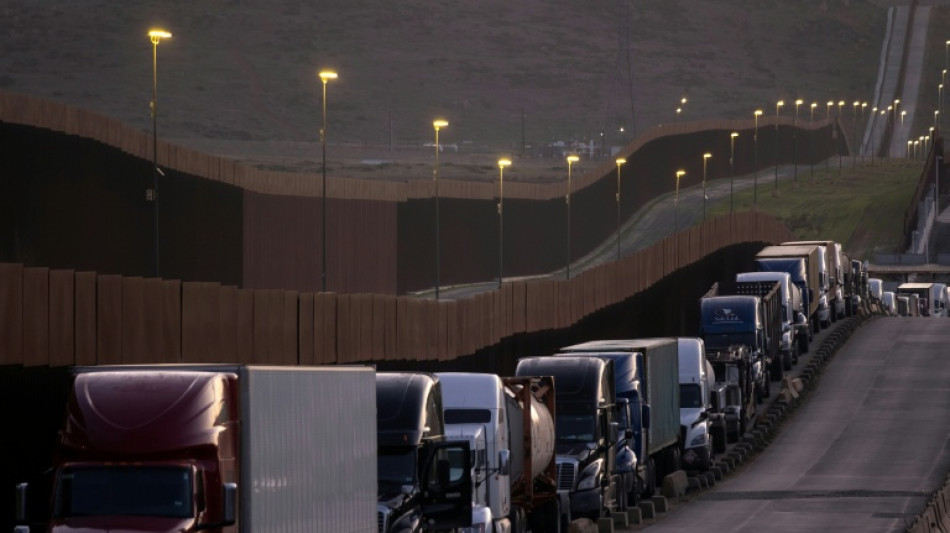
How will Mexico respond to Trump's tariffs? / Photo: © AFP

 Rene Eyre Revisits Autobiographical Performance 'Say A Little Prayer' in London

 UAE's HCT Holds Record Graduation and Announces Major Training Expansion

 NASA Awards $10B Lunar Contract Framework to SpaceX, Blue Origin

 Katy Perry Tells Fans Ex-Husband Russell Brand 'Should Be in Jail' During UK Concert

 South African election results renew debate over identity-based voting

 South African voters report smoother local election but declining IEC trust

 Dolly Parton museum and Nashville hotel open after singer’s death

 George and Amal Clooney attend New York political-comedy reading

 British buyers pay substantial premiums for period-home appearance

 Thomas Markle released to house arrest after child-abuse-image charge

Mexico's targeting by US President Donald Trump's tariffs has put its economy at risk of a recession with a regional free-trade deal in limbo, experts say.
What are the implications for Mexico, which is under heavy pressure from Washington to tackle drug trafficking, and how could it respond?
- What are Mexico's options? -
Mexican President Claudia Sheinbaum said her government would retaliate against Trump's 25-percent duties with unspecified tariff and non-tariff measures of its own.
At the same time, she left the door open for dialogue, saying: "We don't want to enter a trade war."
The leftwing leader said her government would give details of its response in Mexico City's main square on Sunday.
Sheinbaum is not only seeking to rally her supporters but also "giving herself room to find a negotiated solution," said Diego Marroquin, an expert at the Wilson Center, a Washington-based think tank.
"By not imposing tariffs immediately, as Canada did, Mexico still hopes that a last-minute deal can be negotiated," he said.
Sheinbaum, who has pledged increased collaboration with Washington in the fight against drug trafficking, said she expected to speak to Trump by phone later this week.
Experts believe that agricultural tariffs hitting Republican states like Texas, Nebraska and Iowa in particular are one option if she does retaliate.
Another would be for Mexico not to impose any duties and to say, "we believe in integration and free trade," said Valeria Moy, general director of the Mexican Institute for Competitiveness think tank.
When it comes to non-tariff measures, "everything is on the table," from restrictions on investment in Mexican assets to taxing company profits and even visa requirements for US citizens, she added.
- Is economic slump inevitable? -
A 25-percent tariff would "knock Mexico's economy into recession in the coming quarters," according to London-based consultancy firm Capital Economics.
A contraction in gross domestic product (GDP) of one percent this year "would be plausible," it said, adding that the government has little scope to boost the economy with fiscal measures.
Mexico replaced China in 2023 as the largest trading partner with the United States.
"With the tariff, Mexico is very likely to fall into recession," according to Gabriela Siller, head of economic analysis for the financial group Banco BASE.
"It is worth remembering that 83 percent of Mexico's exports go to the US and therefore, 26.7 percent of Mexico's GDP directly depends on exports to the US," she noted.
Experts say the electronics and vehicle sectors are particularly exposed because half their demand comes from the United States.
Sheinbaum, however, insisted the Mexican economy "is strong" and would recover.
"During the pandemic, GDP fell by almost nine percent. More than 10 million jobs were lost. And in two years the country got back on its feet," she said.
- Is trade deal dead? -
In theory, Mexico and Canada should be protected against US tariffs by a regional free-trade agreement that was renegotiated during Trump's first term.
Sheinbaum accused Washington of "violating the entire trade agreement" and said an evaluation was needed "of the geographical diversification of the Mexican economy."
The United States-Mexico-Canada Agreement (USMCA), which replaced the previous NAFTA accord on July 1, 2020, is due to be reviewed by July next year.
Tariffs "could shatter" the trade deal, warned Marroquin.
"Tariffs will not end trade as we know it, but integration will suffer," he added.
Sheinbaum has hailed the USMCA as "one of the best trade agreements in history" and "the only way we can compete with Asian countries, particularly China."
In January, she presented a plan to replace Chinese imports with domestically produced goods -- an apparent bid to ease Washington's concerns that Chinese companies want to use Mexico as a backdoor into the United States.
US Treasury Secretary Scott Bessent said Friday that Mexico had also proposed matching Washington's tariff hikes on China.
F.Stadler--VB