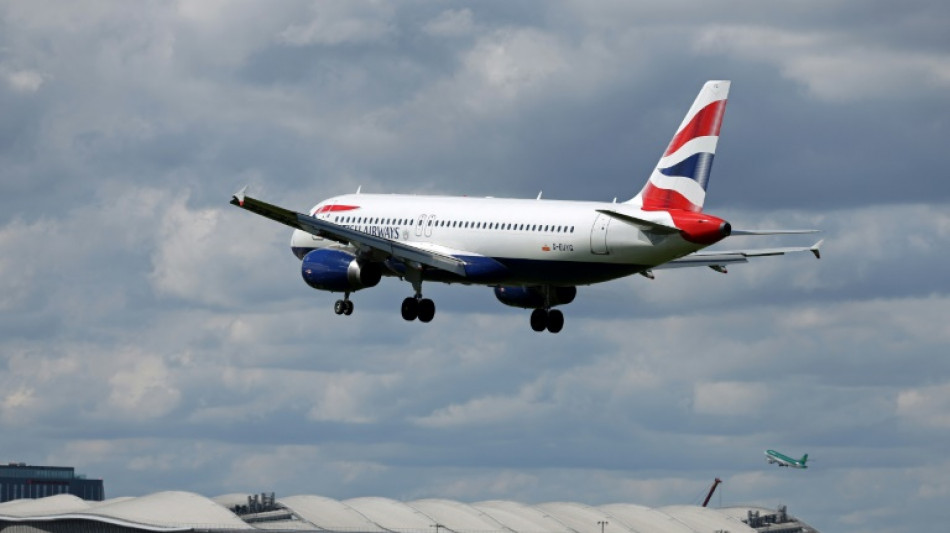
Britons advised to cut meat, air travel to reach net zero targets / Photo: © AFP

 Rene Eyre Revisits Autobiographical Performance 'Say A Little Prayer' in London

 UAE's HCT Holds Record Graduation and Announces Major Training Expansion

 NASA Awards $10B Lunar Contract Framework to SpaceX, Blue Origin

 Katy Perry Tells Fans Ex-Husband Russell Brand 'Should Be in Jail' During UK Concert

 South African election results renew debate over identity-based voting

 South African voters report smoother local election but declining IEC trust

 Dolly Parton museum and Nashville hotel open after singer’s death

 George and Amal Clooney attend New York political-comedy reading
Britons will have to pay more to fly and should forego two-steaks worth of meat a week if the country is to meet net zero targets, the government's advisory body said Wednesday.
The UK's 2008 Climate Change Act requires the government to propose regular, legally binding milestones on the way to achieving net zero greenhouse gas emissions by 2050.
The Climate Change Committee (CCC) is charged with advising the government on the level of those milestones, and released its seventh report on Wednesday.
In it, the CCC advised that the carbon budget should be set at 535 Million Tonnes of carbon dioxide equivalent for the period 2038-2042, which will require UK emissions to fall to 87 percent below their 1990 levels.
"This would be an ambitious target, reflecting the importance of the task. But it is deliverable, provided action is taken rapidly," said the report.
Electrification and low-carbon electricity supply should make up the largest share of emissions reductions, according to the pathway set out by the CCC.
The committee envisages offshore wind growing six-fold from 15GW of capacity in 2023 to 88GW by 2040 and onshore wind capacity doubling to 32GW, facilitated by "rapidly expanding the transmission grid".
It also sees three-quarters of cars and vans and nearly two-thirds of heavy goods vehicles on the road being electric by 2040, up from only 2.8 percent of cars and 1.4 percent of vans in 2023.
The shift will be "propelled by the falling cost of batteries", it predicted.
- Less meat and dairy -
Electrification of heating will be key to reducing emissions from homes, with half being heated using a heat pump by 2040, compared to around one percent in 2023, said the report, which estimated the cost of net zero to be around 0.2 percent of UK GDP per year.
"The roll-out rates required for the uptake of electric vehicles, heat pumps, and renewables are similar to those previously achieved for mass-market roll-outs of mobile phones, refrigerators, and internet connections," it added.
Better infrastructure will encourage more people to choose alternatives to driving, while "relatively large changes in price" will be required to moderate demand for air travel.
If airlines pass the costs of achieving emission targets onto customers, a return ticket from London to Spain could increase by around £150 ($190) by 2050, said the report.
Farmers should be supported to diversify away from livestock agriculture, leading to the number of cattle and sheep falling by 27 percent by 2040.
Shoppers will also be encouraged to eat less meat and dairy, with average meat consumption envisaged to decline by 25 percent by 2040.
The average reduction required to hit the targets would equate to consumers eating two fewer meat mains per week, said the report.
A meat main meal would be the equivalent of a large doner kebab, a 6oz steak, or a cooked breakfast.
The government and parliament must now consider the advice before voting on what the legally-binding carbon budget should be.
H.Weber--VB