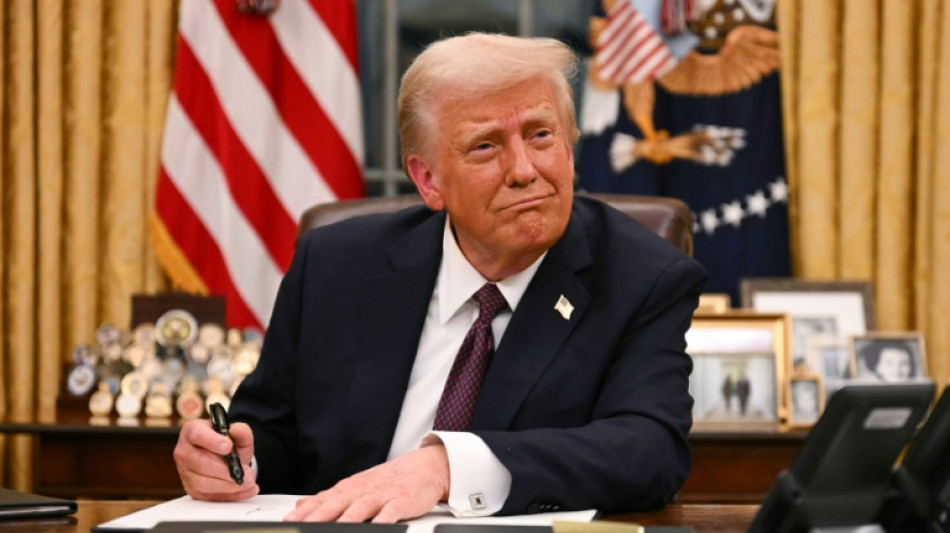
Judge blocks Trump's refugee admissions halt / Photo: © AFP

 Rene Eyre Revisits Autobiographical Performance 'Say A Little Prayer' in London

 UAE's HCT Holds Record Graduation and Announces Major Training Expansion

 NASA Awards $10B Lunar Contract Framework to SpaceX, Blue Origin

 Katy Perry Tells Fans Ex-Husband Russell Brand 'Should Be in Jail' During UK Concert

 South African election results renew debate over identity-based voting

 South African voters report smoother local election but declining IEC trust

 Dolly Parton museum and Nashville hotel open after singer’s death

 George and Amal Clooney attend New York political-comedy reading
A federal judge on Tuesday blocked President Donald Trump's executive order putting a halt to refugee admissions in the United States.
The ruling by a district judge in Seattle came in response to a lawsuit filed by refugee aid groups, and marks the latest legal setback to the president's efforts to re-shape America's relationship with immigration.
Granting a preliminary injunction that prevents the executive order from taking effect until the court case is adjudicated, US District Judge Jamal Whitehead said the executive order likely violates the 1980 Refugee Act, the Seattle Times reported.
Trump's order was part of a flurry of executive actions the president took when he arrived at the White House in January, with a number of them taking aim at immigration and the border.
The order, signed with a flourish in the Oval Office in front of cameras, said the refugee program was "detrimental to the interests of the United States."
Days later, federal funding to resettlement agencies was frozen.
The lawsuit had been brought by Jewish refugee non-profit HIAS, Christian group Church World Service, Lutheran Community Services Northwest and a number of individuals.
Those nonprofits said in their lawsuit the funding freeze had left them "struggling to keep their lights on and their staff employed, let alone continue to serve the vulnerable refugees at the core of their missions."
It said several people who had been about to travel, having sold all their belongings in their own country, were abruptly left in limbo by the order.
There are no readily available official figures for the number of people affected by Trump's order.
But in 2023, the last year for which numbers are available, 60,050 people were admitted to the United States as refugees, according to the Department for Homeland Security.
Refugee resettlement had been one of the few legal routes to eventual US citizenship, and had been embraced by former president Joe Biden, who expanded eligibility for the program to include people affected by climate change.
Trump's White House campaign was marked by vitriol about immigrants, who he said were "poisoning the blood of our country."
Other Trump initiatives since his return to office have included an attempt to overturn the constitutional notion of birthright citizenship. That order has also been suspended by federal judges.
He has also pushed a vigorous program of deportations, with highly publicized military flights taking handcuffed people to countries in Latin America.
The UN high commissioner for refugees estimates that there are 37.9 million refugees in the world, among some 122.6 million displaced people.
M.Vogt--VB