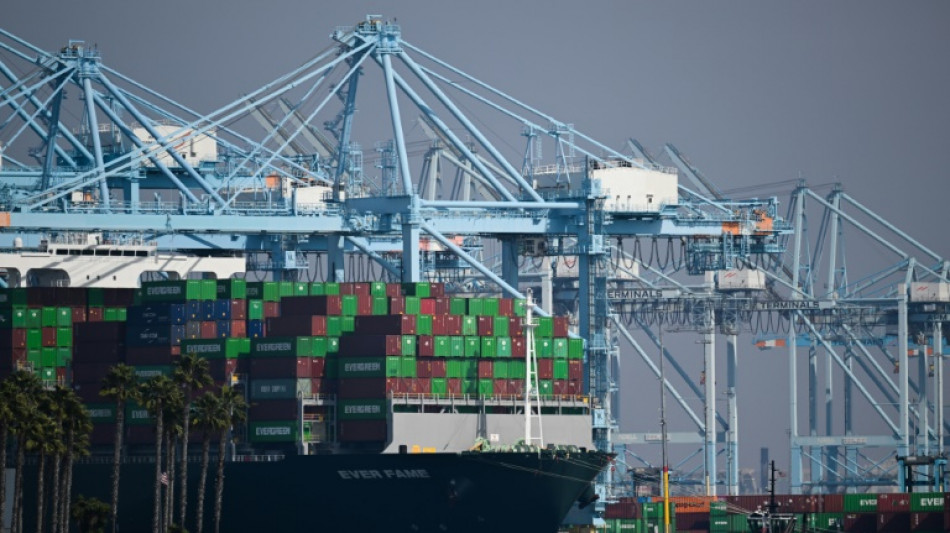
What are Trump's reciprocal tariffs and who may be hit? / Photo: © AFP/File

 Putin, Xi, Iran's Pezeshkian in Kyrgyzstan for summit

 Fully Permitted Tanzanian Gold Project Clears Path to Construction as Financing, EPCM Fall in Place (LVGLF)

 EdWealth Announces MoneyBench Benchmark Comparing AI Money Answers From Ed, ChatGPT and Gemini

 Root says new balls behind batsmen's struggles in England
 Swollen rivers, washed-out roads hamper Nepal rescue effort

 In France's north, winegrowers bet on a warmer future

 Deadly virus stalks South Africa's sardines

 South Korea women's football body probes 'period' insult

 Transitional Fashion Essentials for Autumn: Key Pieces from M&S and Joe Browns

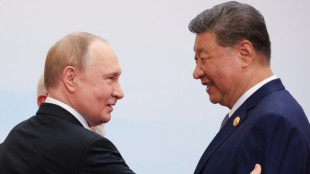 China's Xi and Iran's Pezeshkian in Kyrgyzstan, Putin expected

 Rescuers hunt for missing after deadly N.Cyprus ferry accident

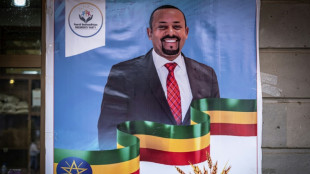 Ethiopia's Abiy could consolidate power as 'executive president'

 Crude prices rise on US-Iran strikes, equities mixed after Warsh remarks

 South Korea court gives Unification Church leader 2 years prison

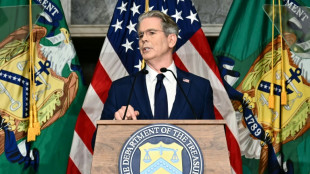 US hosts G20 finance talks with growth, Iran pressure on agenda

 African players in Europe: Wissa flick seals Newcastle victory

 Venice film preview: Clooney, Oasis and Musk

 Poorly Djokovic crashes out of US Open first round

 Djokovic falls in US Open first round, earliest Grand Slam exit in 20 years

 Chinese guitar capital's stairway to export heaven

 Stocks drop as Warsh fans US rate hike bets, crude up on US-Iran strikes

 Injuries cloud tennis as US Open gets under way

 Iran retaliates after first US strikes in a month
 Itauma says 'I'll be back' after bruising heavyweight title loss
 Brilliant Palou clinches fourth straight IndyCar crown
President Donald Trump's plan for "reciprocal tariffs" on US trading partners are set to spark a flurry of negotiations that could bring reductions in levies -- but analysts warn that it also risks painful retaliation.
"This is every country, and essentially, when they treat us fairly, we treat them fairly," Trump told reporters.
What are the details of his plan and what consequences could they bring?
- What are reciprocal tariffs? -
Tariffs are taxes imposed on goods imported from another country.
As for reciprocal tariffs -- during election campaigning, Trump promised: "An eye for an eye, a tariff for a tariff, same exact amount."
"It doesn't matter whether it's strategic competitors like Communist China or allies like the European Union or Japan or Korea," a White House official told reporters Thursday.
"Every one of those countries is taking advantage of us in different ways, and the president characterizes this as a lack of reciprocal trade," the official added, speaking on condition of anonymity.
Reciprocal tariffs could mean hiking rates on imports to match the level that other countries apply to US products, and officials said the levies will be imposed country by country.
But besides considering the tariff rates other countries impose on US goods, Trump's plan will also look into non-tariff factors like value-added taxes (VATs).
- When will they be imposed? -
For now, Trump's memo calls for the commerce secretary and US trade representative, in consultation with the treasury chief and others, to study the issue and propose remedies.
Trump's commerce secretary nominee Howard Lutnick said Thursday that tariffs could start as soon as April 2, after studies on the issue were completed.
The White House official told reporters that the administration will begin by examining countries that have the highest trade deficits or most egregious imbalances with the United States.
The process could take weeks or months, and tariffs could be invoked under legal authorities involving national security, unfair trading or emergency economic powers.
"So far, it seems more like an invitation to negotiate," said Mercatus Center senior research fellow Christine McDaniel.
- Who may be hard-hit? -
Reciprocal tariffs might open the door to a broad tariff hike on emerging market economies who have high duties on US products, JPMorgan analysts expect.
The White House referred to countries like Brazil and India as it unveiled the latest tariff plan.
It pointed to the United States' ethanol tariff at 2.5 percent while Brazil charges an 18 percent rate on US ethanol exports, for example.
Officials also took aim at the European Union over its 10 percent tariff on imported cars in contrast to the United States' 2.5 percent levy -- and Trump called the bloc "absolutely brutal" on trade.
But analysts have pointed out that the United States has higher tariffs on other products such as light trucks.
- What are the complications? -
Using reciprocal levies to address non-tariff issues like VATs could raise the average effective tariff rate notably, Goldman Sachs analysts earlier said.
Analysts at the Tax Foundation noted that "VATs are border-adjusted, meaning they rebate tax on exports and impose tax on imports."
"Despite the appearance of subsidizing exports and punishing imports, however, a border-adjusted VAT is trade neutral," they said in a Wednesday report.
This could prove tricky in negotiations.
Maurice Obstfeld, senior fellow at the Peterson Institute for International Economics (PIIE), warned that other countries could retaliate if Trump doubled down on various levies.
"The more major countries retaliate, the more other countries will be tempted to join in," he told AFP.
US tariff hikes would also result in higher costs for importers.
- What is the goal? -
Obstfeld of PIIE said Trump's policy appears to be aiming to get countries to "discriminate in favor of the United States."
"Suppose that Brazil drops its tariffs on US autos, but keeps its tariffs the same on all foreign autos" for example, he added.
Analysts also note that the threat of tariffs creates uncertainty as a negotiating tactic. This contributes to a situation that ultimately weighs on American and foreign businesses.
The White House on Thursday did not rule out a separate "one-size-fits-all" levy down the road.
C.Koch--VB