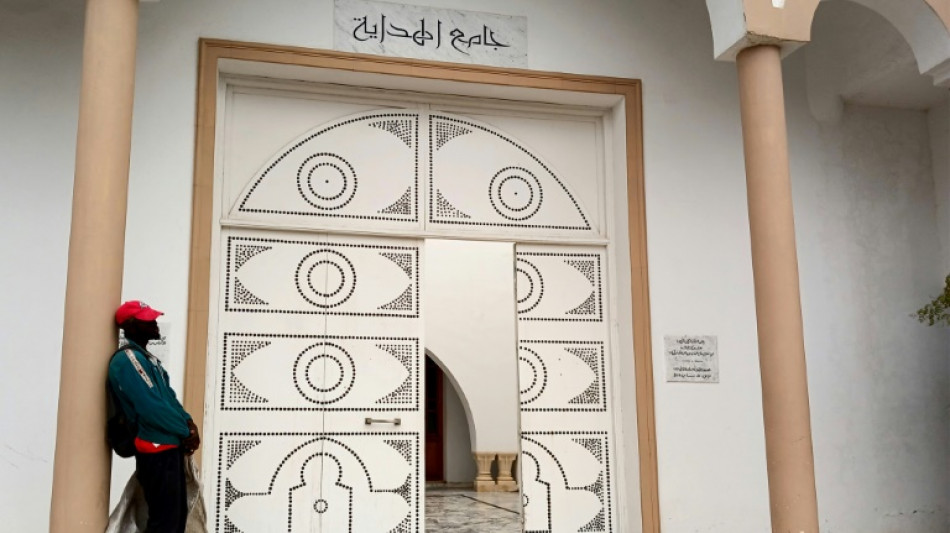
'I carry my cross': sub-Saharan migrants despair in Tunisia / Photo: © AFP

 US vows to keep economic pressure on Iran as G20 finance talks begin

 Shein valued at $26.3 bn in Hong Kong market debut
 Crude prices rise above $90 per barrel on US-Iran strikes

 Liverpool sign Barcola from PSG for reported £124 million

 Putin, Xi, Iran's Pezeshkian in Kyrgyzstan for summit
 Fully Permitted Tanzanian Gold Project Clears Path to Construction as Financing, EPCM Fall in Place (LVGLF)

 EdWealth Announces MoneyBench Benchmark Comparing AI Money Answers From Ed, ChatGPT and Gemini

 Root says new balls behind batsmen's struggles in England
 Swollen rivers, washed-out roads hamper Nepal rescue effort

 In France's north, winegrowers bet on a warmer future

 Deadly virus stalks South Africa's sardines
 South Korea women's football body probes 'period' insult
 Transitional Fashion Essentials for Autumn: Key Pieces from M&S and Joe Browns

 China's Xi and Iran's Pezeshkian in Kyrgyzstan, Putin expected

 Rescuers hunt for missing after deadly N.Cyprus ferry accident
 Ethiopia's Abiy could consolidate power as 'executive president'
 Crude prices rise on US-Iran strikes, equities mixed after Warsh remarks
 South Korea court gives Unification Church leader 2 years prison
 US hosts G20 finance talks with growth, Iran pressure on agenda
 African players in Europe: Wissa flick seals Newcastle victory

 Venice film preview: Clooney, Oasis and Musk

 Poorly Djokovic crashes out of US Open first round
 Djokovic falls in US Open first round, earliest Grand Slam exit in 20 years

 Chinese guitar capital's stairway to export heaven
 Stocks drop as Warsh fans US rate hike bets, crude up on US-Iran strikes
Jonas spent more than a year trying to reach Tunisia after escaping ethnic violence in his native Nigeria, but rising anti-migrant sentiment and a government crackdown in the North African country have left him without help.
Speaking under a pseudonym for fear of expulsion, Jonas said he crossed through Niger and Libya to escape attacks on his Igbo ethnic group.
Upon arriving in Tunis last November, where his wife gave birth to their first child, they were met with a frozen asylum system and an official clampdown on migrant aid organisations.
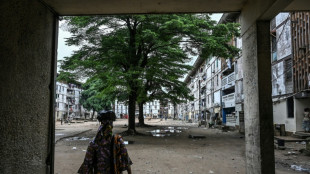
"I have no assistance here," said Jonas, 48, standing before a vast stretch of land in Raoued, north of the capital Tunis, where he hunts for plastic waste to make a living.
"I heard that the United Nations had more power here, that they took care of migrants," he added. "But I didn't find anyone, so I carry my cross."
Tunisia is a key transit country for thousands of sub-Saharan migrants seeking to reach Europe by sea each year.
In 2023, President Kais Saied said "hordes of illegal migrants" posed a demographic threat to Arab-majority Tunisia.
The speech triggered a series of racially motivated attacks with many sub-Saharan migrants chased out of city centres.
Nearly two years later, "authorities continue to criminalise people on the move", the World Organisation Against Torture (OMCT) coalition said in a report last month.
Tunisia has been "depriving thousands of vulnerable people of vital support", it said, with migrants often "left in precarious and dangerous situations".
- 'Traitors and mercenaries' -
In June last year, the UN refugee agency abruptly stopped accepting new applications in Tunisia, and a UNHCR spokesperson told AFP the decision followed "instructions provided by the Tunisian government".
Authorities did not answer AFP's request for comment, but last Friday, the foreign ministry denounced in a statement a "continued spread of malicious allegations".
"Tunisia adopts a balanced approach that combines the duty to protect its borders, enforce the rule of law, and assume its responsibility to respect its international commitments," it said.
Civil society groups have said they have seen the space in which they can freely operate shrink under Saied, and at least 10 people working with migrant aid organisations have been detained since May and awaiting trial.
The flurry of arrests came after Saied denounced the groups as "traitors and mercenaries" who funnelled foreign funds to settle migrants illegally in Tunisia.
Those arrested include Mustapha Djemali, the 80-year-old president of the Tunisian Refugee Council, a vital UNHCR partner that screened asylum applications.
Saadia Mosbah, a prominent black Tunisian and anti-racism pioneer who founded the Mnemty organisation, and Sherifa Riahi, former president of Terre d'Asile Tunisie, were also among those detained.
As a result of the clampdown, 14 organisations "partially suspended or reoriented" their work, said the OMCT, while five others "suspended their activities altogether".
- 'History of racism' -
Romdhane Ben Amor, spokesman for Tunisian rights group FTDES, said this was part of "a strategy to put migrants in a state of fragility".
Amid high unemployment and a stagnating economy, many Tunisians feel their country is unable to host and look after migrants.
With Europe's growing efforts to curb arrivals, many migrants feel trapped.
"We must recall that at a time when migrants were expelled to the borders (of Tunisia) to die in the desert, European leaders came to Carthage and signed agreements to carry out this repression," said Ben Amor, who called Europe "complicit" in the crisis.
In the summer of 2023, Italian far-right Prime Minister Giorgia Meloni visited Tunis multiple times, twice with European Commission chief Ursula von der Leyen.
They signed a deal worth 105 million euros ($109 million) with Tunisia to curb migrant departures.
Consequently, central Mediterranean migrant arrivals in 2024 fell by more than half from the year before, according to the EU.
Meloni hailed the figures as a success, even as Tunisia carried out "increasingly serious violations" against sub-Saharan migrants, according to a report presented to the bloc's parliament in January by an anonymous group of researchers.
The report accused Tunisia of "mass expulsions" and the "sale of migrants to Libyan armed forces and militias", who detain them "until a ransom is paid".
A Tunisian academic speaking on condition of anonymity for fear of reprisal told AFP that despite concern in the rights community, she and other "black Tunisians were not shocked" by Saied's speech in 2023.
She said Tunisia had "an unresolved history of racism" and that Saied only verbalised what many already think.
"It's an ugly reality," she said.
A.Ruegg--VB