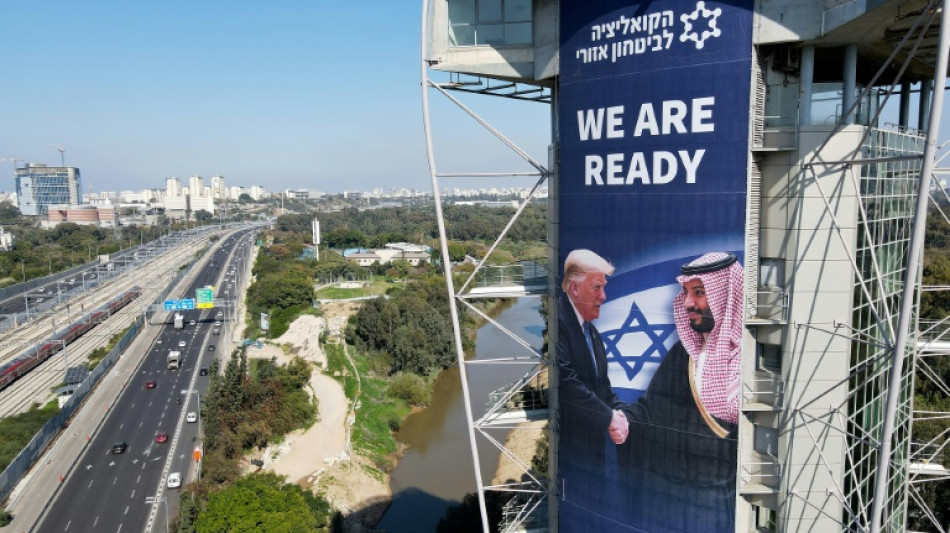
Trump's Gaza plan derails Saudi-Israel ties: analysts / Photo: © AFP

 'Massive' Russian missile, drone attack on Kyiv kills 8
 Defence tech hub Munich booms as Europe rearms
 Nigeria rethinks criminalisation of suicide

 Osaka channels NBA icon Iverson to reach US Open second round
 Fast-fashion giant Shein plunges 10% on Hong Kong debut

 South Korea hire former Spain boss Moreno as interim coach
 China-Taiwan friction clouds Pacific summit
 Two dead after stabbing in New York's Times Square

 Anthropic signs $35B computing deal with startup backed by Nvidia

 Drones in Ithaca: Azov's Odyssey turns Ukraine war into modern myth
 Boat builders keep Pakistan's fishing heritage afloat
 Australia axe Labuschagne for Zimbabwe, South Africa ODI series

 Heavy rain at Grand Canyon after flood kills 2, dozen missing

 Kushner blames soccer power struggle for World Cup plan collapse

 Buoyant Alcaraz shakes off nerves to advance at US Open

 US draws European pushback with Russia G20 finance invite

 Jury begins deliberations in Tupac Shakur murder trial

 US Supreme Court allows Trump ballroom project to proceed

 Trump says US reviewing position on Falkland Islands

 Saka strikes as flawless Arsenal punish troubled Villa
 Oil prices surge on renewed fighting in US-Iran war

 Cycling superstar Pogacar has surgery after Vuelta crash
 Man City agree deal for Everton's Ndiaye

 Apple CEO Tim Cook gives nod to founder Steve Jobs in final memo

 Russian finance minister makes unexpected appearance at G20
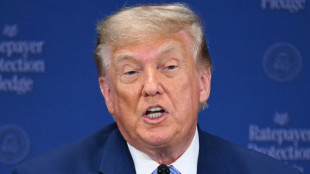
US President Donald Trump's plan to take over Gaza will imperil attempts to forge landmark ties between Saudi Arabia and Israel and fuel anti-American sentiment in the oil-rich kingdom, analysts said.
Trump's proposal to redevelop Gaza and oust the more than two million Palestinians living in the territory prompted a global backlash and enraged the Arab world, making it difficult for the Saudis to consider normalisation.
"If this is going to be his policy, he shut the door on Saudi recognition of Israel," James Dorsey, researcher at the Middle East Institute of the National University of Singapore, told AFP.
Recognition of Israel by Saudi Arabia, home to Islam's holiest sites, is seen as a grand prize of Middle East diplomacy intended to calm chronic tensions in the region.
But Saudi Arabia, the world's biggest oil exporter and the Middle East's largest economy, now faces the spectre of instability on its borders if neighbouring Jordan and Egypt suddenly house large numbers of Gaza exiles.
At the same time, Riyadh must maintain cordial relations with Washington, its long-time security guarantor and bulwark against key regional player Iran.
"When it comes to security, Saudi Arabia has nowhere to go but to Washington," Dorsey said. "There's nobody else. It's not China. They're not willing and they're not able.
"And post-Ukraine, do you want to rely on Russia?"
- Quick reaction -
The Saudis were engaged in tentative talks on normalisation via the United States until the outbreak of the Gaza war, when they paused the negotiations and hardened their position.
They reacted with unusual speed to Trump's proposal, made during an appearance with Israeli Prime Minister Benjamin Netanyahu in Washington.
About an hour after his comments, at around 4:00 am Saudi time, the foreign ministry posted a statement on X that "reaffirms its unequivocal rejection of... attempts to displace the Palestinian people from their land".
In the same statement, the Saudis rejected Netanyahu's comment that normalisation was "going to happen", repeating their insistence there would be no ties without a Palestinian state.
Trump's plan carries real risks for Riyadh, which is throwing everything at an ambitious post-oil economic makeover that relies on stability to attract business and tourism.
If Gazans are displaced to Egypt and Jordan, it "will weaken two countries essential to regional stability and particularly to Saudi security", said Saudi researcher Aziz Alghashian.
"Trump's plan, coupled with Netanyahu's approach, poses major risks for Saudi Arabia.
"It highlights that they are not true partners for peace in Riyadh's eyes -- especially Netanyahu, who appears to want all the benefits without making concessions."
- 'Making normalisation harder' -
Trump's declarations "will further destabilise the region and fuel anti-American sentiment, particularly in Saudi Arabia", said Anna Jacobs, of the International Crisis Group think tank.
"He is making Saudi-Israel normalisation harder, not easier."
Andreas Krieg of King's College London said Saudi Arabia would not agree meekly to normalisation if ordered by Washington.
Prior to the Gaza war, the Saudis were negotiating for security guarantees and help building a civilian nuclear programme in return for Israeli ties.
"They are not a US vassal state and so they're not just taking a diktat from Trump," said Andreas Krieg of King's College London.
"And I think it will stand firm on their positions, willing to negotiate here and there. But the principal red lines remain.
"Nobody in Saudi Arabia has an interest in selling out Palestinian statehood. That is the last and the most important bargaining chip that the Saudis have in terms of authority and legitimacy in the Arab and Muslim world."
But the question is how Saudi Arabia and its 39-year-old de facto ruler, Crown Prince Mohammed bin Salman, will proceed.
"I don't think that the Saudis will take any major steps now," said Krieg.
"They obviously have their own levers that they can use for pressure on America, particularly in the energy sector. I don't think the Saudis will want to use it at this point."
T.Germann--VB